
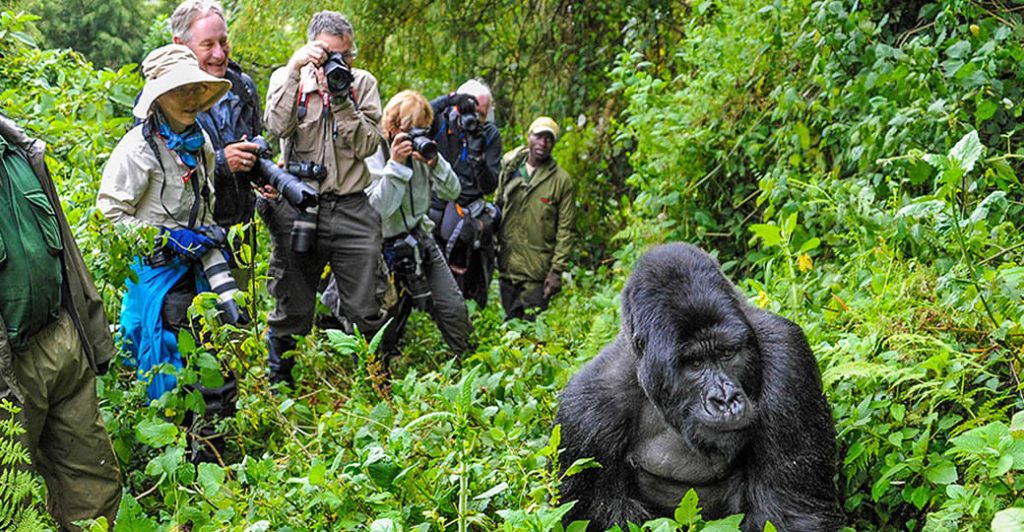
There is a moment, somewhere in the ancient montane forest of southwestern Uganda, when the vegetation ahead of you moves with a force that is unmistakably not wind. The trackers ahead pause and signal silence. You push through a last wall of leaves — and there, five metres away, a mountain gorilla sits regarding you with calm, dark eyes that carry an intelligence that is entirely, uncomfortably familiar. This is gorilla trekking in Bwindi Impenetrable National Park, and it is one of the most extraordinary wildlife experiences available anywhere on earth.
Mountain gorillas — one of the world’s most critically endangered large mammals, with a wild population of approximately 1,063 individuals — exist in only two places: the Virunga Massif (shared between Uganda, Rwanda, and the DRC) and Bwindi Impenetrable National Park in Uganda. Sense of Adventure designs gorilla trekking safaris across both Uganda and Rwanda, and this guide covers the Uganda experience in depth.
Bwindi Impenetrable National Park
Bwindi Impenetrable National Park covers 331 square kilometres of ancient montane rainforest in Uganda’s Kigezi Highlands, near the borders with Rwanda and the DRC. The forest is one of Africa’s most biodiverse — it has survived intact through multiple ice ages, serving as a refuge for species that retreated from drying lowlands, and today supports over 120 mammal species, 350 bird species (including 23 Albertine Rift endemics), and over 1,000 plant species alongside its famous gorilla population.
Bwindi is divided into four sectors, each with habituated gorilla groups available for trekking: Buhoma (north, the original and most developed sector), Rushaga (south, largest sector with the most gorilla groups), Nkuringo (south, dramatic scenery and more adventurous trekking), and Ruhija (east, highest altitude, the most remote and exclusive). Each sector has different character, different trekking terrain, and different lodge options.
The Gorilla Trekking Experience
Each gorilla trekking permit allows one hour with a habituated gorilla family in their natural habitat. This single hour is, for the vast majority of visitors, among the most powerful and emotionally affecting wildlife experiences of their entire lives. Here is what to expect:
Morning briefing (07:00–08:00): At the sector’s ranger station, groups of up to eight permit holders gather for a briefing. Rangers explain the health protocol (keep 7 metres from the gorillas, no trekking if you have respiratory illness), the rules (no flash photography, speak quietly, do not block a gorilla’s path), and the likely location of the gorilla family based on the trackers’ morning report.
The trek: Duration varies from 30 minutes to 6 hours of forest hiking depending on where the gorillas have moved overnight. The forest terrain is genuinely challenging — steep, wet, tangled vegetation — and the effort is real. Most trekkers describe the physical challenge as entirely worth it, but appropriate physical preparation is advisable. Porter services are available at all sectors (highly recommended, as porters also provide physical support on steep sections and the income directly supports local communities).
The encounter: When the trackers locate the family, they clear a viewing area and the group circles in. What happens next is different every time — but it is always extraordinary. A silverback male might be eating thirty metres up a fig tree, occasionally looking down with magnificent indifference. Females groom each other in a clearing while juveniles play chase through the vegetation. A baby scrambles over its mother’s back and peers at the strange-smelling bipeds from a safe distance. The hour passes with a speed that feels deeply unfair.
What makes it so profound: Mountain gorillas share approximately 98.3% of their DNA with humans. In that hour, you see that genetic kinship expressed in every gesture, every look, every social interaction. The silverback’s authority. The mother’s tenderness. The young male’s bravado. The infant’s curiosity. You are looking at yourself in a mirror that evolution has been constructing for 10 million years.
Gorilla Trekking Permits: Cost and Booking
Uganda gorilla trekking permits are issued by the Uganda Wildlife Authority (UWA) at USD $800 per person (2026 pricing). Permits are limited — each gorilla family receives a maximum of eight visitors per day — and demand significantly exceeds supply for the most popular families and sectors during peak season. Book at least 3–6 months ahead for the Buhoma and Rushaga sectors during July–September and December–February.
We handle all gorilla permit booking and coordination as part of our Uganda safari packages. Permit availability is our first planning step — once we secure your permits, we build the accommodation and logistics around them.
Best Time to Trek Gorillas in Uganda
- June–September (dry season): The most popular trekking window. Trails are drier and more manageable. The forest is beautiful in dry-season light. This is peak season — book permits 4–6 months ahead.
- December–February (short dry season): Another excellent window, with drier conditions and high permit availability relative to June–September. Good value for accommodation. Our favourite window for gorilla trekking.
- March–May (long rains): The gorillas are present year-round — trekking happens in all weather — but trails become very muddy and slippery. Lower permit demand means easier booking. Some lodges offer reduced rates. The forest is extraordinarily lush and atmospheric in the rain.
Combining Gorilla Trekking With a Kenya or Tanzania Safari
Uganda gorilla trekking combines naturally with a Kenya or Tanzania wildlife safari on an extended East Africa circuit. A typical 12-day itinerary: fly Nairobi to Entebbe (1.5 hours) → Queen Elizabeth National Park, Uganda (2 nights, tree-climbing lions and chimpanzee tracking) → Bwindi (2 nights, two gorilla treks across different families) → fly back to Nairobi → Masai Mara (4 nights). This circuit delivers one of the world’s most diverse wildlife experiences in a single East Africa journey.
See our East Africa itinerary guide for multi-country circuit options, and our Rwanda gorilla trekking guide for the alternative Virunga Massif gorilla experience. Talk to our team — we design Uganda circuits regularly and have deep knowledge of the sector options, lodge quality, and permit availability across Bwindi’s four sectors.
💬 WhatsApp Us — Plan Your Safari Today
Call or WhatsApp: +254 799 160 081