
Few wildlife spectacles in Africa are as immediately, viscerally overwhelming as a million flamingos on an East African soda lake. The sound reaches you before the sight — a continuous, low, conversational murmur rising from thousands of birds — and then the lake itself comes into view, its shoreline rendered in an improbable, luminous pink that seems to belong more to a painting than to the natural world. Kenya’s flamingo lakes are among the most extraordinary wildlife destinations on the continent, and this guide covers every site worth visiting, the best times to see peak numbers, and how to incorporate them into your Kenya safari.
🌎 Thinking About a Kenya Safari?
Our team is on WhatsApp right now — ask us anything about destinations, dates, or prices. No obligation.
💬 WhatsApp Us Now or call +254 729 837 481
Understanding Kenya’s Flamingos
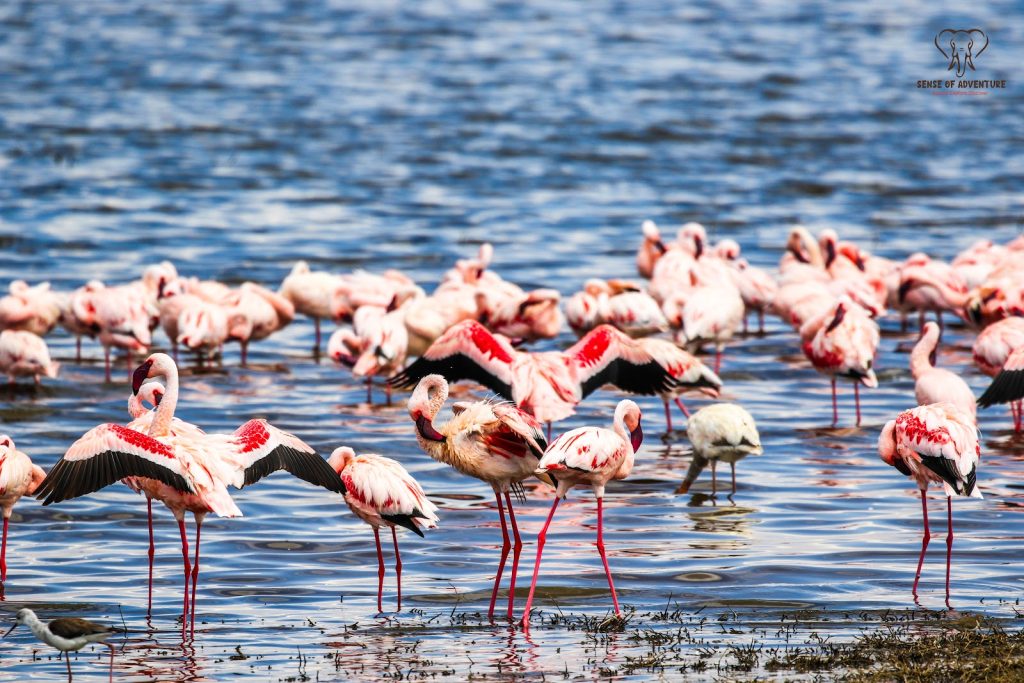
Two flamingo species inhabit Kenya’s Rift Valley lakes: the lesser flamingo (Phoeniconaias minor) and the greater flamingo (Phoenicopterus roseus). Lesser flamingos are significantly more numerous — typically constituting over 90% of the birds at any given lake — and are responsible for the dense pink carpets that create Kenya’s most famous flamingo images. Greater flamingos are taller, paler (almost white with pink accents), and present in smaller numbers at the same lakes.
Both species feed on the blue-green algae (Arthrospira platensis) and microscopic crustaceans that thrive in the alkaline, mineral-rich waters of Kenya’s soda lakes. The alkalinity that makes these lakes uninhabitable for most species — pH levels sometimes exceeding 10, with water temperatures near the surface approaching 60°C in geothermal areas — creates the algae-rich conditions that flamingos have evolved specifically to exploit. The flamingo’s specialised filtering bill, containing hundreds of tiny lamellae that strain microscopic food from the water, is one of nature’s most elegant feeding adaptations.
Flamingo numbers at any individual lake fluctuate significantly based on algae concentration, water levels, and the unexplained collective decisions that large flamingo populations make about where to gather. In good conditions at Lake Nakuru or Lake Bogoria, numbers can exceed one million birds. In poor years, the majority of East Africa’s flamingo population may be distributed across multiple smaller lakes or concentrated at a single alternative site. Current conditions — which our team monitors through our ground network — are the most reliable indicator of where to go for peak flamingo numbers at any given time.
Lake Nakuru: Kenya’s Most Accessible Flamingo Spectacle
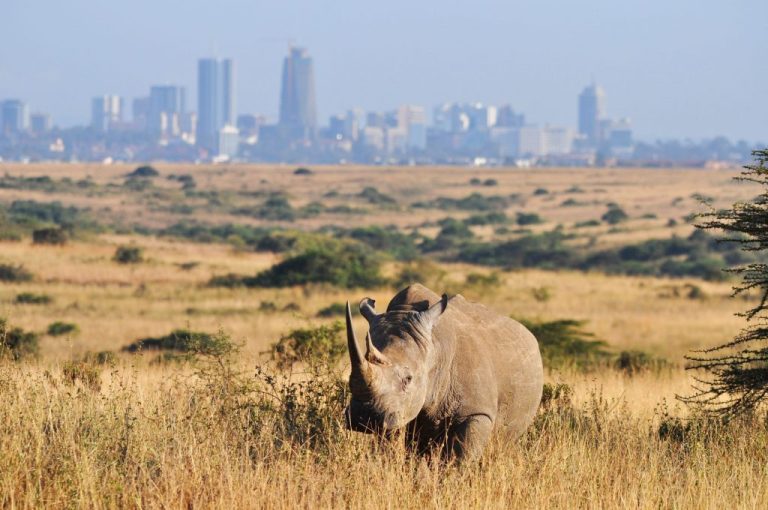
Lake Nakuru National Park is the flamingo destination that most Kenya visitors experience first, and for good reason: it is the most accessible major flamingo lake (2.5 hours from Nairobi by road), has the most developed safari infrastructure, and combines the flamingo spectacle with excellent Big 5 wildlife including both black and white rhino, lion, and leopard.
When conditions are right — the algae bloom is rich and the water level is optimal — the southern shoreline of Lake Nakuru disappears beneath a dense carpet of lesser flamingos that stretches for kilometres. The sight from the park’s Baboon Cliff viewpoint, looking down over the entire lake with its pink-fringed shoreline and the Rift Valley escarpment beyond, is one of Kenya’s most photographed views.
However, Lake Nakuru’s water level has fluctuated significantly in recent decades — rising sharply during heavy rainfall periods and reducing flamingo habitat as the water dilutes the algae. In years of high water, the flamingos often relocate to Lake Bogoria or Lake Magadi. This is exactly why having current intelligence from a local operator matters — we can tell you before you book whether Nakuru is currently in a good flamingo phase or whether Bogoria is the better choice for your specific travel dates.
📅 Get Your Free Safari Proposal
Share your travel dates and interests — we will send you a tailored, fully itemised itinerary within 24 hours.
Lake Bogoria: Kenya’s Flamingo Secret
Lake Bogoria — a shallow alkaline lake 270 kilometres north of Nairobi in the Rift Valley — is less visited than Lake Nakuru but frequently hosts even larger flamingo concentrations, particularly during years when Nakuru’s water level is high. Bogoria’s unique setting — the lake is surrounded by dramatic rocky hillsides, geothermal geysers that shoot boiling water three metres into the air, and hot springs where flamingos wade through knee-deep steaming water — makes it one of Kenya’s most visually extraordinary destinations.
The geothermal features of Lake Bogoria are spectacular in their own right. Steaming vents, bubbling mud pools, and the sulphurous smell of the earth’s interior activity create an atmosphere that feels genuinely primal — the sense of being at a geological frontier, where the African continent is in the process of tearing itself apart along the Rift Valley’s ancient fault lines, is palpable at Bogoria in a way it is not at most Kenyan sites. Combining the geology with the flamingos makes Bogoria one of the Rift Valley’s most rewarding full days.
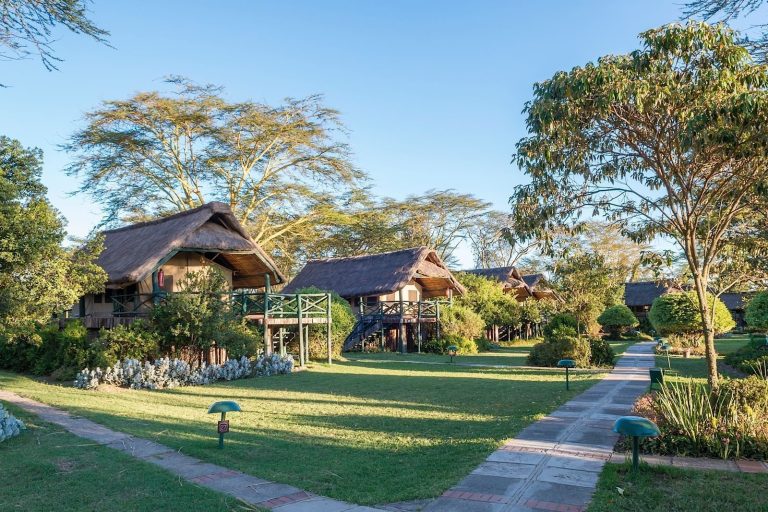
Bogoria is typically visited as a day trip from Nakuru (approximately 1.5 hours) or as an overnight stay at the lake’s simple but comfortable accommodation. It combines naturally with Lake Nakuru and Lake Baringo (40 minutes further north, an outstanding freshwater birdwatching lake) on a 2–3 day Rift Valley birding and flamingo circuit.
Lake Magadi: Kenya’s Remote Pink Wilderness
Lake Magadi — Kenya’s southernmost Rift Valley lake, near the Tanzanian border — is a vast commercial soda extraction site that also supports one of Kenya’s largest lesser flamingo populations. Because of the commercial activity and the lake’s remoteness, Magadi receives far fewer visitors than Nakuru or Bogoria, making it a genuinely off-the-beaten-track flamingo destination for adventurous travellers. The lake’s extraordinary pink-and-white salt pan landscape — punctuated by flamingo concentrations that move slowly across the shimmering surface — is otherworldly and extraordinarily photogenic.
Incorporating Flamingos Into Your Kenya Itinerary
A flamingo safari works best as a component of a broader Kenya circuit rather than a standalone trip. Our most popular format: 4 nights in the Masai Mara → 2 nights in the Rift Valley (Lake Naivasha, Lake Nakuru, possibly Lake Bogoria) → return to Nairobi. This circuit combines the Mara’s extraordinary wildlife with the Rift Valley’s flamingo spectacle, geological drama, and diverse birdlife in a compact 6-night itinerary. See our East Africa safari itinerary guide for the full circuit options. Talk to our team for current flamingo conditions at all sites before you plan your routing.
🏑 Ready to Book Your Kenya Safari?
Sense of Adventure — Kenya-based experts with real local knowledge. Transparent pricing. Personalised itineraries. Guests who return year after year.
Call or WhatsApp: +254 729 837 481