
Kenya’s largest and wildest national park stretches across 21,812 square kilometres of ancient volcanic landscape, dry thornbush, and riverine forest — a primordial wilderness so vast it took the colonial-era railway builders three years and a pair of legendary man-eating lions to cross it. Tsavo National Park, divided into Tsavo East and Tsavo West by the Nairobi-Mombasa highway, is Kenya’s original safari landscape and one of Africa’s last truly wild places.
Tsavo rewards a different kind of traveller than the Masai Mara: those who want space, solitude, drama, and the sensation of genuine wilderness rather than a curated game drive experience. The wildlife is here — in vast numbers — but it operates on Tsavo’s terms, in Tsavo’s scale. This is your complete guide to Tsavo National Park in 2026.
Tsavo East vs Tsavo West: Understanding the Two Parks
The Nairobi-Mombasa highway splits Tsavo into two administratively separate parks with distinctly different characters.
Tsavo East is the larger half — approximately 13,747 sq km of flat, semi-arid landscape dominated by vast open plains, the Galana River, and the dramatic Yatta Plateau, one of the world’s longest lava flows at over 300 kilometres. Tsavo East is more remote and less visited than its western counterpart, making it a destination for travellers who genuinely value exclusivity and wilderness immersion. The Galana River is the park’s ecological backbone — a permanent water source that draws extraordinary concentrations of wildlife through the dry season. The famous Lugard’s Falls — where the Galana River churns through a narrow basalt gorge carved over millennia — is one of Kenya’s most striking natural features.
Tsavo West is more rugged and dramatically scenic. Ancient lava flows, volcanic hills, rocky outcrops, and the extraordinary Mzima Springs — where approximately 50 million gallons of crystal-clear water filter up through the lava rock daily, supporting hippos, crocodiles, and remarkable fish populations visible through an underwater viewing chamber — give Tsavo West a landscape quality unmatched in Kenya. The Chyulu Hills, a young volcanic range with some of the world’s longest lava tubes, forms a dramatic backdrop to the park’s northern sections.
The Red Elephants of Tsavo
Tsavo’s elephants are among Africa’s most immediately recognisable — not because of their size (though Tsavo supports some of Africa’s largest-tusked individuals) but because of their extraordinary red-dust appearance. The park’s distinctive laterite soil is a deep, iron-rich red, and elephants roll in it habitually, coating themselves in a russet-orange pigmentation that makes them look like a completely different species from the grey elephants of Amboseli or the Mara. A Tsavo elephant emerging from a dust bath, shaking clouds of red dust from its flanks with Kilimanjaro in the far distance, is one of East Africa’s most striking wildlife images.
Tsavo supports one of Africa’s largest elephant populations — estimates place the Tsavo ecosystem elephant count at over 13,000 individuals — and sightings are frequent throughout both parks. The Galana River in the dry season provides some of the most spectacular elephant congregation scenes in Kenya, with herds numbering in the hundreds converging on the water.
The Man-Eaters of Tsavo: Kenya’s Most Extraordinary Wildlife Story
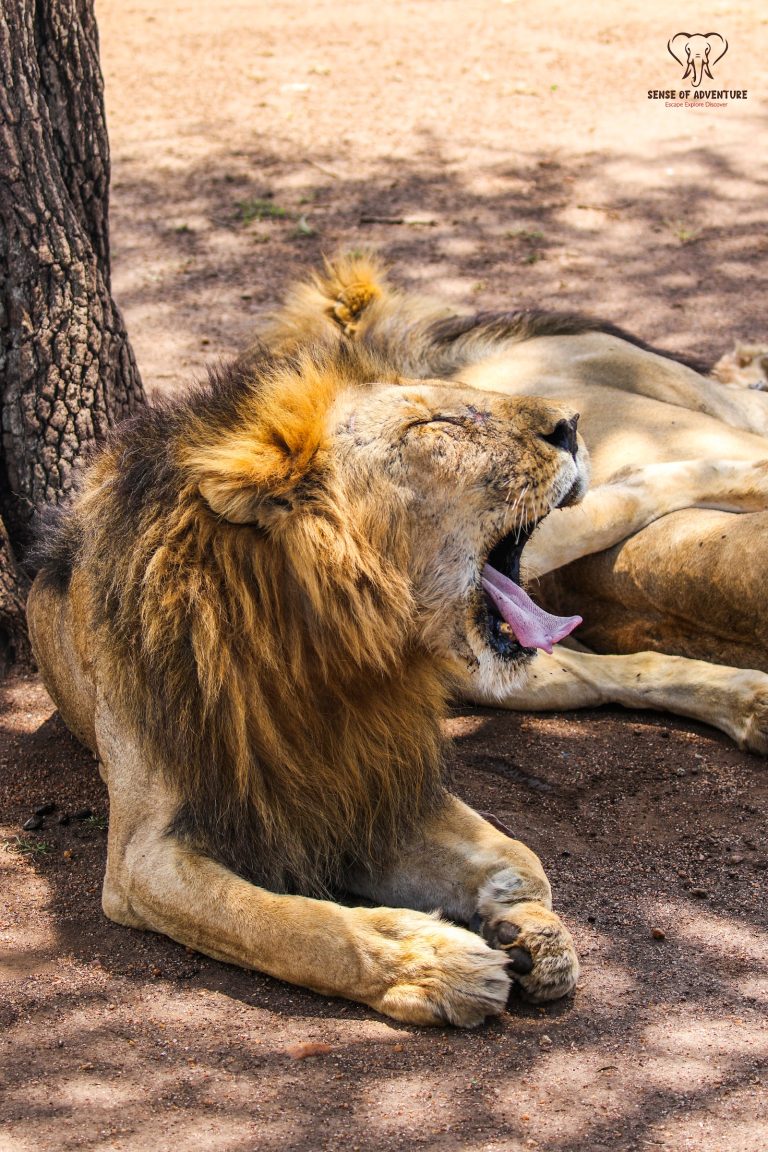
No account of Tsavo is complete without the story of the Man-Eaters of Tsavo — one of the most extraordinary and well-documented wildlife events in recorded history. Between March and December 1898, two maneless male lions systematically preyed upon the construction workers building the Uganda Railway bridge across the Tsavo River. The lions killed an estimated 28 Indian workers (some accounts put the figure higher) and terrorised a workforce of thousands over nine months, halting construction of a railway that was central to British East Africa’s colonial ambitions.
Lieutenant Colonel John Henry Patterson, the project engineer responsible for the bridge, eventually hunted and killed both lions over a period of several months — a task that proved far more difficult than his military training had prepared him for. Patterson documented the experience in his 1907 book The Man-Eaters of Tsavo, which became an international bestseller and has never been out of print. The two lions’ skins were eventually sold to the Field Museum in Chicago in 1924, where they were mounted and remain on permanent display to this day.
The reason the Tsavo lions became man-eaters is still debated among wildlife scientists. Dental evidence from the mounted specimens shows that both lions suffered from significant tooth decay and infection — likely making normal prey capture painful and difficult. The massive labour camp of railway workers, sleeping in tents with minimal protection, presented an opportunity that the injured lions appear to have exploited with extraordinary persistence and intelligence. Their behavior — working as a coordinated pair, entering tents, dragging victims across the defensive thorn perimeter — demonstrated a level of strategic adaptation that continues to fascinate wildlife researchers.
Today, the Tsavo River bridge site where the events occurred is accessible from Tsavo West — a genuinely atmospheric spot to visit with the historical narrative in mind. The experience of camping near the Tsavo River at night, listening to lions calling across the darkness, connects you to the story in a way no museum exhibit can replicate.
Wildlife in Tsavo Beyond the Headlines
Tsavo’s wildlife diversity is exceptional. The Big 5 are all present — lion (including the famous maneless Tsavo lions, a genetically distinct population), elephant, buffalo, leopard, and black rhino (in the Ngulia Rhino Sanctuary within Tsavo West). Cheetah, wild dog, striped hyena, and kudu are among the species more commonly encountered in Tsavo than in southern Kenya’s busier parks. The birding is superb — over 1,000 species recorded across the Tsavo ecosystem, making it one of East Africa’s premier birdwatching destinations.
The Aruba Dam in Tsavo East, built across the Voi River, creates a permanent waterhole that attracts extraordinary concentrations of wildlife in the dry season — lion prides, elephant families, buffalo herds, and a remarkable diversity of waterbirds. Watching a sunset from the Aruba Dam area, with wildlife silhouetted against the fading red sky, is one of Tsavo’s most reliably spectacular experiences.
Getting to Tsavo
Tsavo is Kenya’s most accessible major national park from Mombasa — approximately 2 hours’ drive. From Nairobi it is 3–4 hours by road. Scheduled charter flights connect Wilson Airport to Tsavo’s airstrips (Voi, Aruba in East; Kilaguni, Finch Hatton in West) in approximately 45 minutes. Most travellers combine Tsavo with the Kenyan coast — spending 3 nights in Tsavo and 3 nights in Mombasa or Diani Beach on a 6-night circuit.
Combining Tsavo With Other Destinations
Tsavo works beautifully in combination with several other Kenya destinations. The classic circuit from Nairobi: Amboseli (2 nights, elephants and Kilimanjaro) → Tsavo West (2 nights, Mzima Springs and scenery) → Tsavo East (1 night, Galana River and Aruba Dam) → Mombasa/Diani coast (3 nights). This covers extraordinary ecological variety, ends on the beach, and gives a genuine sense of Kenya’s vast and varied landscape.
For budget planning across a multi-park itinerary, see our Kenya safari cost guide. And for the complete picture of Kenya’s national parks and how they fit together, our top 10 Kenya national parks guide covers every major destination.
Or call us: +254 700 000 000 — we love planning great safaris.