
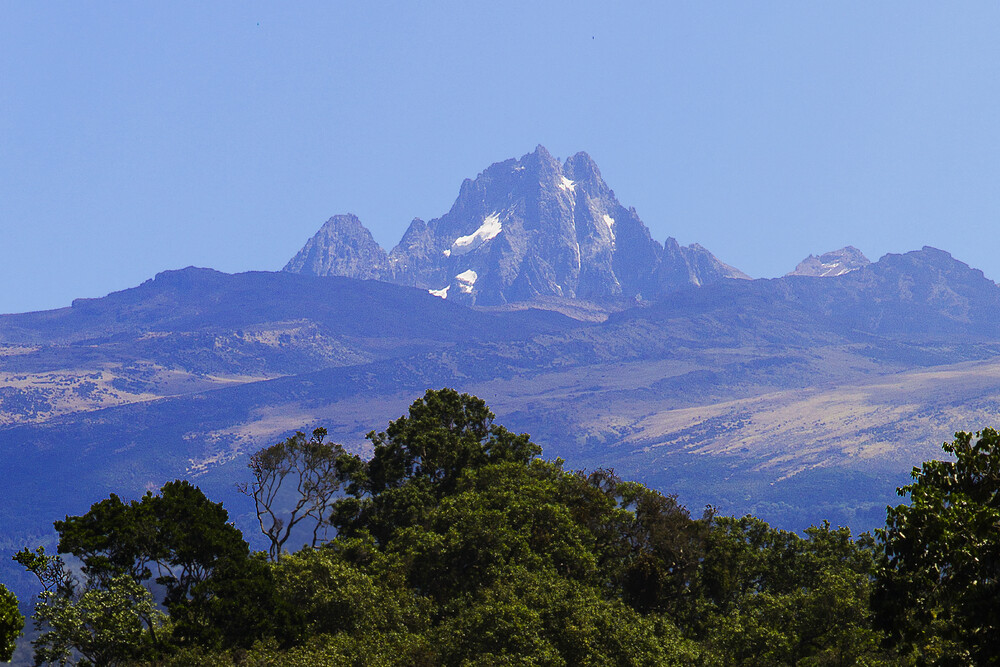
Mount Kenya is Africa’s second-highest mountain and one of the most dramatically beautiful on earth — a volcanic massif so ancient and so eroded that its central peaks look like they were designed by a sculptor, not shaped by geology. At 5,199 metres, the summit of Batian is permanently glaciated. Below the glacier, the mountain moves through altitude zones of extraordinary ecological variety: montane forest, bamboo belt, giant heather moorland, and the surreal Afro-alpine zone where giant lobelias and groundsels grow taller than you are. The mountain sits on the equator. It is crossed by the equatorial line. And it holds permanent snow. Sense of Adventure offers guided Mount Kenya trekking experiences for every fitness level — from the acclimatisation-friendly Point Lenana (4,985 m) to full technical climbs on the twin peaks. This is Kenya completely off the safari circuit, and it is extraordinary.
Trek Africa’s Second-Highest Mountain
Sense of Adventure runs guided Mount Kenya treks for all fitness levels — from 3-day Point Lenana ascents to full technical climbing. Contact us to plan your Kenya mountain adventure.
The Mount Kenya Trekking Routes
Mount Kenya has multiple established trekking routes offering different approaches, difficulty levels, and scenery. Sense of Adventure guides all three main routes and will recommend the best option based on your fitness, schedule, and summit ambitions.
⛰ The Three Main Routes
Sirimon Route (West) — The most gradual ascent, entering through the northwestern Sirimon Gate at 2,650 m and ascending through open moorland. Recommended for acclimatisation-conscious trekkers and those doing the Sirimon-Chogoria traverse (widely regarded as the finest Mount Kenya circuit). 4–5 days to Point Lenana.
Chogoria Route (East) — The most scenically dramatic route, entering through the eastern Chogoria Gate at 3,000 m and ascending past Lake Michaelson, the Hall Tarns, and the extraordinary Gorges Valley. Longer and more remote than Sirimon. 4–5 days to Point Lenana; best combined with Sirimon descent.
Naro Moru Route (West) — The fastest and most direct route, ascending through the notorious “Vertical Bog” above 3,300 m to reach the Teleki Valley. Possible to summit in 3 days, but the rapid altitude gain requires good acclimatisation. Popular with experienced trekkers who want efficiency over scenery.
We left camp at 3am for the summit push. By 6am we were at Point Lenana watching the sun rise over Tanzania, the plains of Kenya spread out 5,000 metres below us. I had been on safari for four days. This was something completely different — and just as extraordinary.
— Sense of Adventure guest, Point Lenana summit, July 2024
Five Mount Kenya Experiences
Point Lenana Summit — 4,985 m on the Equator
Point Lenana is the highest point accessible to trekkers without technical climbing skills — the third summit of Mount Kenya at 4,985 m. The 3am summit push, head torches cutting through freezing darkness, culminates at dawn with a view that encompasses the entire Kenya highland plateau and, on clear days, both the Kenyan coast and Kilimanjaro. Sense of Adventure’s guides know every step of every route and ensure safe, properly acclimatised ascents for all fitness levels.
Afro-Alpine Zone — Giant Lobelias & Groundsels
Above 3,500 m on Mount Kenya, the vegetation is unlike anything else on earth. Giant lobelias — plants that look like botanical sculptures — grow two to three metres tall on the moorland. Giant groundsels, ancient-looking relatives of the common garden plant, form tree-like structures on the ridge crests. Sunbirds flutter around the lobelia flower spikes. Rock hyraxes sunbathe on boulders. The landscape has the quality of a dream.
Montane Forest Walk — Colobus, Elephant & Buffalo
The lower montane forest belt on Mount Kenya — between the park gates at 2,400 m and the bamboo zone — is dense, dark, and full of wildlife. Black-and-white colobus monkeys move through the canopy above the trail. Buffalo tracks are pressed into the mud at every water crossing. Elephant use the forest extensively and are sometimes encountered at close range on the trail. The morning birdsong in this forest is extraordinary — over 130 bird species have been recorded in Mount Kenya’s forest belt.
Lake Michaelson & the Gorges Valley
On the Chogoria Route, Lake Michaelson occupies a glacially carved cirque at 4,020 m — a circular, impossibly blue lake beneath sheer rock walls, completely silent except for wind, absolutely remote, and one of the most beautiful places in Africa. The Gorges Valley below it is equally spectacular. These locations alone justify the Chogoria route, and Sense of Adventure’s guides know the best approach times for photography and the safest camping spots at the lake shore.
Mount Kenya Safari & Trek Combination
Mount Kenya’s foothills are home to Ol Pejeta Conservancy — one of Kenya’s finest wildlife sanctuaries, holding Africa’s last northern white rhinos, large black rhino populations, and the full range of savannah wildlife. Combining an Ol Pejeta game drive with a Mount Kenya trek gives guests both African wildlife and mountain wilderness in a single northern circuit. Sense of Adventure regularly builds this combination into 7–10 day Kenya itineraries alongside Samburu.
Best Time to Trek Mount Kenya
| Season | Trekking Conditions | Views | Notes |
|---|---|---|---|
| Jan – Feb | ⭐⭐⭐⭐⭐ Best | ⭐⭐⭐⭐⭐ Clearest | Dry season, ideal conditions |
| Mar – May | ⭐⭐ Challenging | ⭐⭐ Limited | Long rains; trails wet; cloud frequent |
| Jun – Oct | ⭐⭐⭐⭐ Very good | ⭐⭐⭐⭐ Good | Drier; some cloud on peaks |
| Nov – Dec | ⭐⭐⭐ Good | ⭐⭐⭐ Moderate | Short rains; variable conditions |
Frequently Asked Questions — Mount Kenya
Do I need technical climbing experience to summit Mount Kenya?
No — Point Lenana at 4,985 m is accessible to fit, acclimatised trekkers without any technical climbing experience. The Batian and Nelion peaks (5,199 m and 5,188 m) require full technical rock climbing skills and equipment. Sense of Adventure guides Point Lenana ascents for all fitness levels, with proper acclimatisation schedules to ensure safe ascents.
How long does it take to trek Mount Kenya?
A Point Lenana ascent via the Naro Moru route takes a minimum of 3 days, but 4–5 days is strongly recommended for proper acclimatisation. The Chogoria-Sirimon traverse — widely regarded as the finest Mount Kenya circuit — takes 5–6 days and is Sense of Adventure’s most recommended itinerary for guests with the time available.
Is Mount Kenya harder than Kilimanjaro?
The Point Lenana trek is technically comparable to Kilimanjaro’s Marangu route — similar altitude, similar duration, similar non-technical demands. The Chogoria route is more remote and physically demanding than most Kilimanjaro routes. Batian and Nelion technical ascents are considerably harder than any non-technical Kilimanjaro route. For acclimatisation, Mount Kenya at the equator behaves differently from Kilimanjaro — discuss your experience with Sense of Adventure when planning.
What wildlife might I see on Mount Kenya?
The montane forest zones hold elephant, buffalo, black-and-white colobus monkeys, giant forest hog, and many forest birds. Above the treeline, the moorland supports rock hyrax, eland (the world’s highest resident eland population), and occasionally leopard. The mountain is a UNESCO World Heritage Site and Biosphere Reserve, protecting one of East Africa’s most important montane ecosystems.