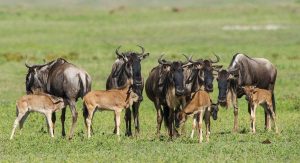
The calving season is the Great Migration’s best-kept secret. Every safari website leads with the river crossings, July to October, the wildebeest launching themselves into the Mara River, the crocodiles, the drama. And the crossings are extraordinary. But the calving season in the southern Serengeti, between January and March, is arguably more extraordinary and significantly less crowded. In six weeks, approximately 500,000 wildebeest calves are born onto the short-grass plains of Ndutu and the southern Serengeti. The predator response is the most concentrated and visible of the entire year: lions, cheetahs, leopards, hyenas, jackals, and wild dogs all converge on the calving grounds for the most reliable and dramatic predator-prey interactions available anywhere in Africa. Sense of Adventure runs Tanzania calving season safaris every January to March, and this guide tells you exactly why this season belongs at the top of your East African wishlist.
January to March. The Calving Season. We’ll Get You There.
Sense of Adventure runs calving season Tanzania safaris every year — southern Serengeti, Ndutu, and the most intense predator sightings of the annual cycle. Contact us now to plan yours.
What the Calving Season Actually Looks Like on the Ground
The short-grass plains of the Ndutu area in the southern Serengeti are wide, flat, and open, the grass cropped low by the accumulated grazing of the massive herds, visibility extending for five to ten kilometres in every direction. In January, the wildebeest arrive in hundreds of thousands, and the calving begins: females dropping calves in the open grass, the calves on their feet within minutes, and the predators watching from every direction. A wildebeest calf that cannot run within ten minutes of birth will not live, and this pressure produces the most urgent and intensive predator-prey interactions of the year. You might watch a cheetah take a calf 50 metres from the vehicle. You might watch a lion pride take a female wildebeest while she gives birth. You will certainly watch jackals, hyenas, and vultures cycling through the abundant mortality of 500,000 animals being born simultaneously into a landscape full of professional killers. This is not cruel; it is the ecology of the savannah operating at full capacity, and it is more intense and more visible than anything the river crossings produce.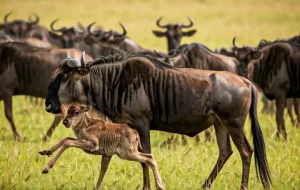
The Calving Season’s Five Wildlife Highlights
Cheetahs at Maximum Hunting Pressure
The calving season produces cheetah hunting behaviour at a density that no other period in the year matches. Vulnerable, wobbly-legged calves in open grassland are cheetah-optimal prey, and the Ndutu cheetah coalitions are well-documented individuals who hunt with clinical efficiency in the morning light. Sense of Adventure guides track individual Ndutu cheetah coalitions by name and consistently position guests for the most reliable cheetah hunting sightings in the Serengeti ecosystem.
Lion Prides at Full Saturation
The Ndutu lion prides — some of the most thoroughly studied in Africa, subjects of ongoing Serengeti Lion Project research — are visibly well-fed during the calving season in a way they are not at any other time. The abundance of prey produces longer daytime activity, more visible hunting attempts, and, in particular, the sight of fully-fed lions with full bellies in the open morning sun, completely indifferent to approaching vehicles. This is the peak lion-viewing period of the Serengeti calendar.
Wild Dog — Africa’s Most Endangered Predator
The African wild dog (painted wolf) is present in the Ndutu ecosystem, and the calving season offers some of the most reliable wild dog sightings available in the Serengeti. The dogs’ cooperative hunting makes them the calving season’s most efficient predator per unit of effort — a pack can take multiple calves in a single dawn hunt. Wild dog sightings are never guaranteed, but Ndutu in January–February is one of Africa’s best locations for a genuine wild dog encounter.
The Scale of the Herds — More Wildebeest Than You Have Seen
In August, the migration herds are in Kenya. In January–March, they are in the southern Serengeti, and the Ndutu plains in January hold a wildebeest density that exceeds the Masai Mara in peak migration. The herds extend to the horizon in every direction. The sound of half a million animals grazing is a constant, rolling, grinding ambience, something completely different from the silence of empty plains.
Ndutu’s Extraordinary Birding
Lake Ndutu and its adjacent wetlands attract raptors, storks, and waterbirds in exceptional numbers during the calving season. Tawny eagles, martial eagles, bateleurs, and yellow-billed kites gather around the carcasses and kills. The Ndutu shoreline at dawn, the light flat on the water, the acacia fringe full of weavers, and the raptors circling are among the finest birding environments available in the Serengeti ecosystem.
Everyone told me to go in August for the crossings. I went in February. I watched a cheetah take a calf in front of a herd of half a million wildebeest. The mother ran one circle and then stopped. The cheetah ate. The herd kept walking. Nothing stopped. This is nature, and it is incomprehensibly large.
— Sense of Adventure guest, Ndutu, February 2025
500,000 Calves. Every Predator in East Africa. We’ll Put You There.
Sense of Adventure designs calving season Tanzania safaris every January to March. Contact us now — the best Ndutu camps fill early for peak calving dates in late January and early February.
Frequently Asked Questions — Serengeti Calving Season
Is the calving season better than the river crossings?
Different, not directly comparable. The river crossings are dramatic, unpredictable, and produce moments of extreme concentrated action. The calving season is sustained, pervasive, and produces predator-prey interactions across an entire landscape rather than at a single point. Guests who have done both consistently say the calving season surprised them more; they expected drama and got something deeper: an entire ecosystem in high-functioning abundance. Sense of Adventure can speak to both from direct field experience every year.
When exactly does the calving season peak?
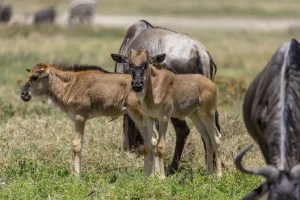
Calving typically peaks in late January and early February, approximately three weeks after the main herds arrive in the Ndutu area in early January. By March, the calf cohort has become more mobile, and the herds begin their northward movement. The three best weeks for maximum calving activity are typically January 20–February 10, though this varies by a week in either direction depending on the rains. Sense of Adventure monitors herd position and provides current-season guidance to all guests.
Where should I stay for the calving season?
The best calving season accommodation is in or adjacent to the Ndutu area, the mobile tented camps that reposition seasonally to stay with the herds, or the permanent Ndutu camp positioned on the lake shore. These books faster than the standard Seronera-area lodges for January–February. Sense of Adventure identifies and reserves the best-positioned Ndutu area accommodation for every calving season safari guest.
