
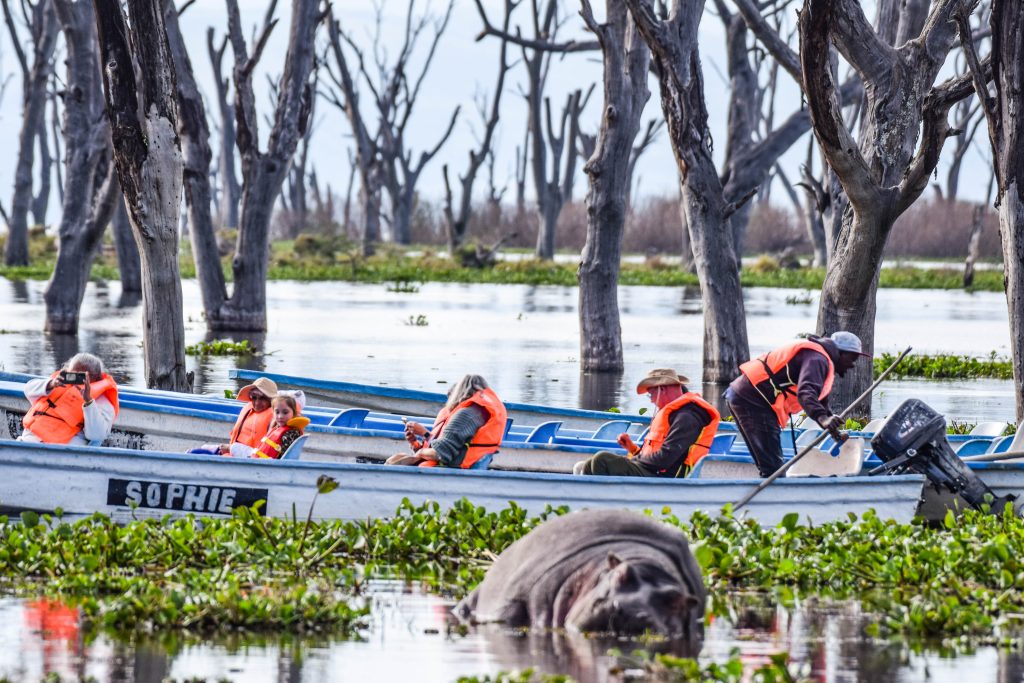
Hippos are the most dangerous large animal in Africa — and the most wrongly underestimated. The enormous round shape, the comic yawning, the wallowing in brown river water — all of it suggests docility. The reality is a 2,000 kg animal that can run at 30 km/h, has six 50-cm incisors that can bisect a crocodile, is profoundly territorial, and accounts for more human fatalities annually than any other African mammal. Understanding this is part of what makes a close hippo encounter so electrically alive: you are genuinely in the presence of something that demands complete respect. Kenya holds some of the finest hippo viewing on the continent — from the rivers of the Masai Mara to Lake Naivasha’s papyrus shoreline to Mzima Springs’ underwater observatory — and Sense of Adventure positions guests at each location with the specific combination of proximity and safety that makes the experience extraordinary.
Hippos at Arm’s Length. Safely.
Sense of Adventure knows exactly where and how to get you close to Kenya’s hippo pods — by boat, from a waterhole hide, or through Mzima’s underwater window. Contact us to plan.
Kenya’s Best Hippo Viewing Locations
Lake Naivasha — 600 Hippos From a Boat
Lake Naivasha holds approximately 600 hippos — one of Kenya’s densest populations — and the flat-bottomed boat safari approach allows you to drift within metres of pods surfacing in the papyrus channels. The pre-dawn boat drive at 05:30, when hippos are returning from their nocturnal grazing and processing back into the water through the shallows, produces the closest and most relaxed hippo encounters anywhere in Kenya. The animals are completely habituated to the silent electric boats, and the guides know the pod territories intimately.
Mara River — Hippos at the Migration Crossing
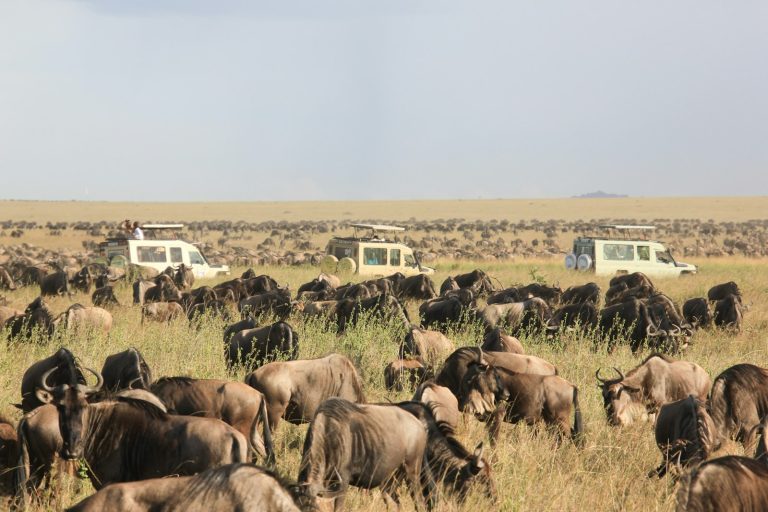
The Mara River holds large hippo pods that are permanent residents — the same families in the same pools year after year. During the Great Migration crossing season (July–October), hippos share the river with tens of thousands of wildebeest and the Nile crocodiles that hunt them. The hippos’ own role in the crossing drama is mostly passive — they hold their territory and the wildebeest give them a wide berth — but watching a pod of hippos react as a crossing begins, the territorial bulls grunting and moving to the edge of their pool, is part of the river crossing spectacle that most visitors miss in the excitement of the wildebeest.
Mzima Springs — Hippos Underwater
Tsavo West’s Mzima Springs is the most unique hippo viewing experience in Kenya — possibly in Africa. The crystal-clear volcanic-filtered pools support a resident hippo pod visible from a subterranean glass observation chamber built into the pool wall. Watching hippos underwater — their improbable bulk suspended in water, moving with surprising weightless grace, bubbles streaming from their skin — is a perspective on a familiar animal that permanently reorders your understanding of it. Tsavo West guide covers the full Mzima Springs experience.
Hippo Pool — Masai Mara’s Famous Gathering
The Hippo Pool on the Mara River is one of the Masai Mara’s most consistently visited locations — a wide, dark pool where 50–100 hippos pile up in territorial proximity, grunting, yawning their enormous mouths (a dominance display, not a yawn), and periodically erupting into brief violent disputes that churn the water white. The social dynamics of a large hippo pool — the positioning of bulls, the clustering of cows with calves, the alert posture when a strange male approaches — reward patient watching and are genuinely complex.
Nocturnal Hippo Grazing — Camp Perimeter Encounters
Hippos are almost entirely nocturnal grazers — they spend the daylight hours in water for thermoregulation and emerge at dusk to graze, often covering 10 km in a single night. Camps located near permanent water at Lake Naivasha and the Mara River regularly have hippos grazing on the lawn at night. The sound — a deep, resonant grunt that carries remarkably far and feels like it comes from inside the chest — is one of the definitive sounds of the African night. Sense of Adventure selects Naivasha accommodation specifically for lakeside positioning and nocturnal hippo access.
We heard the hippos outside the tent at 2am. It was not distant — it was right there, maybe ten metres away, that extraordinary sound. I lay completely still and listened for forty minutes. It was one of the best parts of the whole trip.
— Sense of Adventure guest, Lake Naivasha camp, February 2025
Understanding Hippo Ecology — Why They Are the Way They Are
The hippopotamus is one of the most ecologically important animals in the African freshwater system — a “keystone species” whose grazing and defecation behaviour creates conditions that feed entire aquatic food chains. A single hippo processes 40 kg of grass per night and deposits the organic material in the rivers and lakes where it rests, fertilising the algae and plankton that feed the fish. The hippo paths between water and grazing areas — tramped flat over decades — become corridors for other wildlife and drainage channels that shape the landscape. Sense of Adventure’s guides explain this ecological role as part of every hippo encounter briefing, giving guests a framework that turns a fascinating animal sighting into a genuine understanding of how African river systems work.
Hippo Safety — The Critical Rules
⚠ Hippo Safety — What Sense of Adventure Tells Every Guest
Never stand between a hippo and water. A hippo on land is heading for water. If you are in the way, it will not stop.
Never approach a hippo on foot at night. Hippos graze silently and move fast. A torch is essential if walking near water after dark.
Boat safety at Lake Naivasha. The guides maintain safe distances and never position the boat between a hippo pod and their exit route. The flat-bottomed boats are stable but cannot outrun a territorial bull. Guide judgement is absolute.
Camp protocols. If you hear hippos outside your tent, stay inside unless escorted by a ranger. This is not excessive caution — it is the behaviour that keeps guests safe.
2,000 kg of Pure Presence. You Will Not Forget It.
Book your Kenya hippo experience with Sense of Adventure — Lake Naivasha boat safaris, Mara River drives, and the extraordinary underwater window at Mzima Springs.
Frequently Asked Questions — Hippos in Kenya
Why are hippos considered the most dangerous animal in Africa?
Hippos kill more people annually than lions, leopards, or buffalo — largely because they are not perceived as dangerous and because they share water sources with human communities. Their aggression is primarily territorial rather than predatory: a hippo does not want to eat you, it wants you away from its pool or out of its path to water. The combination of territorial aggression, extreme speed over short distances, and proximity to human activity at rivers and lakes makes them the most statistically dangerous large African mammal.
What is the best place to see hippos in Kenya?
For volume and intimacy: Lake Naivasha by boat (600+ hippos, habituated to silent approach). For drama: the Mara River Hippo Pool (50–100 animals, territorial displays, location at the migration crossing point). For uniqueness: Mzima Springs in Tsavo West (underwater viewing through glass). Sense of Adventure can incorporate all three into a Kenya circuit — contact us to plan.
Can hippos run faster than humans?
Yes — hippos can reach 30 km/h over short distances, which is considerably faster than the average human sprint speed. They are not endurance runners — they tire quickly — but over the 10–20 metres between a hippo on land and a perceived threat, the speed advantage is decisive. This is why Sense of Adventure’s guides always position vehicles and boats with a safe exit route maintained.
Do hippos swim or walk underwater?
Hippos do both — they can swim properly but more often walk and bound along the river or lake bed, using their weight to anchor against the current and push off the bottom with their feet. At Mzima Springs, where the water is exceptionally clear, both behaviours are visible from the underground observation chamber. A bounding hippo moving along the bottom in slow motion is one of the most improbable and extraordinary sights available anywhere in the natural world.