
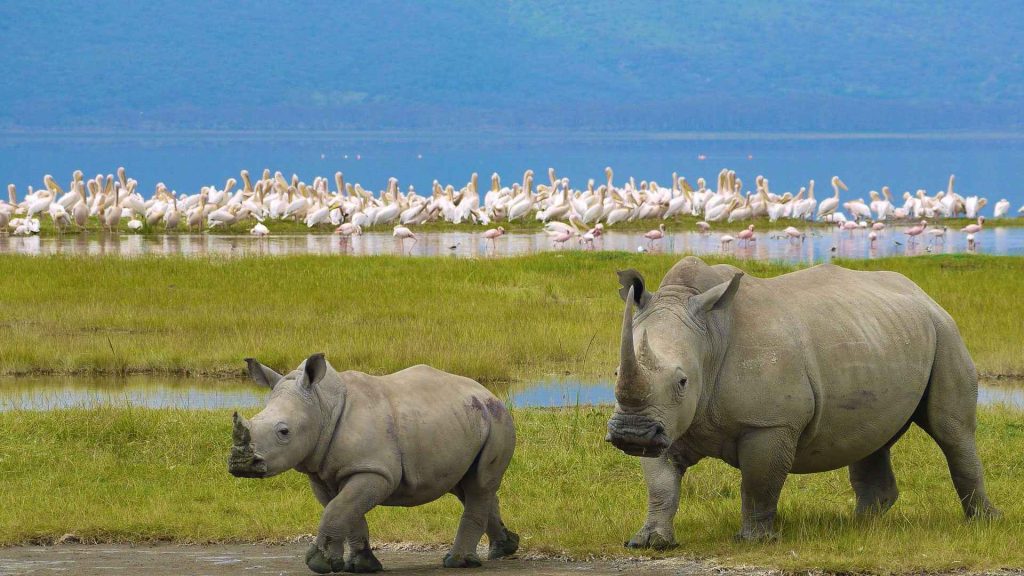
Lake Nakuru’s flamingos are the image most associated with Kenya’s Rift Valley — a dense pink shoreline that from the escarpment above looks like someone has painted the entire lake edge with a single stroke. But the flamingos are only half the story. Lake Nakuru National Park is also Kenya’s most important black rhino sanctuary — a fenced 188 km² park that holds 25+ black rhinos and over 70 white rhinos, giving it one of the highest rhino densities of any protected area in East Africa. Arriving at Nakuru is arriving at a park where you will almost certainly see both flamingos and rhinos on the same morning, while lions watch from the fever tree woodland and leopards rest in the acacia canopy above the baboon troops. Sense of Adventure brings guests to Lake Nakuru because it delivers more concentrated wildlife diversity per square kilometre than almost any other Kenyan park — and because the escarpment viewpoint over a pink shoreline is one of the genuinely unforgettable visual experiences of African travel.
Flamingos at Dawn. Rhinos Before Lunch.
Sense of Adventure includes Lake Nakuru in Kenya Rift Valley circuits — contact us to build the most rewarding flamingo and rhino experience in Kenya.
Understanding Lake Nakuru’s Flamingo Dynamics
Lake Nakuru’s flamingo population is not fixed — the birds move between Nakuru and the other alkaline Rift Valley lakes (Bogoria, Elementaita, Magadi) in response to algae and salinity levels that fluctuate with rainfall and temperature. The two species present at Nakuru — lesser flamingo (the smaller, more intensely pink species that feeds on blue-green algae) and greater flamingo (taller, paler, with a distinctive pink-and-white bill) — respond differently to these changes. At peak concentrations, over a million birds can line the Nakuru shoreline. At low concentration periods, a few thousand are still present. Sense of Adventure monitors current conditions before every Nakuru visit and can combine it with Lake Bogoria when numbers are higher there.
Five Must-Do Lake Nakuru Experiences
Escarpment Viewpoint — The Pink Lake From Above
The Baboon Cliff viewpoint on Nakuru’s western escarpment gives the overview that makes the flamingo spectacle comprehensible: the entire lake visible below, the pink edge of the shoreline flamingo band clearly delineated from the blue-grey water, the fever tree woodland in the foreground, and the distant hills of the opposite escarpment framing everything. Sense of Adventure drives every Nakuru guest to the escarpment viewpoint at the start of the visit for orientation, then descends to the lakeside for close-range flamingo encounters.
Lakeside Flamingo Encounter — Pink at Point-Blank Range
The vehicle track along Nakuru’s southern shore brings you within fifteen metres of the flamingo shoreline — close enough to photograph individual birds with a standard zoom lens, close enough to hear the collective murmur of thousands of feeding birds, close enough to see the precisely engineered filter system of their inverted bills sieving algae from the water. Lesser flamingos at this range reveal details that photographs do not capture: the translucent quality of their wing feathers in morning light, the almost mechanical precision of their synchronised feeding, the occasional burst of courtship wing-spreading that runs through a section of flock like a wave.
Black Rhino Tracking — Kenya’s Densest Sanctuary
Lake Nakuru’s fenced sanctuary holds black and white rhinos at one of the highest densities in Kenya. KWS rangers patrol the rhino zones daily and Sense of Adventure’s Nakuru guides receive current location data before each morning drive. Both species are regularly seen — the black rhino (smaller, with hooked lip for browsing) in the fever tree and euphorbia woodland, and the white rhino (larger, with square lip for grazing) in the open grassland above the lake. Seeing both species in a single morning at Nakuru is entirely achievable.
Fever Tree Woodland — Leopards & Waterbuck
Nakuru’s yellow fever acacias — those pale, lime-yellow barked trees that appear almost luminescent in morning light — provide habitat for the park’s leopard population and its enormous waterbuck herds. The fever tree woodland between the lake and the park’s northern boundary is the most reliable Nakuru leopard zone, and morning drives through this section produce regular resting-leopard sightings in the acacia canopy. Waterbuck — large, shaggy antelopes with the distinctive white toilet-seat ring on their rumps — graze beneath the trees in groups of ten to thirty.
African Fish Eagle — Nakuru’s Signature Sound
The call of the African fish eagle — a wild, carrying two-note cry that is the definitive sound of African lakes — is constant at Nakuru. The birds perch in the tops of dead acacias at the waterline, scanning for tilapia, and their diving strikes on the lake’s shallow southern margins produce some of the most dramatic bird photography in Kenya. Nakuru’s fish eagle population is substantial — you will hear them before you reach the lake and see them throughout every game drive. Sense of Adventure’s guides know the most reliable perch trees for photography.
By 7am we had seen three rhinos — a black and two whites — and we were parked at the flamingo shore. It was absolutely pink for as far as we could see. Then a fish eagle called from directly above us and I completely lost the ability to speak.
— Sense of Adventure guest, Lake Nakuru, November 2024
Lake Nakuru on Your Rift Valley Circuit
Nakuru sits perfectly between Lake Naivasha (60 km south) and Lake Bogoria (55 km north), making a three-lake Rift Valley circuit one of Kenya’s most rewarding and underrated safari routes. Sense of Adventure builds this circuit regularly: Naivasha (hippos and boat safari), Nakuru (flamingos and rhinos), Bogoria (maximum flamingo density and hot springs) — three nights, three completely different lake experiences, all connected by spectacular Rift Valley escarpment roads. See our Kenya safari planning guide for full routing options.
A Million Flamingos. Both Rhino Species. One Morning.
Sense of Adventure builds Lake Nakuru into Rift Valley circuits for guests who want Kenya’s most concentrated wildlife diversity per square kilometre. Contact us to plan yours.
Frequently Asked Questions — Lake Nakuru Flamingos & Rhinos
How many flamingos are at Lake Nakuru?
Flamingo numbers at Lake Nakuru fluctuate seasonally and in response to algae levels — from a few thousand to over a million birds. The most spectacular concentrations occur in the dry seasons when algae density peaks. Sense of Adventure monitors current conditions before every Nakuru visit. When Nakuru numbers are lower, we recommend combining the visit with Lake Bogoria which often holds the highest concentrations in the region.
What is the difference between the two flamingo species at Nakuru?
Lesser flamingos (the more numerous and more intensely pink species) feed on blue-green algae at the lake surface with their heads inverted. Greater flamingos (taller, paler, with a more strongly curved pink-and-white bill) feed on invertebrates in the shallows. Both species are usually present at Nakuru simultaneously, allowing direct visual comparison in the same flock — an unusual opportunity that few bird-watching destinations offer.
Is Lake Nakuru good for the Big Five?
Lake Nakuru delivers four of the Big Five reliably: both black and white rhino (one of Kenya’s best rhino parks), lion, leopard, and buffalo. Elephant are occasionally present near the forest sections. Combined with the flamingos, the fish eagles, and the dramatic escarpment scenery, Nakuru offers more varied wildlife per day than almost any other single-day Kenya park visit.
How long does a Lake Nakuru game drive take?
A full morning drive covering the lake shore, the escarpment viewpoint, the fever tree woodland, and the rhino zones takes 4–5 hours. Sense of Adventure recommends an overnight stay at Nakuru to get both a morning and afternoon drive — the escarpment light at sunset is as extraordinary as the dawn flamingo light. Day trips from Naivasha or Nairobi are possible but give less time in the park.