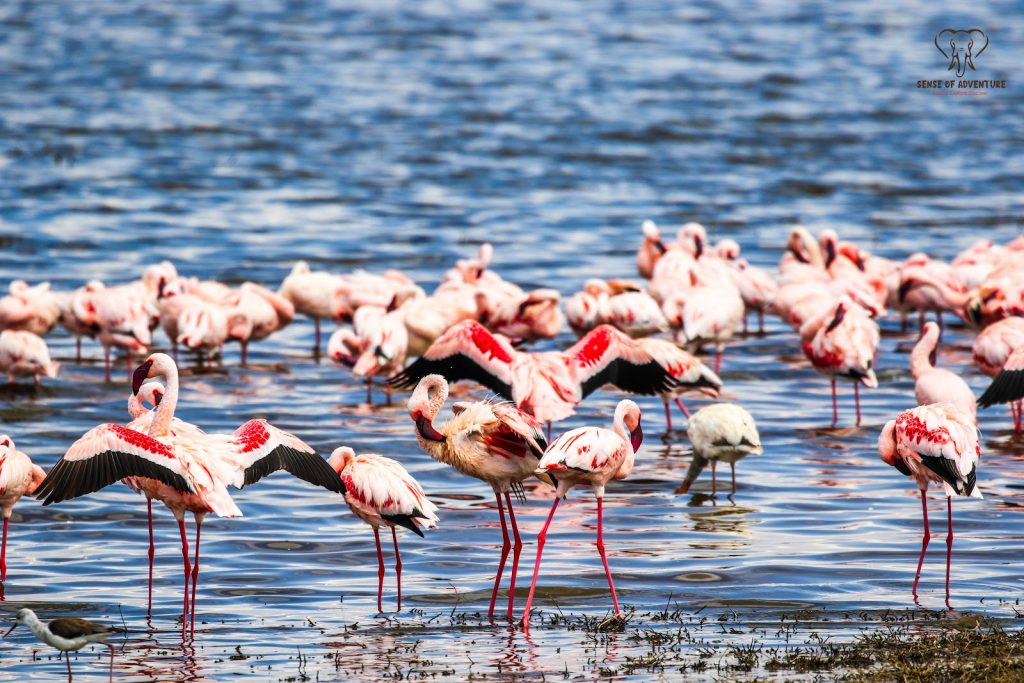
This Lake Bogoria guide starts with a simple truth: Lake Bogoria is where Kenya’s flamingo experience reaches its absolute apex. When conditions are right — and Sense of Adventure’s team monitors those conditions closely — Lake Bogoria can hold more lesser flamingos than almost any other lake in the world: in peak years more than a million birds, turning long stretches of the 34 km shoreline an almost violent shade of pink that looks more like a special effect than a natural phenomenon.
The lake sits in a steep-sided Rift Valley trough where geothermal activity pushes boiling water and steam directly through the ground and out onto the shore in a series of hot springs and geysers that hiss and spit at the flamingos’ feet. It is, in the most literal sense, a surreal and spectacular place — and it is almost entirely off the international safari radar. Sense of Adventure makes it possible to experience Lake Bogoria on day trips from Lake Nakuru or as a dedicated overnight stop.
✅ Lake Bogoria Quick Answer
- Where: Lake Bogoria National Reserve, Baringo County, in Kenya’s central Rift Valley — roughly four to five hours by road from Nairobi.
- Why go: lesser flamingos (numbers vary with the algae), more than 200 hot springs and geysers, greater kudu and dramatic escarpment scenery.
- Best time: the dry months of January–February and June–October for easy roads; flamingo numbers depend on food, so ask us for current reports.
- Time needed: a long half day from Nakuru, or one night to add Lake Baringo.
- Fees: the reserve is run by Baringo County, not KWS, so a separate county entry fee applies — check current rates with us.
Two Million Flamingos Await
Sense of Adventure includes Lake Bogoria in Kenya safari circuits for guests who want the most extraordinary bird spectacle on earth. Contact us to add it to your itinerary.
Why Lake Bogoria Outperforms Lake Nakuru for Flamingos
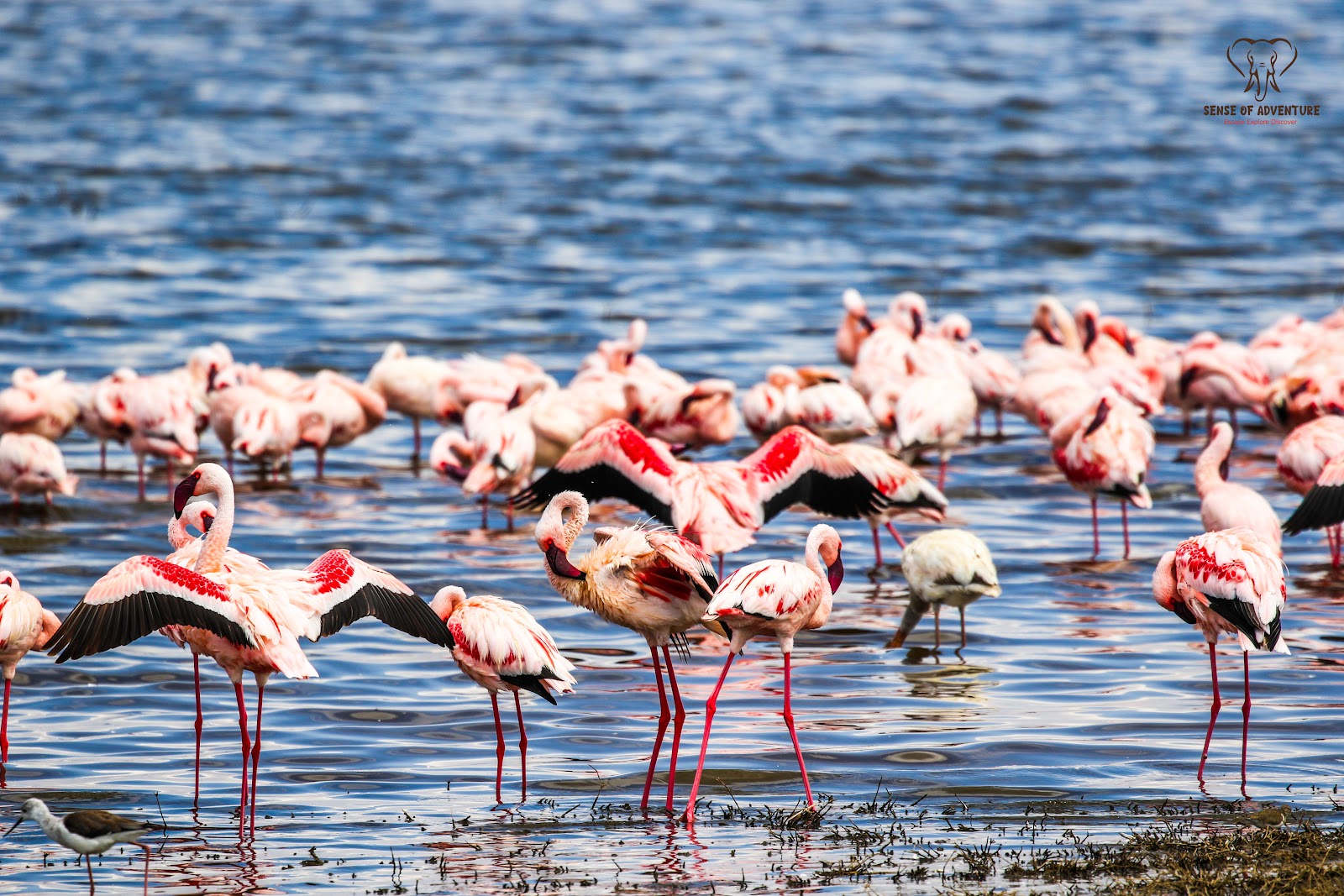
Lake Bogoria and Lake Nakuru have had a competitive relationship for Kenya’s flamingo crown since the mid-2000s, when changes in Nakuru’s water levels and algae concentration sent large numbers of birds north to Bogoria. The two lakes share the same flamingo population — the birds move between them based on food availability — but Bogoria’s high alkalinity, shallow margins and often steadier algae production have made it a primary flamingo site for much of the time since then. On a peak Bogoria day, the flamingo numbers dwarf anything you will see at Nakuru: the shore is packed with birds, the sound is a roar, and the spectacle defies rational description.
An honest note for planning: flamingos are nomadic, and no lake guarantees them. Since about 2010 the Rift Valley lakes have risen markedly, and at Bogoria higher water has covered some shoreline springs and changed where the birds feed. On some visits you will see a dense pink band; on others the flocks are smaller or spread out along the far shore. That is exactly why we check recent reports before we route you, and why we often pair Bogoria with Nakuru or Lake Elementaita to spread the odds.
Four Essential Lake Bogoria Experiences
Flamingo Shore Walk — The Pink Carpet
Lake Bogoria is a reserve where you can step out of the vehicle at designated points and walk along the shore with your guide, within sight of the flamingo concentrations. The experience is completely different from a vehicle-based sighting: the scale of the flock, the sound of thousands of birds, the smell of the alkaline water, and the geothermal steam rising behind the flamingos all combine to create something that cannot be photographed adequately. You have to be there.
Hot Springs & Geysers — Bogoria’s Geothermal Show
Lake Bogoria’s western shore, around the Loburu area, has the most visited geothermal field on the lake — springs that emerge at near-boiling temperatures directly on the beach, small geysers that spurt intermittently, and a constant sulphurous steam that drifts across the flamingo flocks. The contrast between the delicate pink birds and the primeval violence of the boiling water behind them creates the most dramatic compositional scene in Kenya’s Rift Valley.
Greater Kudu Sightings — Kenya’s Rarest Large Antelope
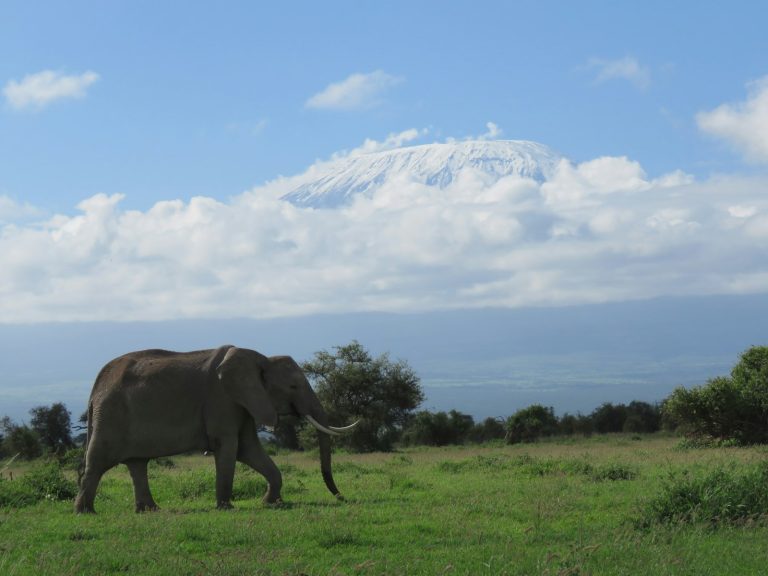
Lake Bogoria’s rocky escarpment slopes and dry bush are one of the very few places in Kenya where greater kudu are regularly seen. The kudu — one of Africa’s most magnificent antelopes, with spiralling horns that can reach 1.8 metres and a striped grey-brown coat perfectly suited to rocky bush — move in small groups on the steep hillsides above the lake, especially towards the southern end. Seeing greater kudu in Kenya is a rare achievement that Bogoria makes possible.
Rift Valley Panorama — Escarpment Views
Lake Bogoria sits in a dramatically steep section of the Great Rift Valley — the Siracho escarpment rises close and high along the eastern side, giving the lake an almost enclosed quality that intensifies both the flamingo spectacle and the geothermal activity. The views on the approach to the lake — the long blue-green water below, edged with pink when the birds are in — are among the most striking landscape photographs possible in Kenya.
Lake Bogoria Guide to the Reserve: Key Facts
Lake Bogoria National Reserve was gazetted in 1973 and covers roughly 107 km² of lake, shoreline and bush in Baringo County. Older maps call the lake Lake Hannington, its colonial-era name. The water is highly alkaline and saline, with no outlet, which is why it grows the dense blue-green algae (spirulina) that lesser flamingos filter from the surface.
A Ramsar wetland and part of a UNESCO World Heritage Site
Bogoria was listed as a Ramsar wetland of international importance in 2001. In 2011 it was inscribed alongside Lake Nakuru and Lake Elementaita as the Kenya Lake System in the Great Rift Valley World Heritage Site, recognised for its flamingo feeding grounds and its geological activity. Visiting more than one of the three lakes gives you a real sense of why UNESCO grouped them together.
Who manages Lake Bogoria?
Unlike Lake Nakuru, which is a national park run by the Kenya Wildlife Service, Lake Bogoria is a national reserve managed by the Baringo County Government. In practice this means separate gate fees paid on arrival, county rangers rather than KWS staff, and simpler facilities. The land around the lake is the ancestral home of the Endorois community, and buying local honey or crafts is a small, direct way to support them.
Best Time to Visit Lake Bogoria
Lake Bogoria is hot and dry for much of the year, and it can be visited in any month. Our Lake Bogoria guide suggests choosing the season by what you want most: smooth roads and clear light, or the green landscape and fewer visitors of the rains.
Dry seasons: January–February and June–October
These are the most comfortable months for driving and walking. Dust is the main nuisance, and midday heat on the lakeshore often rises above 30°C, so early mornings are the time to be at the springs. These months also fit neatly with a Masai Mara safari, so many travellers add Bogoria on the way to or from the Mara via Nakuru.
Rainy seasons: March–May and November–December
The long and short rains turn the bush green and bring migrant birds from November. Rain usually falls in afternoon storms rather than all day. The murram sections near the lake can turn slippery, so a 4×4 vehicle and an experienced driver matter more at this time of year.
When are the flamingos at their peak?
There is no fixed flamingo season. Numbers depend on the algae, which responds to water level, salinity and temperature across all the Rift Valley soda lakes. We check with guides and recent visitors before every trip; if Bogoria is quiet, we will tell you honestly and suggest where the birds are instead.
How to Get to Lake Bogoria
Lake Bogoria lies north of Nakuru, and almost every visitor arrives by road. There are no scheduled flights to the reserve.
By road from Nairobi
The usual route runs north-west from Nairobi to Nakuru on the main highway (around two and a half to three hours), then north through Mogotio and Marigat towards the reserve. Allow roughly four to five hours in total, plus stops at the Rift Valley viewpoints. Our Kenya safaris from Nairobi handle the driving so you can enjoy the scenery.
From Lake Nakuru or Lake Baringo
From Nakuru town the drive takes around two hours, which makes Bogoria a realistic long day out from a Nakuru base. Lake Baringo lies a short drive further north, and staying a night there lets you visit Bogoria fresh in the early morning, when the light is soft and the steam from the springs shows best.
Gates and getting around
The main entrance is Loboi Gate in the north, with Emsos Gate serving the southern end. A track runs down the western shore past the hot springs towards the southern woodland. Parts of it can flood or wash out after heavy rain, so your guide will check conditions before you set off.
Lake Bogoria Costs and Safari Options
The reserve entry fee is charged by Baringo County and is separate from KWS park fees; rates change, so check current rates with us before you travel. On a Sense of Adventure itinerary, fees are built into your written quote so there are no surprises at the gate.
- Lake Nakuru first: our Lake Nakuru Day Safari starts from USD 180 per person, and we can extend it into an overnight trip that adds Bogoria the next morning.
- For birders: the 8-day Kenya Birding Tour covers Naivasha, Nakuru, Baringo, Kakamega and the Masai Mara from USD 2,050 per adult sharing, and Bogoria can be added on the Baringo day.
- Tailor-made: a private Kenya safari lets you set your own pace, stay longer at the springs and time your visit around the latest flamingo reports.
Combining Lake Bogoria With Other Rift Valley Destinations
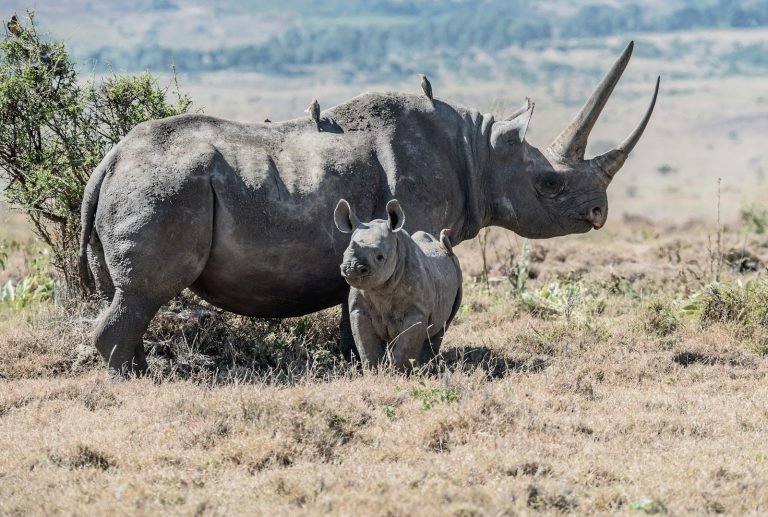
Lake Bogoria sits about two hours’ drive north of Nakuru town — an easy combination that gives guests both a top flamingo site and the Lake Nakuru rhino sanctuary on one trip. Alternatively, Bogoria makes an excellent overnight stop on a northern Kenya circuit that includes Samburu to the north. Our Kenya safari planning guide covers Rift Valley circuit options in detail.
Lake Baringo: the freshwater neighbour
Just north of Bogoria, Lake Baringo is a freshwater lake with hippos, Nile crocodiles and more than 450 recorded bird species. Boat trips and guided walks along the cliffs make it one of Kenya’s classic birding stops, and the contrast with Bogoria’s steaming soda shore is striking.
Nakuru and Elementaita: the UNESCO trio
Combining Bogoria with Nakuru and Elementaita lets you see all three lakes of the World Heritage Site in two or three days. For a side-by-side comparison of their salt, depth and birdlife, read our Kenya Rift Valley lakes ranked guide.
Hot Springs Safety and Visitor Rules
The springs are the highlight of any Lake Bogoria guide, but they are genuinely dangerous. The water is at or close to boiling point, and the crust around some vents is thin.
- Stay on firm, well-used ground and follow your guide’s line; never step onto wet, discoloured or hollow-sounding crust.
- Keep children within arm’s reach and do not let anyone touch the water.
- Do not swim in the lake: the water is strongly alkaline and very warm near the springs.
- Keep a respectful distance from the flamingos so they keep feeding rather than taking flight.
- Carry out all litter and never feed wildlife, including the baboons near the campsites.
What to Pack for Lake Bogoria
Pack for heat, glare and dust. Most essentials in this Lake Bogoria guide are the same as for any Rift Valley safari, but the lakeshore is hotter and more exposed than Nakuru or Naivasha.
- A wide-brimmed hat, sunglasses and high-factor sunscreen.
- Light, breathable clothing in neutral colours, plus a warm layer for early starts.
- Closed shoes with thick soles for walking near the hot springs.
- At least two litres of water per person, and snacks for the drive.
- Binoculars and a telephoto lens for distant flocks and kudu.
- Insect repellent and any malaria prevention advised by your doctor.
Photography Tips for Bogoria’s Flamingos and Springs
The single best photography tip in any Lake Bogoria guide is to go early. In the first two hours after sunrise the air is cooler, the steam from the springs is most visible and the light warms the pink of the birds. By midday, heat haze flattens distant flocks. A lens of 300 mm or more helps for tight flock shots, while a wide-angle lens captures the springs, the escarpment and the birds in one frame. Protect your camera from steam and spray, and wipe the lens often.
Before you travel
Once you have read this Lake Bogoria guide, sort out the paperwork. Most visitors need a Kenya eTA, which you apply for online at the official eTA Kenya portal before departure. For general travel information, the Magical Kenya tourism board is a useful starting point, and UK travellers should read the latest GOV.UK travel advice for Kenya.
The World’s Greatest Flamingo Spectacle Is Waiting
Let Sense of Adventure include Lake Bogoria in your Kenya itinerary — we monitor conditions to ensure you arrive when the flamingos are at their most spectacular.
Frequently Asked Questions — Lake Bogoria
Is Lake Bogoria better than Lake Nakuru for flamingos?
Since the mid-2000s, Lake Bogoria has often held larger flamingo concentrations than Lake Nakuru — in peak years, more than a million birds. The two lakes share the same flamingo population and numbers move between them with the algae. Sense of Adventure monitors current conditions and will recommend the best flamingo experience for your travel dates.
Can you walk around Lake Bogoria?
Yes — Lake Bogoria allows guided walks at points along the shore, which puts you within sight of the flamingo flocks and right beside the hot springs. This walking access is one of Bogoria’s advantages over the vehicle-only national parks. Walk with a guide, keep to firm ground, and Sense of Adventure provides experienced guides for all Bogoria visits.
What other wildlife is at Lake Bogoria?
In addition to the flamingos, Lake Bogoria has greater kudu on the rocky escarpment slopes — one of very few places in Kenya to see this species. Impala, zebras, dik-diks and many birds are present throughout the reserve. The hot springs also support specialised heat-loving algae and micro-organisms.
How do I get to Lake Bogoria from Nairobi?
Lake Bogoria is reached by road via Nakuru and Marigat, a journey of roughly four to five hours from Nairobi. It is most conveniently visited in combination with Lake Nakuru, or with an overnight at Lake Baringo. Sense of Adventure includes Bogoria in Rift Valley safari circuits and arranges all transfers.
Is Lake Bogoria managed by KWS?
No. Lake Bogoria National Reserve is managed by the Baringo County Government, so its entry fee is paid separately from Kenya Wildlife Service park fees. Rates change from time to time, so check current rates with us. When you book with Sense of Adventure, the reserve fee is included in your written quote.
Can you swim in Lake Bogoria?
No, swimming is not advisable. Lake Bogoria is a strongly alkaline soda lake, and the water near the springs is close to boiling point. The crust around some vents is thin and can break underfoot. Enjoy the lake from firm ground with your guide, and save swimming for your lodge pool.
How long should I spend at Lake Bogoria?
A long half day is enough to see the hot springs and the flamingos, especially as a day trip from Nakuru. If you want to look for greater kudu and visit Lake Baringo as well, spend one night in the area. An early morning at the springs gives the best light and the coolest temperatures.
Is this Lake Bogoria guide suitable for families with children?
Yes, Lake Bogoria works well for families, provided children are closely supervised near the hot springs. The flamingos and geysers fascinate most children, and the walks are short and flat. Bring plenty of water and sun protection, and plan the visit for early morning before the midday heat builds.