
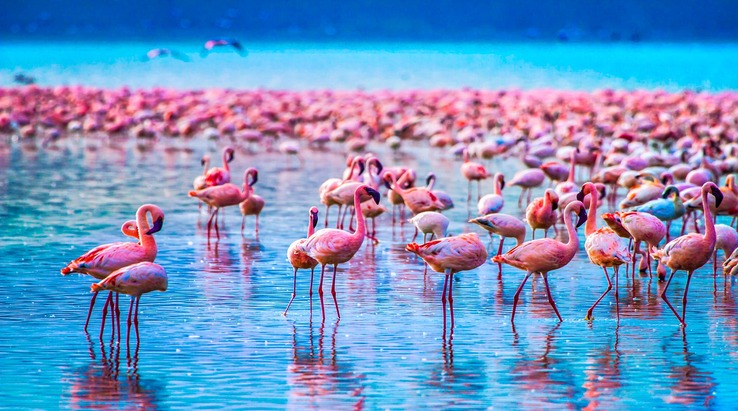
Kenya’s flamingos produce the most visually overwhelming wildlife spectacle in Africa. Nothing prepares you for the moment the Rift Valley escarpment road descends to reveal a lake shore that is not a lake shore anymore — it is a solid pink line, ten kilometres long, of two million lesser flamingos feeding shoulder to shoulder in the alkaline shallows. The sound reaches you before the full image resolves: a vast, low murmur, like a distant crowd, that is actually the feeding noise of a million birds. This is not metaphor or approximation — Kenya holds the world’s largest lesser flamingo populations, the world’s most important flamingo breeding grounds in the wider region, and the most accessible and spectacular flamingo viewing anywhere on earth. Sense of Adventure designs itineraries around the flamingo lakes because the experience is genuinely unlike anything else in Africa, and because most international visitors have no idea it exists at this scale.
See the Pink Shore With Sense of Adventure
We monitor flamingo numbers at all four Rift Valley lakes in real time and route you to the best concentration on your travel dates. Contact us to plan.
Kenya’s Four Flamingo Lakes — Where to Go and When
🕝 The Flamingo Lake Comparison
Lake Bogoria — Kenya’s flamingo capital and the world record holder for maximum flamingo concentration. Up to 2 million lesser flamingos at peak, combined with active geothermal hot springs that steam behind the flamingo shoreline. The birds can be approached on foot along the eastern shore. Best overall flamingo experience in Kenya.
Lake Nakuru — Variable flamingo numbers (a few thousand to a million+) but the advantage of combining flamingos with rhinos, leopards, lions, and the most dramatic Rift Valley escarpment view in Kenya. The fever tree backdrop to the flamingo shore is uniquely photogenic. Best for combining flamingos with Big Five wildlife.
Lake Elementaita — A smaller, more remote alkaline lake between Nakuru and Naivasha. UNESCO World Heritage Site. Lower flamingo numbers than Nakuru or Bogoria but exceptional for greater flamingos and a wide range of Rift Valley waterbirds. Extremely photogenic landscape with the Sleeping Warrior hill as a backdrop. Often overlooked and therefore uncrowded.
Lake Magadi — Kenya’s southernmost soda lake, near the Tanzania border. Extremely alkaline, extremely hot, and holding one of Kenya’s most important lesser flamingo breeding colonies. Remote and rarely visited by tourists. For serious flamingo enthusiasts and birdwatchers wanting the full Rift Valley flamingo picture.
The Science of the Pink — Why Flamingos Are Pink
Flamingos are not born pink — juvenile flamingos are white-grey. The pink colour develops over 1–3 years as the birds consume blue-green algae (specifically Spirulina and related cyanobacteria) which contain carotenoid pigments that are metabolised and deposited in the feathers and skin. The intensity of the pink correlates directly with the quality and quantity of the algae diet. At Lake Bogoria, where the alkaline chemistry produces exceptionally dense algae blooms, the lesser flamingos are among the most intensely pink in Africa. At lakes with lower algae concentration, the same birds appear paler and more washed out. The Kenyan Rift Valley’s unique chemical composition produces some of the world’s richest flamingo colours.
I thought I understood what “a million flamingos” meant. I was completely wrong. The scale of it, the sound, the colour — it was like nothing I had ever experienced. I stood there for half an hour before I could even think about taking a photograph.
— Sense of Adventure guest, Lake Bogoria, January 2025
Lesser vs Greater Flamingo — How to Tell Them Apart
| Feature | Lesser Flamingo | Greater Flamingo |
|---|---|---|
| Size | Smaller (80–90 cm tall) | Larger (110–145 cm tall) |
| Colour intensity | More intensely pink | Paler pink-white |
| Bill | Blackish-red, strongly curved | Pink with black tip |
| Diet | Blue-green algae (Spirulina) | Invertebrates & algae |
| Numbers at Bogoria | Up to 2 million | Up to 50,000 |
| Feeding position | Head inverted in water | Head partly submerged |
Planning Your Kenya Flamingo Lake Circuit
The three-lake Rift Valley circuit — Naivasha (hippos and boat safaris), Nakuru (flamingos and rhinos), Bogoria (maximum flamingo density and hot springs) — is one of Kenya’s most rewarding and underrated itineraries. Sense of Adventure builds this circuit as a 3–4 day standalone trip from Nairobi or as part of a longer Kenya safari. The driving distances are manageable (2–3 hours between each lake) and the landscapes — the escarpment descent into the valley, the volcanic hills, the soda lake shorelines — are spectacular throughout. For a Kenya trip that combines flamingo lakes with the Masai Mara, read our Kenya safari planning guide for complete circuit options.
Two Million Birds. One Shore. One Morning.
Sense of Adventure monitors current flamingo concentrations at all Kenya lakes and routes every guest to the best spectacle on their travel dates. Contact us to plan your Rift Valley flamingo circuit.
Frequently Asked Questions — Flamingos in Kenya
Which Kenya lake has the most flamingos?
Lake Bogoria consistently holds the largest flamingo concentrations — up to 2 million birds at peak. Since approximately 2005, Bogoria has generally surpassed Lake Nakuru as the primary flamingo concentration site, though both lakes share the same overall population and numbers fluctuate between them seasonally. Sense of Adventure monitors conditions at all four Rift Valley flamingo lakes and routes guests to the highest concentration on their travel dates.
Are flamingos at Kenya’s lakes year-round?
Yes — the Kenyan Rift Valley lakes hold flamingos year-round. Numbers fluctuate seasonally based on algae productivity, water salinity, and rainfall, but there is no season when the lakes are empty. The dry seasons (January–March and June–October) typically produce the highest concentrations. Sense of Adventure can advise on expected numbers for your specific travel dates.
Can you walk among the flamingos at Kenya’s lakes?
At Lake Bogoria, walking access along the eastern shore brings you within fifteen metres of the flamingo shoreline — one of the most extraordinary wildlife experiences available in Kenya. At Lake Nakuru, flamingo viewing is primarily from the vehicle track along the southern shore. At Lake Elementaita, walking access is possible in parts. Sense of Adventure arranges walking access where available and always within safe and permitted parameters.
Why do flamingos stand on one leg?
Flamingos stand on one leg primarily for thermoregulation — tucking one leg against the body reduces heat loss in cool water. The behaviour is most common when the birds are resting and the water temperature is lower. It is not a sign of injury or imbalance; flamingos can stand this way for hours without apparent effort, and can take off into flight directly from the one-legged resting position.