
Drive north from Nairobi for four hours — past Mount Kenya’s forested flanks, through the dry acacia scrub of the Laikipia Plateau — and the landscape shifts into something entirely different: semi-arid northern Kenya, where the Ewaso Nyiro River winds through a gallery of ancient doum palms and fig trees, and where five remarkable animal species live that you will find nowhere else in Kenya’s southern parks. This is Samburu National Reserve, and it is one of East Africa’s most extraordinary and undervisited wildlife destinations.
While the Masai Mara rightly dominates most Kenya safari itineraries, Samburu occupies a uniquely rewarding niche: it delivers a fundamentally different ecological experience, genuine exclusivity (visitor numbers here are a fraction of the Mara’s), and wildlife encounters — particularly with elephants and the “Samburu Special Five” — that are among the most intimate and extraordinary available anywhere in Kenya.
The Samburu Special Five
Samburu is defined by five animal species found in the northern arid zone that do not occur in Kenya’s southern parks. These are the “Samburu Special Five,” and finding all of them on a three-night stay is entirely realistic:
1. Reticulated Giraffe: The world’s most beautiful giraffe subspecies, with large, clearly defined polygonal patches separated by white lines — a network pattern as precise and individual as a fingerprint. Reticulated giraffe are common in Samburu and easily the most frequently photographed of the Special Five. Seeing them drink from the Ewaso Nyiro River — legs spread wide in their characteristic awkward stance — is a classic Samburu image.
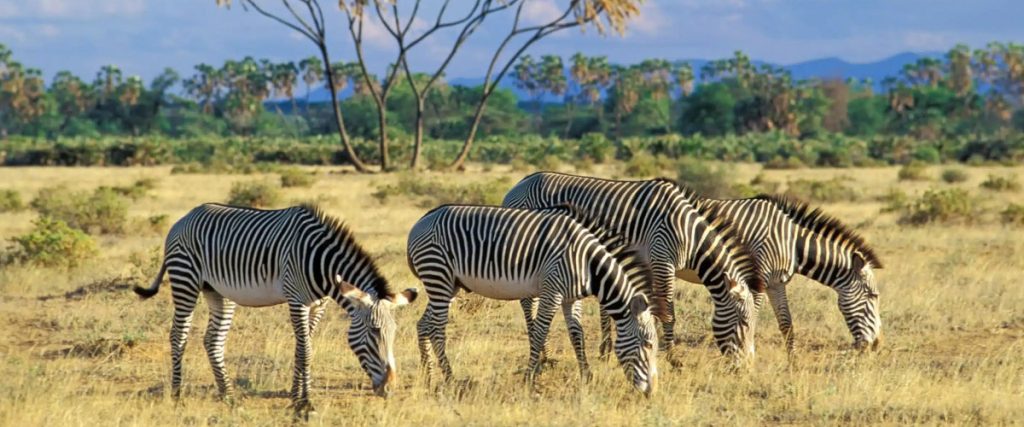
2. Grevy’s Zebra: Larger than the common plains zebra, with much narrower, more closely-spaced stripes and distinctive large rounded ears, Grevy’s zebra is the world’s largest wild equid and one of Africa’s most endangered mammals. The Samburu-Buffalo Springs ecosystem supports one of the most significant remaining Grevy’s populations. Their narrow-striped coats are strikingly different from the broader-patterned common zebra that also occur in the reserve.
3. Beisa Oryx: A large, elegant antelope with long, straight horns and a distinctive black-and-white face pattern, the beisa oryx is perfectly adapted to dry, hot environments — it can survive without drinking water for extended periods, obtaining moisture from its food. Oryx often stand in the open during the heat of the day, their pale coats reflecting solar radiation. Groups of oryx moving across the red-gold sand with the Mathews Range as a backdrop are quintessentially Samburu.
4. Somali Ostrich: Slightly larger than the common ostrich, with blue-grey (rather than red) neck skin on the male and a different eye-ring colour, the Somali ostrich is found only in the northeast of Kenya and the Horn of Africa. Often seen in pairs or family groups moving purposefully across the scrub, their extraordinary speed (up to 70 km/h) occasionally triggered by a spooked response to vehicles.
5. Gerenuk: The showstopper of the Special Five — an impala-like antelope with a dramatically elongated neck and legs that allow it to stand fully upright on its hind legs to browse thornbush at heights that other antelopes cannot reach. A feeding gerenuk, balanced on its rear legs with its neck extended, munching on the highest leaves of an acacia, is one of the most remarkable and photographically irresistible sights in East Africa. Gerenuks are common in Samburu’s thornbush areas and regularly encountered in the early morning.
The Ewaso Nyiro River: Samburu’s Lifeline
The Ewaso Nyiro River is the ecological heart of Samburu National Reserve. Running east through the park from the slopes of Mount Kenya, the river supports a narrow ribbon of lush, permanent vegetation — doum palms, fig trees, Tana River poplars — that acts as a magnet for wildlife in the surrounding dry country. Elephant herds come to drink and bathe daily. Buffalo, lion, and leopard patrol the riverine vegetation. Crocodile and hippo inhabit the deeper pools.
Game drives along the river are among the most productive in Kenya. The combination of density (animals concentrated at the water) and setting (the ancient palms, the red rock outcrops, the mountains in the distance) gives Samburu river drives a visual quality that is quite distinct from the open savannah photography of the Amboseli or Masai Mara.
The elephants of Samburu deserve special mention. This population is one of the most studied in Kenya — the Save the Elephants organisation has been monitoring and researching Samburu’s elephants for over 25 years, and many individuals are named and known to researchers. The habituation level is extraordinary: it is normal to have game drive vehicles completely surrounded by a relaxed breeding herd, with elephants moving peacefully within touching distance. The intimacy of these encounters with wild elephants is unlike anything available in the southern parks.
Predators and Other Wildlife
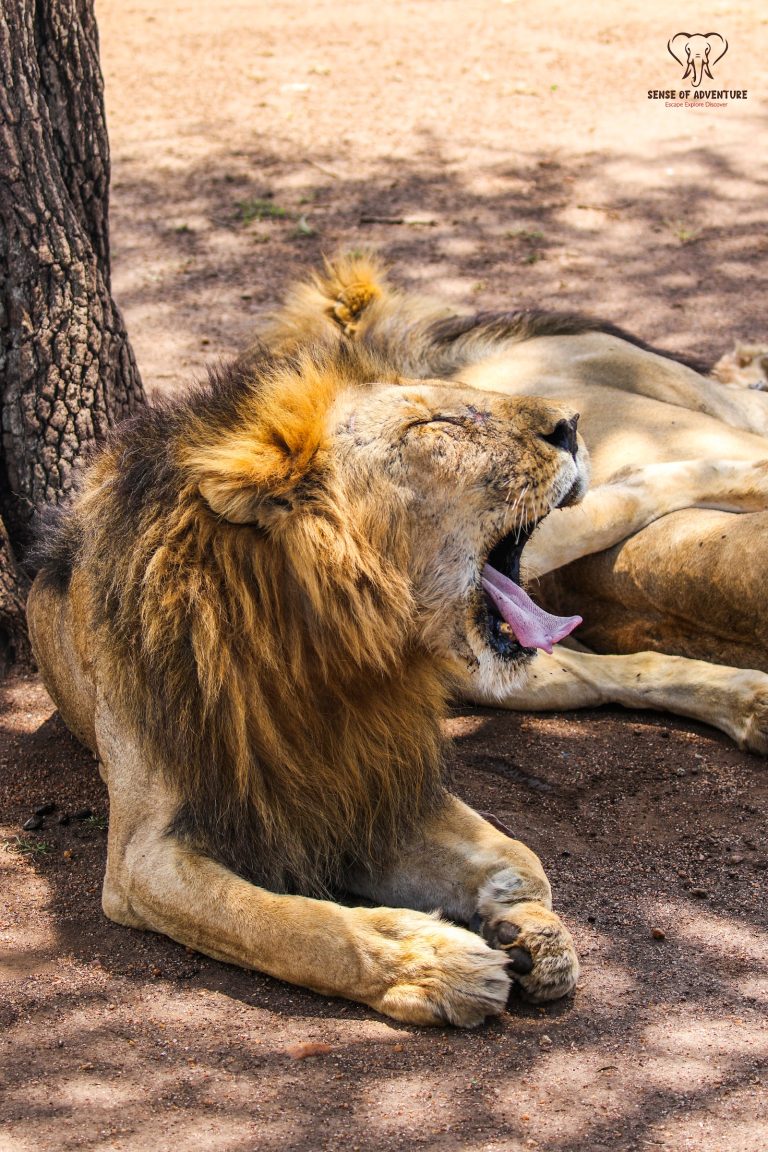
Lion, leopard, cheetah, and spotted hyena all occur in Samburu. The lion population is smaller than in the Mara but well-established and regularly encountered, particularly near the river at dawn. Leopard are present in good numbers and most commonly seen in the riverine vegetation and rocky kopjes of the Samburu hills. Cheetah patrol the more open areas of the adjacent Buffalo Springs National Reserve (immediately south of Samburu across the river), which is drier and more open than Samburu proper.
Wild dog — increasingly rare in East Africa — are occasionally seen in the broader Samburu-Laikipia landscape. Bat-eared fox, patas monkey (the world’s fastest primate), and vulturine guineafowl (a spectacularly beautiful bird endemic to dry East Africa) add to the reserve’s distinctive wildlife profile.
Getting to Samburu
Samburu is approximately 330 kilometres north of Nairobi — about 4–5 hours by road via Nanyuki or Isiolo, or 45 minutes by scheduled charter flight from Wilson Airport. Flying is the preferred option for most safari travellers and allows combination with other northern Kenya destinations without long road transfers.
Combining Samburu in a Kenya Circuit
Samburu combines naturally with Mount Kenya and the Laikipia Plateau on a northern Kenya circuit, or with the Masai Mara on a north-south Kenya itinerary. Our most popular comprehensive Kenya circuit: fly from Nairobi to Samburu (3 nights, Special Five and elephant intimacy) → fly south to the Masai Mara (4 nights, Big 5 and migration) → fly back to Nairobi. This 7-night circuit covers Kenya’s wildlife from north to south in a beautifully varied format. See our Kenya safari cost guide for the cost structure of a multi-destination circuit, and our Kenya national parks guide for the full picture of what Kenya offers beyond Samburu.
Or call us: +254 700 000 000 — we love planning great safaris.