
An African safari is the greatest wildlife photography opportunity on earth. Nowhere else can you spend hours with apex predators at close range, watch the world’s largest land migration from an open vehicle, and photograph lions, elephants, leopards, and cheetahs against landscapes of extraordinary scale and beauty — all in a single week. Whether you are a smartphone photographer capturing memories for Instagram or a serious photographer building a professional wildlife portfolio, the Masai Mara and East Africa’s other great parks will challenge, inspire, and reward you.
This guide compiles the most important safari photography advice from our guides and from the professional wildlife photographers who work with us annually across Kenya and Tanzania. It covers gear, technique, light, positioning, and the mindset that separates good safari photographs from great ones.
Understanding Light: The Most Important Variable
In wildlife photography, light is everything. The same lion resting under the same acacia tree will produce a forgettable photograph at 11:00 AM and an extraordinary one at 07:00 AM — the difference is entirely in the light. Golden hour in the Masai Mara — the hour after sunrise and the hour before sunset — produces a warm, directional light that transforms the colour of the grass, the animals, and the landscape. The lion’s coat glows amber. The elephant’s wrinkled skin shows depth and texture. The wildebeest’s blue-black flanks catch fire. This is why our game drives begin at 06:00.
Key light principles for safari:
- Shoot with the sun behind you or to the side — front-lit subjects have the most detail and colour saturation.
- Pre-dawn periods (before sunrise) produce beautiful blue-toned light that works well for mood shots and silhouettes.
- Overcast light — common during the green season — eliminates harsh shadows and is excellent for portrait-style animal shots.
- Midday light is harsh and creates unflattering shadows — use this time for landscape photography, environmental context shots, or simply resting before the afternoon drive.
- Backlight (sun behind the subject) creates beautiful rim-lighting on fur and grass — particularly effective for cheetah on the open plains and lion in tall grass.
Camera Gear Recommendations
For serious wildlife photographers:
- Camera body: A full-frame mirrorless or DSLR with strong high-ISO performance (Sony A1, Canon R5, Nikon Z9, or comparable). Wildlife photography in low light (dawn, dusk) is demanding on sensors.
- Telephoto lens: A 100–500mm or 200–600mm zoom covers the widest range of safari situations. For open savannah subjects like cheetah and lion, 400–600mm is regularly necessary. A 300mm f/2.8 prime with 1.4x teleconverter is exceptional for quality and light-gathering but less versatile than a zoom.
- Wide/standard zoom: 24–105mm or 28–70mm for landscape context shots, camp life, and environmental portraits of animals in their setting.
For enthusiast/travel photographers:
- Any modern mirrorless camera (Sony, Fuji, Canon, Nikon) with a telephoto zoom of at least 300mm equivalent.
- Micro four-thirds systems (Olympus/OM System, Panasonic) offer excellent reach in compact form — 300mm on MFT is equivalent to 600mm full-frame.
For smartphone photographers:
- A clip-on telephoto lens adapter significantly extends reach. Moment and Sandmarc make good options for iPhone; similar products exist for Android.
- For anything beyond distant landscape shots, a dedicated camera with telephoto capability will produce dramatically superior results. Consider renting a telephoto lens for your trip rather than buying one.
Essential Safari Photography Accessories
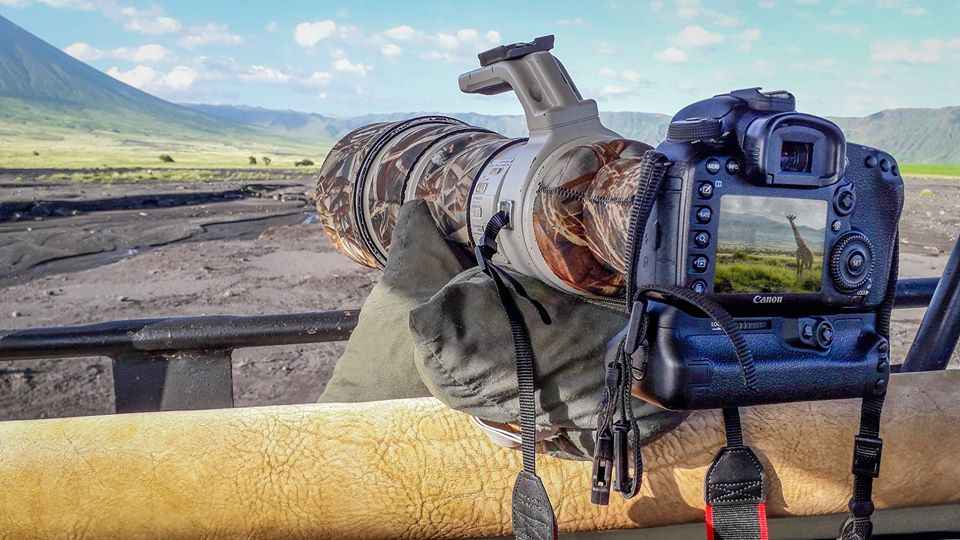
- Bean bag: The single most important accessory for game drive photography. Rested on the door frame or roof rail of a game vehicle, a bean bag provides a stable, vibration-absorbing platform that is far superior to a tripod in a moving vehicle context. Buy a travel bean bag (empty, to be filled with rice or sand at destination) rather than shipping a heavy filled one. This is non-negotiable for serious photographers.
- Spare batteries (minimum 2 per body): Cold early mornings, continuous shooting, and full days of use drain batteries fast. Never rely on a single battery.
- Multiple high-capacity memory cards: A river crossing can produce 500+ shots in five minutes. Run out of space at that moment and you will not forgive yourself. Carry multiple 128GB or 256GB cards, formatted and ready.
- Lens cleaning kit: Dust is pervasive on safari game tracks. A lens blower, lens pen, and clean microfibre cloth are used constantly.
- Dust protection bag: A Ziploc bag large enough for your camera body protects it when not actively shooting in dusty conditions.
- Polarising filter: Reduces glare, deepens sky blue, and improves colour saturation — particularly useful for water and landscape shots.
- Portable power bank: For charging during full-day game drives away from camp power.
Technique: How to Get Sharp Wildlife Images
Shutter speed is your friend: To freeze animal movement, use a minimum shutter speed of 1/1000s for moving subjects (running predators, birds in flight). For stationary subjects, 1/500s is usually sufficient. Use shutter priority mode (Tv or S) and set your target shutter speed — let the camera manage aperture and ISO.
Burst mode: Animals move unpredictably. Shoot in high-speed burst mode during any action sequence — a running cheetah, a lion yawning, a bird landing. Review afterward and select the peak moment. Modern cameras shoot 20–30 frames per second — use this capability.
Autofocus: Use continuous autofocus (AI Servo on Canon, AF-C on Sony/Nikon) for moving subjects. Modern eye-tracking AF is extraordinarily effective for wildlife — the camera finds and locks onto the animal’s eye automatically. If your camera has this feature, use it.
Expose for the subject: Bright sky backgrounds and dark shadow areas can fool your camera’s metering. In Aperture or Manual mode, expose for your subject’s face or eye — sacrifice the background if necessary. Use the camera’s histogram to check that highlights are not blown.
Mindset and Patience: The Most Important Skill
The best safari photographs come from patience — not from rushing to the next sighting. Staying with a subject for thirty minutes produces far better images than visiting fifteen subjects for two minutes each. Watch what is happening. Anticipate behaviour. Position your vehicle for the best light angle before the action starts rather than scrambling when it begins. The photographers who return from the Masai Mara with exceptional images are those who sat with a cheetah for an hour, reading its body language and positioning accordingly, rather than those who drove around checking off species.
Our guides are extraordinarily skilled at reading animal behaviour and can usually anticipate what a predator will do next — positioning the vehicle accordingly. Work with your guide. Tell them what you are trying to photograph and they will help you achieve it.
For Specific Destination Photography Planning
Different parks offer different photography strengths. Amboseli is unparalleled for elephant + Kilimanjaro landscapes. The Masai Mara delivers the best predator encounters in Africa. Samburu offers uniquely dramatic lighting in its dry red-rock landscape. Talk to our team about designing a photography-focused itinerary that puts you in the right park at the right season for the specific images you want to make. We work with professional wildlife photographers regularly and understand what different destinations offer across the year.
💬 WhatsApp Us — Plan Your Safari Today
Call or WhatsApp: +254 799 160 081