
No phrase in safari travel carries more weight than The Big Five. Originally coined by the trophy hunters of colonial East Africa to describe the five most dangerous and difficult animals to hunt on foot — lion, leopard, elephant, Cape buffalo, and rhinoceros — the term has evolved into the defining ambition of modern wildlife tourism. Today, completing your Big Five is less about conquest and entirely about encounter: the privilege of meeting these five extraordinary animals in their natural habitat, understanding what makes each one remarkable, and leaving with a deeper connection to the wild world than any photograph can fully capture.
This guide covers each of the Big Five in depth — their ecology, behaviour, where to find them across East Africa, and what makes each one genuinely extraordinary. Whether you are planning your first safari or your fifth, this is the essential wildlife companion to take with you. For Masai Mara-specific Big Five information, see our Big Five in Masai Mara guide. For a broader Kenya parks overview, see our Kenya national parks guide.
1. The African Lion — Panthera leo
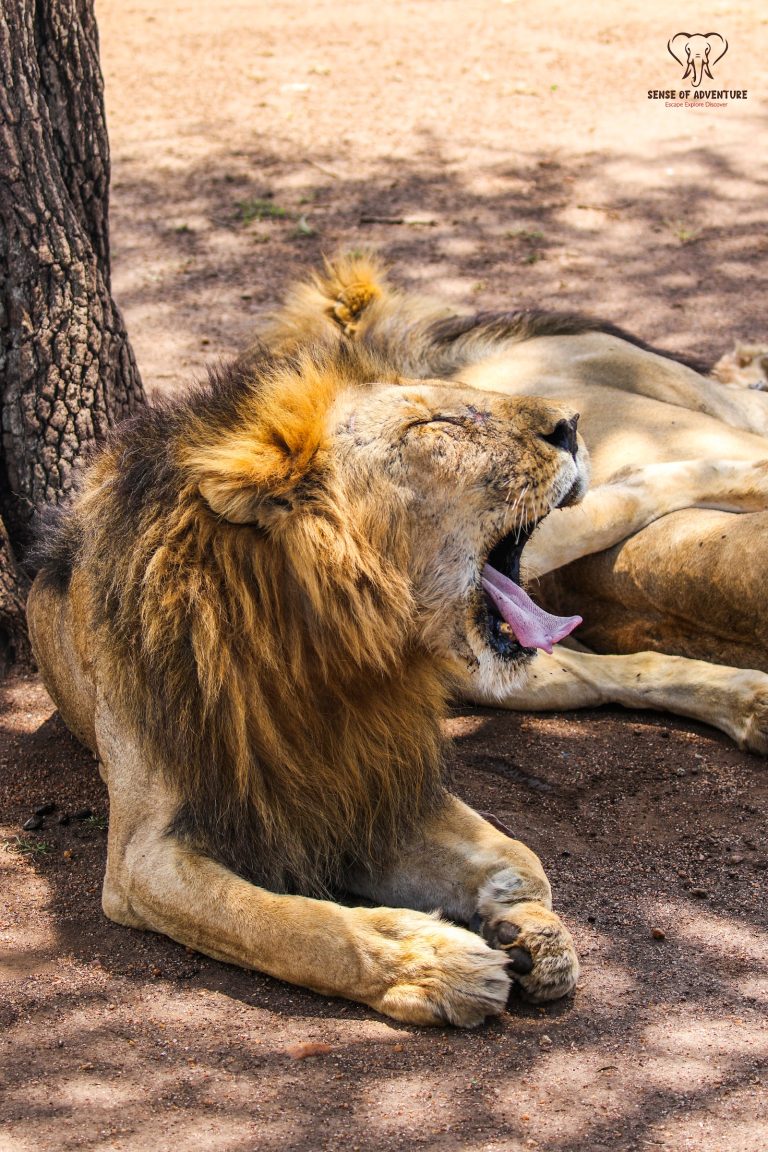
The lion is Africa’s apex predator and the animal most safari travellers most want to see. It is also, paradoxically, the easiest of the Big Five to find in most East African parks — because lions, unlike most large predators, are not secretive. They spend up to twenty hours a day resting in visible locations, and their social structure — living in stable, territorial prides — means that good guides know exactly where to find them on any given morning.
What makes lions genuinely extraordinary is not just their physical power — though a male lion at close range, his mane full and his amber gaze fixed on your vehicle, is an overwhelming presence — but the complexity of their social lives. Lion prides are sophisticated societies built around female kinship groups: sisters, mothers, daughters, and granddaughters who hunt cooperatively, raise cubs communally, and defend territories that may span hundreds of square kilometres. The relationship between pride females and their male coalitions — the coalition males who defend the pride from rival males while the females hunt for the group’s food — is nuanced, sometimes tender, often brutal, and endlessly fascinating to observe.
The Masai Mara supports one of Africa’s highest lion densities. Multiple large, well-studied prides roam defined territories that experienced guides track intimately. The Marsh Pride, made famous by BBC’s Big Cat Diary, the Paradise Pride, and numerous other groups occupy the reserve’s various zones. East Africa’s lion population faces significant pressure from habitat loss, human-wildlife conflict, and disease, making every encounter with these animals a reminder of what we stand to lose.
Best destinations: Masai Mara (Kenya), Serengeti (Tanzania), Ngorongoro Crater (Tanzania), South Luangwa (Zambia).
Best time to see: Year-round in the Mara; dawn and dusk for active behaviour; midday for relaxed close-range resting.
2. The African Elephant — Loxodonta africana
The African elephant is the largest land animal on earth — and one of the most intelligent. Adult bull elephants can reach four metres at the shoulder and weigh over six tonnes. But the scale is only part of what makes elephants extraordinary. Their cognitive abilities, emotional complexity, and social structures — which parallel human societies in remarkable ways — have been the subject of scientific study for decades, and the more we learn, the more astonishing these animals become.
Elephants live in matriarchal family groups led by the oldest, most experienced female — the matriarch, whose ecological knowledge (the location of water sources, safe migration corridors, the identity of threatening individuals or groups) is the group’s collective memory. When a matriarch is lost — through poaching, human-wildlife conflict, or age — the family loses irreplaceable knowledge accumulated over decades. The scientific literature on elephant grief, communication (including infrasound frequencies below human hearing that carry for kilometres), and self-awareness (elephants pass the mirror self-recognition test, one of a handful of species that do) is one of the most extraordinary bodies of knowledge in modern biology.
Watching a breeding herd of elephants — calves playing, juveniles testing their independence, females maintaining the complex social bonds of the group — is one of safari’s most reliably moving experiences. Seeing the great old bulls — the ancient tuskers, their massive ivory curving almost to the ground, moving alone across the landscape with the unhurried authority of creatures who fear nothing — is something different: a confrontation with the weight of deep time.
Best destinations: Amboseli (Kenya, Kilimanjaro backdrop), Masai Mara (Kenya), Samburu (Kenya, intimate encounters), Tsavo (Kenya, red dust tuskers), Chobe (Botswana).
Best time to see: Year-round; dry season concentrations at water sources are most spectacular.
3. The Leopard — Panthera pardus
Of all the Big Five, the leopard is the one that most consistently exceeds expectations. People arrive expecting a brief, distant glimpse of a cat in a tree. What the Masai Mara — and particularly the surrounding community conservancies — frequently delivers is something entirely different: a prolonged, intimate encounter at close range with one of the most beautiful and accomplished predators on earth, going about its life in total indifference to the vehicle parked fifteen metres away.
Leopards are the most widespread of the big cats — found from sub-Saharan Africa through the Middle East to Southeast Asia — but their population is declining across most of their range. In East Africa’s better-managed parks and conservancies, they are doing relatively well, and the Masai Mara’s leopard population, in particular, is one of Africa’s most reliably viewable. The Talek River area, the Olare Motorogi Conservancy, and the rocky luggas (seasonal watercourses) throughout the ecosystem are known leopard territories.
The leopard’s physical capabilities are staggering. It is the strongest pound-for-pound of Africa’s big cats — able to haul prey larger than itself up into a tree to cache it away from lions and hyenas. It hunts with a patience and precision that makes the lion’s more spectacular group efforts look almost crude by comparison. Watching a leopard stalk prey — flattening its body to the ground, moving with impossible slowness, calculating each step — is one of the most tension-filled wildlife experiences available anywhere.
Best destinations: Masai Mara conservancies (Kenya), Serengeti Seronera Valley (Tanzania), South Luangwa (Zambia), Sabi Sands (South Africa).
Best time to see: Dawn and dusk; night drives in conservancy areas for nocturnal hunting behaviour.
4. The Cape Buffalo — Syncerus caffer
The Cape buffalo is the most statistically dangerous of the Big Five to humans — responsible for more hunting fatalities historically than any other member of the group — and easily the most underestimated by first-time safari visitors. People see what looks like cattle and feel a flicker of disappointment. Then they watch a breeding herd of five hundred buffalo move across the plains in a dark, purposeful mass, accompanied by the thunder of hooves and clouds of red dust, and recalibrate entirely.
Buffalo are extraordinarily powerful animals. Adult bulls can exceed 900 kilograms. The distinctive fused horn boss that develops on mature bulls — a continuous armoured plate of horn stretching across the top of the skull — is one of the most formidable natural weapons in the animal kingdom. Old bulls that have been pushed out of the breeding herd — called “dagga boys,” a South African term referencing the mud (dagga) they wallow in — are among the most dangerous animals in Africa to encounter on foot. They have long memories, hold grudges, and have been known to circle back and ambush those who disturb them.
Within the broader ecosystem, buffalo are critical prey for lions — and the drama of a lion pride attempting to separate a buffalo from the herd, the herd’s collective defensive response, and the chaos of a successful hunt are among the most intense predator-prey dynamics in the African bush. The Masai Mara’s large buffalo herds and high lion density mean this interaction is more commonly witnessed here than almost anywhere else in East Africa.
Best destinations: Masai Mara (Kenya), Serengeti (Tanzania), Katavi (Tanzania), Kruger (South Africa).
Best time to see: Year-round; dry season herds concentrate near permanent water.
5. The Rhinoceros — Black (Diceros bicornis) and White (Ceratotherium simum)
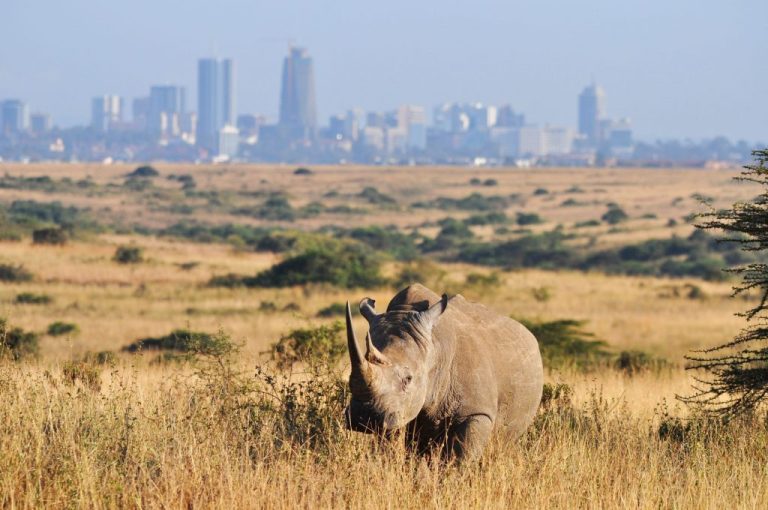
The rhinoceros is the rarest of the Big Five in East Africa — and the one whose presence in any park represents a genuine conservation triumph. Decades of catastrophic poaching for their horn (composed of keratin, the same material as human fingernails, yet worth more than gold per kilogram on black markets driven by demand in Asia) reduced Africa’s rhino population from an estimated 70,000 in 1970 to fewer than 2,500 by 1995. The recovery since then — driven by intensive protection, anti-poaching operations, and breeding programmes — is one of conservation’s greatest modern achievements.
Two species occur in East Africa: the black rhinoceros (smaller, with a hooked upper lip adapted for browsing shrubs and trees; solitary, territorial, and notoriously volatile in temperament) and the white rhinoceros (larger, with a wide square lip adapted for grazing; more social and generally calmer). The name “white” is not a colour description — it derives from the Afrikaans word weit (wide), referring to the lip shape, which was mistranslated by early English speakers.
In Kenya, the best rhino viewing is at Lake Nakuru National Park (both species in a fenced sanctuary), Ol Pejeta Conservancy (Kenya’s largest black rhino sanctuary, and home to the world’s last two northern white rhinos — Najin and Fatu — under 24-hour armed guard), and Lewa Wildlife Conservancy. In Tanzania, the Ngorongoro Crater supports a small but significant black rhino population within the crater floor.
Seeing a rhino on safari is always special — but seeing a black rhino, a truly wild and deeply endangered animal moving through its natural habitat on its own terms, is a profound experience that carries the weight of everything humanity has almost destroyed and is fighting to save.
Best destinations: Ol Pejeta (Kenya), Lake Nakuru (Kenya), Lewa Conservancy (Kenya), Ngorongoro Crater (Tanzania).
Is a Complete Big Five Sighting Possible on One Safari?
In most major East African parks, yes — with one important caveat: rhino. Lion, elephant, leopard, and buffalo are all reliably found in the Masai Mara, Amboseli, Serengeti, and most other major parks. Rhino require a specific destination. Our recommended approach for a genuine Big Five safari: combine the Masai Mara (lion, elephant, leopard, buffalo, plus migration and all other wildlife) with either Ol Pejeta or Lake Nakuru for rhino. This gives you a complete Big Five experience in a Kenya-only circuit of 5–7 nights. Talk to our team to design the right circuit for your dates.
💬 WhatsApp Us — Plan Your Safari Today
Call or WhatsApp: +254 729 837 481