
“Antelope” covers one of the widest size ranges of any animal group you’ll see on a Kenya safari — from the dik-dik, standing just 35-45cm at the shoulder and weighing as little as 3kg, small enough to fit in a large backpack, to the eland, the largest antelope on Earth, where a fully grown bull can weigh up to 900kg, nearly as much as a small car. In between sit the impala, with its lyre-shaped horns and explosive leaping escape, the kudu, whose males carry spiral horns up to 1.8 metres long, and the Beisa oryx, whose horns are the longest of any antelope in East Africa. Picture standing beside a dik-dik one morning and an eland bull the next, and realising they share a taxonomic family despite looking like they belong to different worlds. Sense of Adventure points out this range on every game drive, not just the headline species.
See the Full Antelope Size Range in One Trip
Message us to build a wildlife-focused Kenya safari covering the smallest to largest species.
A Family That Spans an Extraordinary Size Range
The dik-dik sits at the smaller extreme, standing just 35-45cm at the shoulder and weighing 3-7kg, small enough that a first-time visitor sometimes mistakes one for a young animal rather than a fully grown adult. The impala occupies the middle ground, medium-sized and slender with lyre-shaped horns on the males, common enough across Kenya’s parks to become background scenery within a day despite its genuinely striking build. The kudu is dramatically larger again, males carrying spectacular spiral horns that can reach 1.8 metres in length and body weight up to roughly 270kg, while the Beisa oryx carries the longest antelope horns anywhere in East Africa, a straight, rapier-like pair that can exceed a metre. At the very top sits the eland, the largest antelope species on the planet, where a mature bull can weigh up to 900kg — roughly 300 times heavier than the dik-dik sharing the same broad taxonomic family.
Our guide had us guess the weight of a dik-dik we’d just seen, then told us an eland bull two days later in the same trip could weigh 300 times more — that comparison stuck with us more than almost any single sighting.
— Sense of Adventure guest, Kenya safari
Kenya’s Antelope Species by Size
Dik-Dik — Kenya’s Smallest Antelope — 3-7kg, 35-45cm at the shoulder
Tiny, monogamous and territorial, dik-diks are common in scrubby bushland across much of Kenya, often overlooked entirely by visitors focused on larger species.
Impala — The Common Middle Ground — medium-sized, lyre-shaped horns on males
One of the most widespread antelope species in Kenya, known for explosive vertical leaps as a predator-evasion strategy. See our Masai Mara antelope & plains game guide.
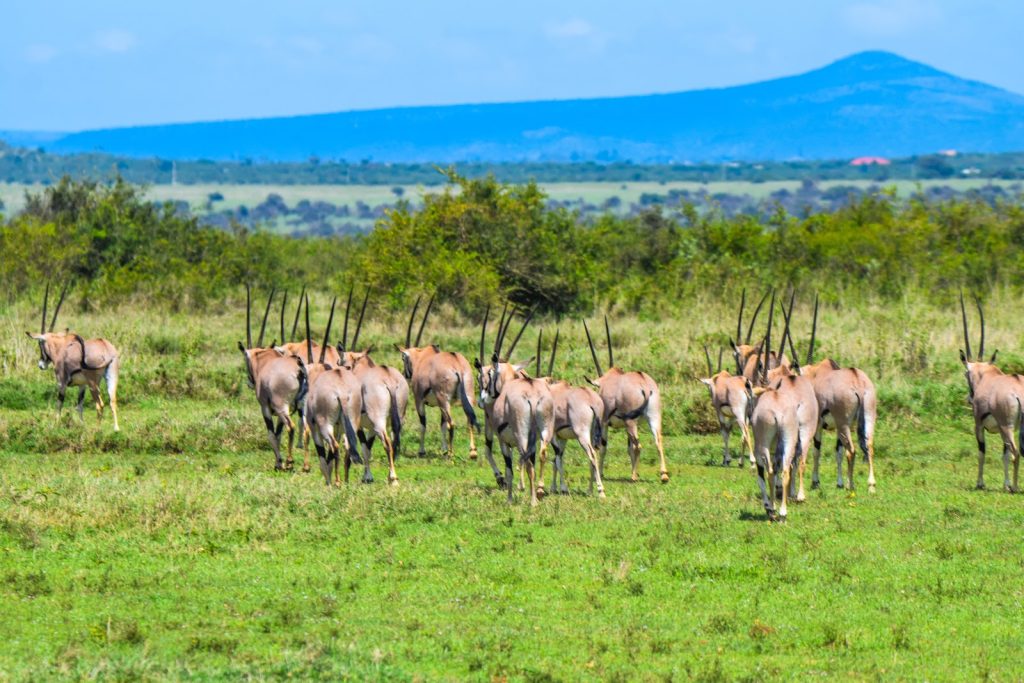
Beisa Oryx — East Africa’s Longest Horns — straight, rapier-like horns exceeding a metre
Adapted to Kenya’s drier northern landscapes, the Beisa oryx carries the longest antelope horns anywhere in East Africa on both sexes, not just males.
Kudu — Spiral Horns Up to 1.8 Metres — up to roughly 270kg, dramatic spiralling horns
A large, striking antelope found in Kenya’s woodland and bushland habitat, its males carrying some of the most visually dramatic horns of any African antelope species.
Eland — The World’s Largest Antelope — up to 900kg, roughly 300x a dik-dik’s weight
Despite its huge size, the eland is a surprisingly capable jumper and found across Kenya’s open plains and woodland edges — the single largest antelope species anywhere on Earth.
Spot the Full Range on a Single Safari
Message us to build a trip that highlights Kenya’s antelope diversity, not just the Big Five.
Kenya Antelope Facts
- Smallest species: the dik-dik, weighing 3-7kg and standing 35-45cm at the shoulder.
- Largest species: the eland, the world’s largest antelope, with bulls reaching up to 900kg.
- Longest horns in East Africa: the Beisa oryx, whose straight horns can exceed a metre on both sexes.
- Most dramatic horn shape: the kudu, whose spiralling horns can reach 1.8 metres in mature bulls.
- Most commonly seen: the impala, widespread across nearly every Kenyan park and reserve.
- Size range: roughly a 300-fold weight difference between Kenya’s smallest and largest antelope species.
Building a Wildlife-Diversity Kenya Safari
Read our Masai Mara antelope & plains game guide for species commonly seen on a standard circuit, and combine with our Kenya Luxury Big Five Safari for the widest range of habitats and species in one trip.
The Full Wildlife Picture, Not Just the Big Five
Message us to plan a Kenya safari built around genuine species diversity.
Frequently Asked Questions
What is the smallest antelope in Kenya?
The dik-dik is Kenya’s smallest antelope species, weighing just 3-7kg and standing 35-45cm at the shoulder — small enough that first-time visitors sometimes mistake an adult for a young animal.
What is the largest antelope in Kenya?
The eland is the largest antelope species in Kenya and the world, with mature bulls reaching up to 900kg — roughly 300 times heavier than a dik-dik.
Which antelope has the longest horns in East Africa?
The Beisa oryx carries the longest antelope horns in East Africa, a straight, rapier-like pair exceeding a metre in length on both males and females.
How big are kudu horns?
Mature kudu bulls carry spectacular spiral horns that can reach up to 1.8 metres in length, among the most visually dramatic horns of any African antelope.
What is the most commonly seen antelope on a Kenya safari?
The impala is one of the most widely seen antelope species across nearly every Kenyan park and reserve, known for its lyre-shaped horns and explosive leaping escape from predators.