
Kenya’s primates rarely get top billing next to Uganda’s gorillas or Rwanda’s golden monkeys, but three species turn up on almost every Kenya safari, each with genuinely distinct social behaviour worth understanding rather than dismissing as background scenery. Olive baboons live in troops of up to 150 individuals built around stable female lineages passed down through generations. Vervet monkeys, instantly recognisable by a black face fringed with white and, in males, a startling turquoise-blue scrotum, form smaller troops of 10 to 70. Black-and-white colobus monkeys occupy Kenya’s forested highlands, an entirely different, more arboreal lifestyle from either. Picture watching a baboon troop’s social hierarchy play out in real time between game drives, rather than treating primates as filler between Big Five sightings. Sense of Adventure builds this context into every itinerary.
See Kenya’s Primates With Real Context
Message us to build a trip that covers the full wildlife picture, primates included.
Three Species, Three Different Social Systems
Olive baboons organise into large troops of 15 to 150 individuals structured around stable, inherited female rank — related females form tight subgroups reinforced through grooming, while males disperse to new troops on reaching maturity, found across savannah, grassland, forest and even desert habitat throughout Kenya. Vervet monkeys run smaller troops of 10 to 70, similarly built on female-line stability with separate dominance hierarchies for each sex; males are distinctly larger than females and instantly identifiable by a black face with a white fringe and, notably, a bright turquoise-blue scrotum. Black-and-white colobus monkeys take a different path entirely, living a genuinely arboreal life in Kenya’s forested highlands and river-fringed woodland — a striking black-and-white coat and near-total tree dependence set them apart from the more ground-active baboon and vervet.
We’d mostly ignored the baboon troop near our lodge until a guide pointed out the social hierarchy playing out in real time, which females were grooming which, and why. It turned what we’d written off as camp-side wildlife into one of the more interesting behavioural sightings of the whole trip.
— Sense of Adventure guest, Masai Mara safari
Kenya’s 3 Common Primate Species
Olive Baboon — Kenya’s Largest Troops — up to 150 individuals, stable female lineages
Found across savannah, grassland and forest throughout Kenya, olive baboon troops run on inherited female rank passed down through generations, with males dispersing at maturity to find new groups.
Vervet Monkey — Smaller Troops, Distinctive Markings — 10-70 individuals, black face with white fringe
Common throughout East Africa’s savannahs, riverine woodland and coastal forest, vervet monkeys are easily identified by their black facial markings and, in males, a distinctly bright blue-turquoise scrotum.
Black-and-White Colobus — Kenya’s Forest Specialist — genuinely arboreal, found in highland forest
Living almost entirely in trees rather than on the ground, colobus monkeys occupy Kenya’s forested highlands and riverine woodland, a striking contrast to the more terrestrial baboon and vervet.
Add Real Primate Context to Your Kenya Trip
Message us to build a wildlife-focused itinerary covering primates as well as the Big Five.
Kenya Primate Facts
- Olive baboon troop size: up to 150 individuals, among the largest primate social groups in Kenya.
- Baboon social structure: built on stable, inherited female rank, with males dispersing to new troops at maturity.
- Vervet monkey troop size: 10 to 70 individuals, with separate male and female dominance hierarchies.
- Vervet markings: a black face with a white fringe, and in males, a distinctive turquoise-blue scrotum.
- Colobus monkey lifestyle: almost entirely arboreal, found in Kenya’s forested highlands rather than open savannah.
- Where to see them: baboons and vervets are common throughout the Masai Mara, Amboseli and Lake Naivasha; colobus require forested highland habitat.
Building a Wildlife-Focused Kenya Safari
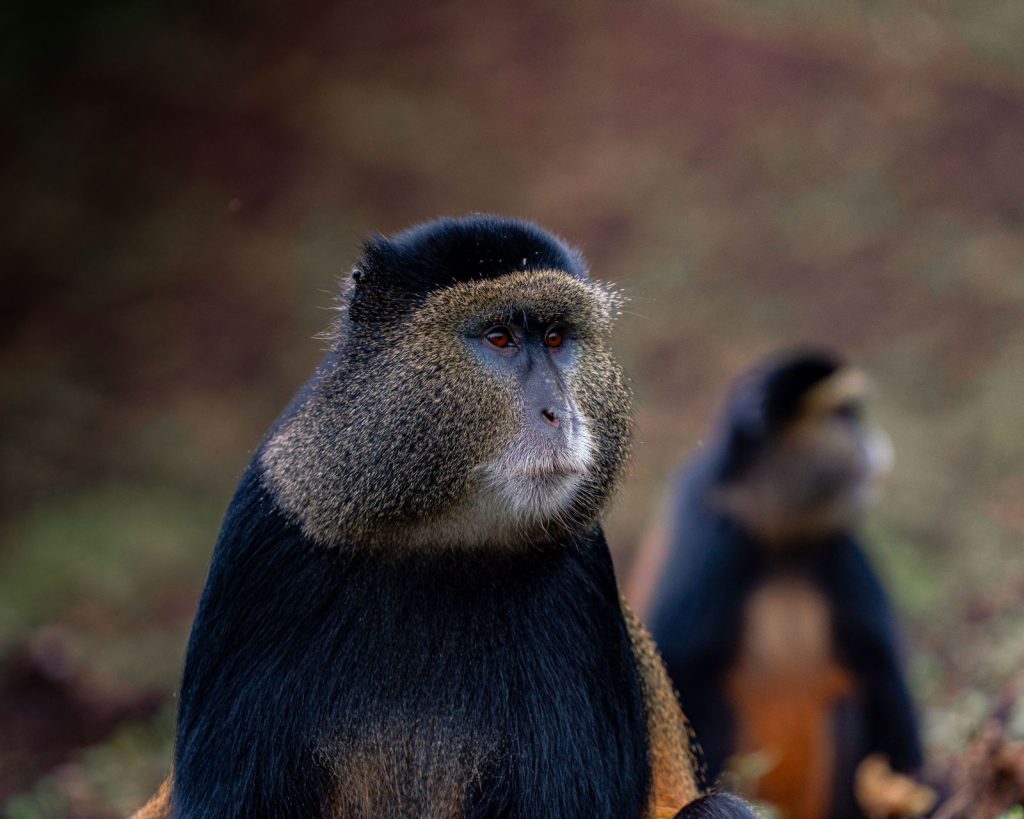
For Kenya’s larger primate relatives across the border, see our golden monkey trekking guide. Combine primate sightings with a wider game drive itinerary via our Kenya Luxury Big Five Safari.
The Full Wildlife Picture, Not Just the Big Five
Message us to build a Kenya safari with real primate and predator context.
Frequently Asked Questions
What primates can you see on a Kenya safari?
The most commonly seen primates on a standard Kenya safari are olive baboons, vervet monkeys and, in forested highland areas, black-and-white colobus monkeys — all distinct from the mountain gorillas and golden monkeys found in Uganda and Rwanda.
How big is an olive baboon troop?
Olive baboon troops in Kenya range from 15 to 150 individuals, structured around stable, inherited female social rank, with males dispersing to new troops upon reaching maturity.
How do you identify a vervet monkey?
Vervet monkeys are identified by a black face with a white fringe of hair and grizzled-grey body fur; males are additionally identifiable by a distinctly bright turquoise-blue scrotum.
Where can you see colobus monkeys in Kenya?
Black-and-white colobus monkeys require forested habitat and are found in Kenya’s highland forests and riverine woodland, a more arboreal, tree-dependent lifestyle than the ground-active baboons and vervet monkeys.
Are Kenya’s primates related to Uganda’s mountain gorillas?
Not closely in terms of what visitors typically see — Kenya’s common safari primates (baboons, vervet and colobus monkeys) are genuinely different species from the mountain gorillas of Uganda and Rwanda, which require a dedicated gorilla trekking trip to those countries.