
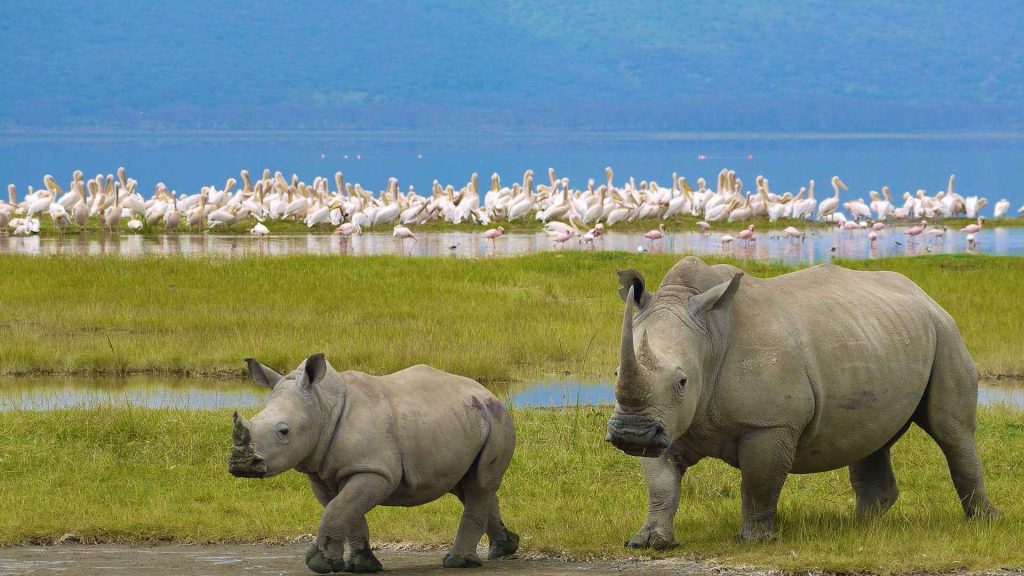
When conditions are right at Lake Nakuru National Park, the lake’s surface disappears beneath a carpet of pink. Over a million lesser flamingos — sometimes several million — congregate along the alkaline shores to filter the blue-green algae that thrives in Nakuru’s mineral-rich waters, turning the lakeshore into one of Africa’s most visually spectacular natural phenomena. This is Lake Nakuru’s defining image and one of the most remarkable wildlife spectacles on the continent.
But Lake Nakuru National Park offers considerably more than flamingos. It is one of Kenya’s most reliable destinations for both black and white rhino — housed within a fenced sanctuary that gives the park’s rhino population extraordinary protection. It supports lion, leopard, Rothschild’s giraffe, and a remarkable diversity of waterbirds and open-grassland species that make it a genuinely comprehensive wildlife destination. And at 188 square kilometres, it is compact enough to explore thoroughly in a single day while delivering wildlife experiences that exceed far larger parks. This is your complete Lake Nakuru National Park safari guide for 2026.
The Flamingos of Lake Nakuru
Lake Nakuru is a shallow, highly alkaline soda lake — its pH of approximately 10.5 creates ideal conditions for the blue-green algae Spirulina platensis on which lesser flamingos feed. When the algae bloom is rich, the flamingo concentrations are extraordinary. At peak numbers, the birds stand so densely packed along the shoreline that the lake’s edge appears to be made of pink fabric.

However, flamingo numbers at Nakuru fluctuate significantly based on the algae concentration and water levels. In years when Nakuru’s water level rises significantly (as it has done several times in recent decades due to increased rainfall in the Rift Valley catchment), the algae concentration drops and the flamingos move to other alkaline lakes — Lake Bogoria, Lake Magadi, and the Tanzanian lakes. The most reliable information on current flamingo numbers comes from on-the-ground intelligence, which is exactly the kind of local knowledge we maintain at Sense of Adventure. When planning your visit, ask us for current lake conditions.
For the latest picture, read our update on flamingos in Lake Nakuru in 2026, which explains what the higher water levels mean for sightings.
Great white pelicans are year-round residents and always present in impressive numbers regardless of flamingo conditions. The pelican population at Nakuru is one of Africa’s largest, and watching a flotilla of pelicans fishing cooperatively — driving fish into a tightening circle and then scooping in synchronized dips — is endlessly watchable.
Part of a UNESCO World Heritage Site
Lake Nakuru is one of three lakes, with Lake Bogoria and Lake Elementaita, that make up the Kenya Lake System in the Great Rift Valley, inscribed by UNESCO as a World Heritage Site in 2011. The listing recognises the lakes’ importance for lesser flamingos, great white pelicans and other waterbirds, as well as their striking volcanic setting.
Rhino: One of Kenya’s Best Viewing Opportunities
Lake Nakuru National Park is enclosed within a predator-proof electric fence — primarily to protect its rhino population from poaching. Both black rhino and white rhino are present within the sanctuary, making Nakuru one of the very few places in Kenya where you can reliably see both species in a single visit.
White rhino, originally extinct in Kenya, were reintroduced from South Africa and have established a healthy breeding population within the park. They are grazers rather than browsers and favour the open grassland areas of the park’s south and west — where their large, square mouths (adapted for cropping grass) and distinctive front horn profile make them unmistakable.

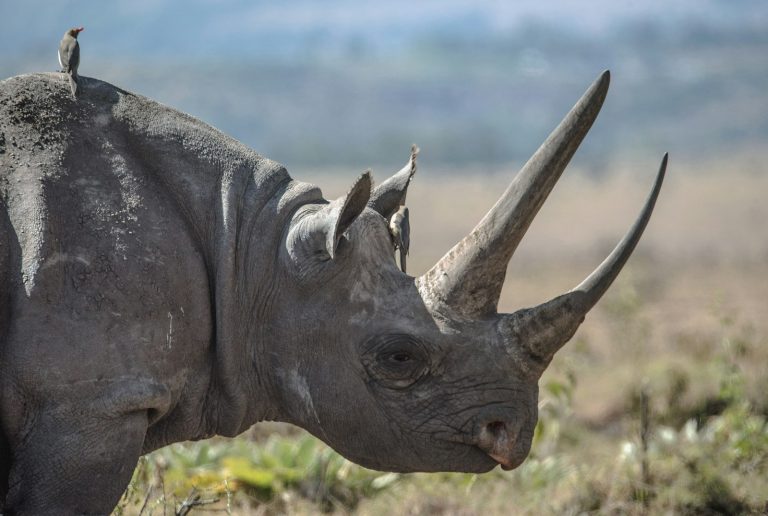
Black rhino — more solitary, more elusive, and considerably more dangerous when encountered at close range — are browsers that favour the dense thornbush areas of the park’s hillier northern sections. They are harder to find than white rhino but regular sightings occur, particularly in the early morning when they move to the lake edge to drink.
Not sure how to tell them apart? Our guide to black rhino vs white rhino explains the lip, head and behaviour differences, and our Lake Nakuru vs Ol Pejeta comparison helps if rhino are the main reason for your trip.
Wildlife Beyond Flamingos and Rhino
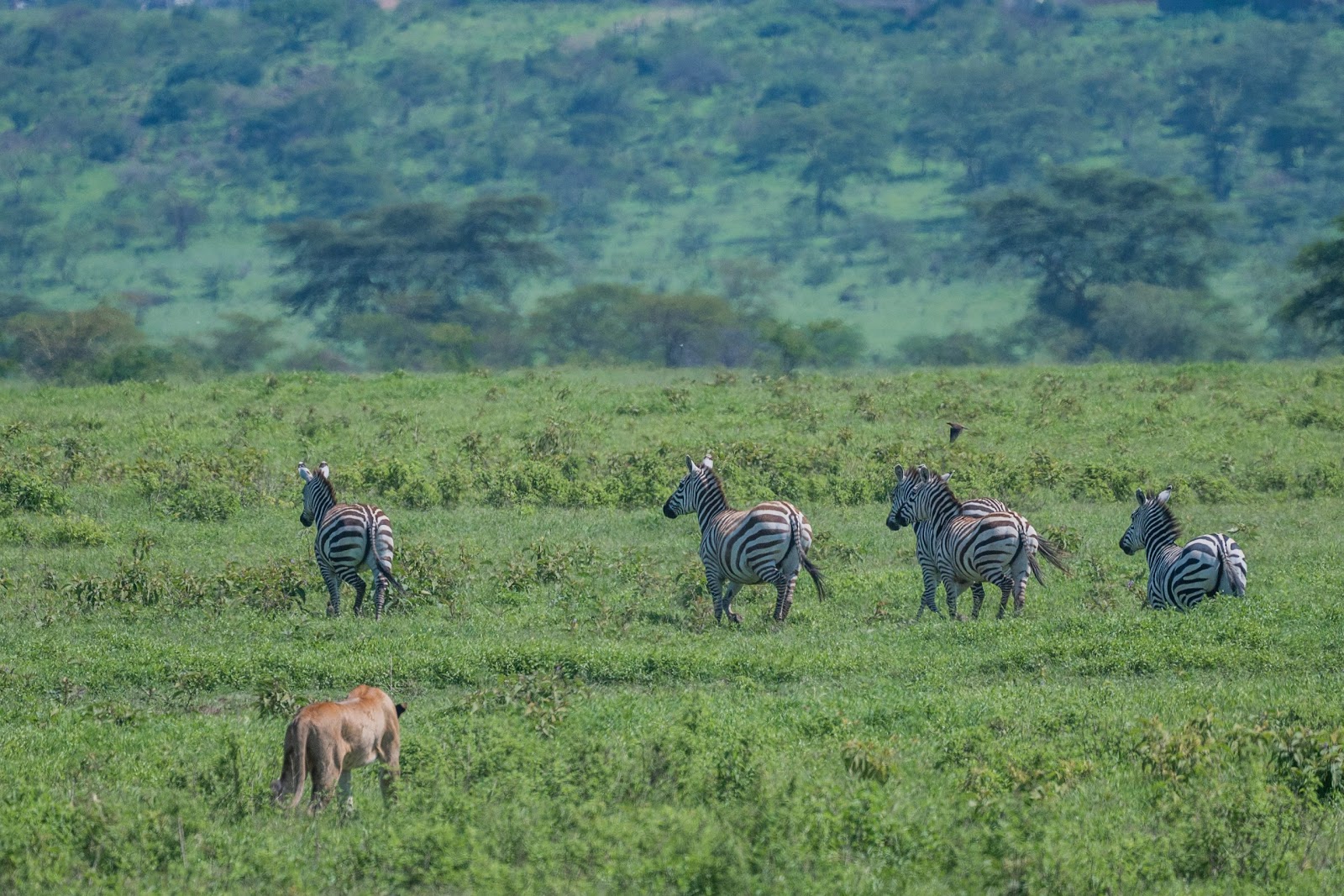
Lake Nakuru’s wildlife diversity is broader than its famous headline species suggest. Lion prides occupy territories throughout the park and are regularly located by guides who know their ranging patterns. Leopard are present and most commonly seen in the yellow fever acacia woodland on the lake’s northern shore — where the distinctive lime-green bark of fever trees creates a beautiful and eerie forest environment.
Rothschild’s giraffe — one of Africa’s most endangered giraffe subspecies — were reintroduced to Nakuru and now form a healthy population visible throughout the park.
The birdlife is extraordinary beyond the flamingos and pelicans. African fish eagle, grey crowned crane (Kenya’s most elegant bird), long-tailed widowbird, and hundreds of additional species populate the park’s varied habitats. Nakuru is a serious birdwatching destination in its own right.
Viewpoints and Highlights Inside the Park
- Baboon Cliff: a high escarpment viewpoint with a sweeping view over the lake and shoreline — a favourite photo stop.
- Lion Hill: wooded slopes on the eastern side, good for giraffe and a panoramic view back across the water.
- Makalia Falls: a seasonal waterfall in the south of the park, at its best after the rains.
- The yellow fever tree forest: the most atmospheric drive in the park and a likely spot for leopard.
- The southern grasslands: the best area for white rhino, buffalo and plains game.
Getting to Lake Nakuru
Lake Nakuru is approximately 160 kilometres from Nairobi — about 2.5 hours by road via the A104 Naivasha highway and then north through Naivasha town. The road is tarmac throughout and well-maintained. Scheduled charter flights from Wilson Airport reach Nakuru in approximately 30 minutes.
Nakuru combines beautifully with Lake Naivasha (40 kilometres south) and Hell’s Gate on a Rift Valley circuit. The classic two-day Rift Valley itinerary from Nairobi: Day 1 — Hell’s Gate cycling and Lake Naivasha boat trip. Day 2 — Lake Nakuru game drive with flamingos and rhino. Return to Nairobi or continue to the Masai Mara for a longer circuit.
Park Gates
Most visitors enter through the Main Gate on the edge of Nakuru town, which is closest to the lake shore and the flamingo areas. Lanet Gate, on the Nairobi side, is handy if you are coming straight from the capital, and Nderit Gate in the south suits travellers heading on towards the Masai Mara. Like other KWS parks, Lake Nakuru uses cashless payment for entry fees.
Accommodation at Lake Nakuru
Several camps and lodges operate within and around Lake Nakuru National Park, ranging from mid-range tented camps to the comfortable Sarova Lion Hill Game Lodge with its lake-view terrace. For families, the park’s compact size, rhino viewing, and flamingo spectacle make it an excellent choice — particularly in combination with a longer circuit. For budget planning, see our Kenya safari cost guide.
Staying overnight turns a short visit into a fuller Lake Nakuru National Park safari, with time for both evening and dawn drives. For a room-by-room comparison of the options, see our guide to Lake Nakuru National Park lodges.
Planning Your Lake Nakuru National Park Safari
A little planning goes a long way at Nakuru, and a well-timed Lake Nakuru National Park safari can deliver rhino, lion and huge flocks of waterbirds in a single morning. The park is small enough that you will not waste hours driving between sightings, but timing, season and the length of your stay all change what you see.
Best Time for a Lake Nakuru National Park Safari
The park is open all year. The long dry season from roughly June to October and the short dry season from roughly January to February give the easiest game viewing: grass is shorter, tracks are firm and animals stay close to water. The rainy months, roughly March to May and November, bring green scenery, fewer vehicles and excellent birdlife, though some tracks can be muddy.
Flamingo numbers do not follow a fixed calendar, so it is best not to plan a Lake Nakuru National Park safari around them alone. They depend on water levels and algae, so check current conditions with us before you travel.
How Long to Stay
- Day trip from Nairobi: the simplest Lake Nakuru National Park safari — an early start gives you a full game drive and a return the same evening. Our Lake Nakuru day safari is planned around this timing.
- One night: allows an afternoon drive and a dawn drive, the best times for rhino and predators.
- As part of a longer circuit: Nakuru fits naturally between Lake Naivasha and the Masai Mara.
Sample Lake Nakuru National Park Safari Itinerary
- Early morning: depart Nairobi, with a short stop at a Great Rift Valley viewpoint on the escarpment.
- Late morning: enter the park and drive the shoreline for flamingos and pelicans, then the southern grasslands for white rhino.
- Lunch: picnic at a designated site or lunch at a lodge inside the park.
- Afternoon: visit Baboon Cliff for the view, then search the fever tree forest and northern thickets for leopard and black rhino.
- Evening: return to Nairobi, stay overnight, or continue to the next stop on your circuit.
Want more than one park? Our 8-day Kenya safari covering Amboseli, Naivasha, Nakuru and the Masai Mara includes Lake Nakuru as part of a classic circuit.
What to Pack for a Lake Nakuru National Park Safari
- Binoculars for rhino and birds at a distance.
- A camera with a zoom lens — flamingos and pelicans are often far out on the water.
- Warm layers: Nakuru sits at high altitude and early mornings can be chilly.
- A hat, sunglasses and sunscreen for the strong midday sun.
- Neutral-coloured clothing and comfortable shoes for viewpoint stops.
- Insect repellent, especially near the lake shore in the evening.
Who It Suits
A Lake Nakuru National Park safari suits first-time visitors who want rhino almost guaranteed, families who prefer short drives, birders, and photographers who want flamingos, pelicans and predators in one day. It is also a good choice for travellers with limited time, because the park is close to Nairobi and easy to explore. For official park information, visit the Kenya Wildlife Service, and for wider trip ideas see Magical Kenya, the national tourism board.
Game Drive Tips for a Lake Nakuru National Park Safari
Nakuru rewards patience more than distance. Because the park is compact, the best drives are slow ones that return to the same productive areas at different times of day rather than racing round the whole loop.
- Start early: enter at opening time for the best chance of black rhino at the lake edge and lion still on the move.
- Work the shoreline first: waterbirds are most active in the cooler morning hours, and the light across the water is softer for photography.
- Give the fever tree forest time: leopard sightings here usually come from slow driving and careful scanning of branches.
- Use the viewpoints for orientation: from Baboon Cliff your guide can often spot rhino and buffalo herds on the plains below.
- Ask about recent sightings: guides share information through the day, which is one of the advantages of travelling with an experienced driver-guide.
Photography on a Lake Nakuru National Park Safari
Morning light from the east falls nicely on the western shore, and late afternoon light warms the escarpments and the yellow bark of the fever trees. A zoom lens in the 100–400mm range covers most wildlife here, while a wider lens is useful at the viewpoints. Keep the engine off for sharp images and ask your guide to position the vehicle with the sun behind you.
Costs and What Affects the Price
The cost of a Lake Nakuru National Park safari depends mainly on four things: whether you go as a day trip or stay overnight, the standard of lodge you choose, the size of your group, and whether Nakuru is a single stop or part of a longer circuit. Park entry fees are set by the Kenya Wildlife Service and differ for non-residents, residents and citizens.
Sharing a private vehicle with family or friends lowers the cost per person, and combining Nakuru with Lake Naivasha or the Masai Mara is usually better value than separate trips. Our package pages show current prices, and we are happy to build a quote around your dates and budget.
Responsible Visiting and Safety
Lake Nakuru is a fenced sanctuary that protects some of Kenya’s most valuable wildlife, so a few simple rules matter here more than most:
- Stay in your vehicle except at designated viewpoints, picnic sites and lodges.
- Keep to marked tracks — driving off-road damages habitat and disturbs rhino.
- Keep a respectful distance from rhino, buffalo and lion, and never block an animal’s path.
- Do not feed baboons or monkeys at picnic sites, and keep food out of sight.
- Take all litter away with you.
Nakuru town is a busy regional centre and the park itself is well patrolled. Normal travel precautions apply, and travellers from the UK can check the latest government travel advice for Kenya before departure.
Lake Nakuru FAQs
Is a Lake Nakuru National Park safari worth it?
Yes. A Lake Nakuru National Park safari offers some of Kenya’s most reliable rhino viewing, with both black and white rhino, plus lion, leopard, Rothschild’s giraffe and huge numbers of waterbirds. Its compact size and closeness to Nairobi make it rewarding even on a single day, and it fits easily into a longer circuit.
Will I see flamingos at Lake Nakuru?
Possibly, but not guaranteed on any Lake Nakuru National Park safari. Flamingo numbers rise and fall with water levels and algae, and in recent high-water years many birds have moved to other Rift Valley lakes. Great white pelicans are present all year. Ask us for current conditions before travel, and consider adding Lake Bogoria or Elementaita if flamingos are a priority.
Can you see the Big Five in Lake Nakuru National Park?
Not quite. The park has rhino, lion, leopard and buffalo, but no elephant, so it covers four of the Big Five. Combine it with the Masai Mara or Amboseli to complete the set. Rhino viewing at Nakuru is among the best in Kenya, which makes it a valuable part of a wider itinerary.
Can I visit Lake Nakuru as a day trip from Nairobi?
Yes. The drive takes about two and a half hours each way on tarmac, so an early departure gives you a full game drive and a return to Nairobi in the evening. A day trip suits travellers short on time, but an overnight stay adds dawn and dusk drives when wildlife is most active.
Are night game drives allowed at Lake Nakuru?
No. Like other Kenya Wildlife Service national parks, Lake Nakuru does not allow night game drives, and vehicles must be at their lodge or out of the park by closing time. Plan to make the most of the early morning and late afternoon, when predators and rhino are usually most active.
How many days do I need for a Lake Nakuru National Park safari?
One full day covers the main highlights, including the shoreline, rhino areas and Baboon Cliff. One night is better, because it adds an afternoon and a dawn game drive when wildlife is most active. If you are combining Nakuru with Lake Naivasha and the Masai Mara, allow at least five to seven days in total.
Or call us: +254 799 160 081 — we love planning great safaris.