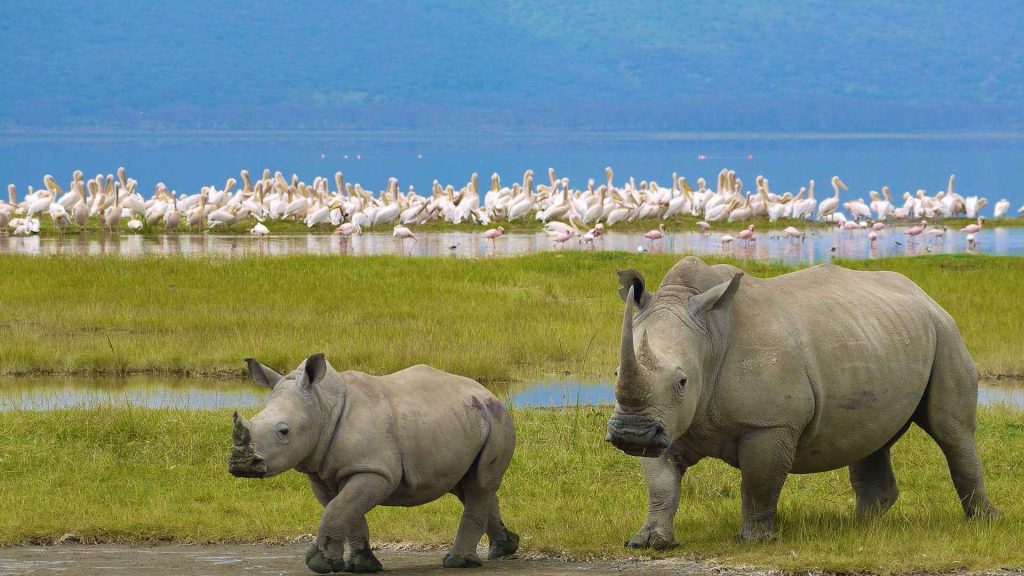
Lake Nakuru flamingos and rhinos are the two images most associated with Kenya’s Rift Valley — a pink-edged shoreline seen from the escarpment above, and armoured rhinos grazing on the grassland below. Lake Nakuru National Park is one of Kenya’s most important rhino sanctuaries — a fenced 188 km² park that holds both black and white rhinos at one of the highest densities of any protected area in East Africa.
Arriving at Nakuru means arriving at a park where you have an excellent chance of seeing rhinos on a single morning drive, while lions rest in the fever tree woodland and leopards lie up in the acacia canopy above the baboon troops. Flamingo numbers are more variable than they once were, and this guide explains honestly what to expect. Sense of Adventure brings guests to Lake Nakuru because it delivers more concentrated wildlife diversity per square kilometre than almost any other Kenyan park — and because the escarpment viewpoint over the lake is one of the genuinely unforgettable visual experiences of African travel.
✅ Lake Nakuru Quick Answer
- Rhinos: both black and white rhinos live in the fenced park, and most visitors see white rhinos on a single game drive; black rhinos are shyer.
- Flamingos: numbers vary a great deal; since the lake rose and became less salty, large flocks are less common than in older photographs.
- Other wildlife: Rothschild’s giraffes, lions, leopards, buffalo, waterbuck and more than 450 bird species.
- Getting there: about 160 km from Nairobi, usually 3 hours by road; the main gate is on the edge of Nakuru town.
- From: our Lake Nakuru Day Safari starts from USD 180 per person.
Flamingos at Dawn. Rhinos Before Lunch.
Sense of Adventure includes Lake Nakuru in Kenya Rift Valley circuits — contact us to build the most rewarding flamingo and rhino experience in Kenya.
Understanding Lake Nakuru’s Flamingo Dynamics
Lake Nakuru’s flamingo population is not fixed — the birds move between Nakuru and the other alkaline Rift Valley lakes (Bogoria, Elementaita, Magadi) in response to algae and salinity levels that fluctuate with rainfall and temperature. The two species present at Nakuru — lesser flamingo (the smaller, more intensely pink species that feeds on blue-green algae) and greater flamingo (taller, paler, with a distinctive pink-and-white bill) — respond differently to these changes.
In past peak years, more than a million birds lined the Nakuru shoreline. Since around 2013, however, the lake has risen sharply and its water has become less salty, which reduces the algae lesser flamingos depend on. On many visits today you will see scattered groups or a few thousand birds rather than a solid pink band, and on some days very few. Sense of Adventure checks current conditions before every Nakuru visit and can combine it with Lake Bogoria when numbers are higher there. For the latest picture, read our flamingos in Lake Nakuru 2026 status update.

Lake Nakuru Flamingos and Rhinos: The Rhino Sanctuary Story
Lake Nakuru was declared a rhino sanctuary in 1987, and the park was fenced to protect the animals from poaching. Black rhinos were brought in from other parts of Kenya, and southern white rhinos were later added. Today the park is one of the country’s most important breeding populations, and Kenya Wildlife Service rangers monitor the animals closely. The Kenya Wildlife Service manages the park and sets its rules and fees.
How to tell black and white rhinos apart
The names have nothing to do with colour; both are grey. The white rhino is larger, with a broad, square lip for grazing, and it usually walks with its head low over open grassland. The black rhino is smaller, with a pointed, hooked lip for browsing on shrubs, and it prefers thicker bush. White rhinos tend to be calmer and are often seen in small groups, while black rhinos are usually solitary and more easily disturbed.
Rothschild’s giraffes and other wildlife
Nakuru is also a refuge for the endangered Rothschild’s giraffe, first introduced in 1977, and you can often see them browsing among the acacias. Buffalo are common and large, and lions are seen regularly. Impala, Bohor reedbuck, Defassa waterbuck, warthogs and olive baboons complete a busy list for such a compact park.

Five Must-Do Lake Nakuru Experiences
Escarpment Viewpoint — The Pink Lake From Above
The Baboon Cliff viewpoint on Nakuru’s western escarpment gives the overview that makes the whole park comprehensible: the entire lake visible below, any flamingo band along the shoreline clearly delineated from the blue-grey water, the fever tree woodland in the foreground, and the distant hills of the opposite escarpment framing everything. Sense of Adventure drives every Nakuru guest to the escarpment viewpoint for orientation, then descends to the lakeside for closer encounters.
Lakeside Flamingo Encounter — Pink at Close Range
When the birds are present, the vehicle tracks near the shore bring you close enough to photograph individual flamingos with a standard zoom lens, to hear the collective murmur of feeding birds, and to see the precisely engineered filter system of their inverted bills sieving algae from the water. Lesser flamingos at this range reveal details that photographs do not capture: the translucent quality of their wing feathers in morning light, the almost mechanical precision of their synchronised feeding, and the occasional burst of courtship display that runs through a flock like a wave.
Rhino Tracking — One of Kenya’s Densest Sanctuaries
Lake Nakuru’s fenced sanctuary holds black and white rhinos at one of the highest densities in Kenya. KWS rangers patrol the rhino zones daily and Sense of Adventure’s Nakuru guides share sightings with other guides by radio during each drive. Both species are regularly seen — the black rhino (smaller, with hooked lip for browsing) in the fever tree and euphorbia woodland, and the white rhino (larger, with square lip for grazing) in the open grassland above the lake. Seeing both species in a single morning at Nakuru is entirely achievable, though never guaranteed.
Fever Tree Woodland — Leopards & Waterbuck
Nakuru’s yellow fever acacias — those pale, lime-yellow barked trees that appear almost luminescent in morning light — provide habitat for the park’s leopard population and its large waterbuck herds. The fever tree woodland around the lake is one of the better Nakuru leopard zones, and patient morning drives through this section sometimes produce resting-leopard sightings in the acacia canopy. Waterbuck — large, shaggy antelopes with the distinctive white ring on their rumps — graze beneath the trees in groups of ten to thirty.
African Fish Eagle — Nakuru’s Signature Sound
The call of the African fish eagle — a wild, carrying cry that is the definitive sound of African lakes — is constant at Nakuru. The birds perch in the tops of dead acacias at the waterline, scanning for tilapia, and their diving strikes on the lake’s margins produce some of the most dramatic bird photography in Kenya. You will hear them before you reach the lake and see them throughout every game drive. Sense of Adventure’s guides know the most reliable perch trees for photography, and our Lake Nakuru birds guide covers the pelicans, cranes and raptors too.
Best Time to See Flamingos and Rhinos at Nakuru
Rhinos are resident all year, so there is no bad month for them. The dry seasons from late June to October and from January to February make game viewing easiest, because the grass is shorter and animals gather near water. The rains in April–May and November make the park greener and quieter, with migrant birds arriving from November.
When are Lake Nakuru flamingos and rhinos easiest to see together?
There is no fixed flamingo season. Numbers depend on algae, which in turn depends on water level and salinity, so a dry spell that lowers the lake can help. In practice, plan your trip around the rhinos and the wider park, and treat a large flamingo flock as a welcome bonus. We check recent sightings before you travel so your expectations are realistic.
How to Get to Lake Nakuru National Park
Lake Nakuru lies right on the edge of Nakuru town, about 160 km north-west of Nairobi. The drive normally takes around three hours, with a stop at the Rift Valley viewpoints on the way down the escarpment. The main gate is near the town, and there are other gates at Lanet and Nderit.
- Day trip: leave Nairobi early, spend the middle of the day in the park and return in the evening.
- Overnight: stay inside or near the park to enjoy both a dawn and an afternoon game drive.
- On a circuit: Nakuru links neatly with Naivasha to the south and the Masai Mara to the south-west.
Lake Nakuru Costs and Safari Packages
Park entry fees are set by KWS and change from time to time, so check current rates with us or on the KWS website. Our packages include park fees, a pop-up roof vehicle and a professional driver-guide. These Sense of Adventure trips include Nakuru:
- Lake Nakuru Day Safari — from USD 180 per person.
- Masai Mara & Lake Nakuru Camping Safari (4 Days) — from USD 590 per person.
- Lake Naivasha Family Safari – Hell’s Gate & Lake Nakuru (4 Days) — from USD 780 per person.
- Kenya Group Safari – Masai Mara, Lake Nakuru & Naivasha (6 Days) — from USD 1,390 per person.
Prefer your own vehicle and pace? A private Kenya safari lets you spend longer with the rhinos and time your visit around the latest flamingo reports.
Lake Nakuru on Your Rift Valley Circuit
Nakuru sits neatly between Lake Naivasha (roughly 1.5 hours south) and Lake Bogoria (about two hours north), making a three-lake Rift Valley circuit one of Kenya’s most rewarding and underrated safari routes. Sense of Adventure builds this circuit regularly: Naivasha (hippos and boat safari), Nakuru (rhinos, giraffes and, often, flamingos), Bogoria (hot springs and, in good years, large flamingo flocks) — three nights, three completely different lake experiences, all connected by spectacular Rift Valley roads. See our Kenya safari planning guide for full routing options.
Other sights inside the park
Beyond the lake, look out for Makalia Falls in the south of the park, a seasonal waterfall that flows best after rain, and Lion Hill, a ridge that offers more views over the lake. Nakuru is part of the Kenya Lake System UNESCO World Heritage Site, alongside Bogoria and Elementaita.
Safari Tips for Lake Nakuru Flamingos and Rhinos
A few simple habits make a big difference to what you see and photograph.
- Start early: rhinos are most active in the cool of the morning, and the light over the lake is softer.
- Bring binoculars and a lens of at least 200 mm for black rhinos in thicker bush.
- Stay in the vehicle except at marked points such as viewpoints and picnic sites.
- Keep voices low near rhinos, which have poor eyesight but excellent hearing.
- Pack a warm layer: at about 1,750 metres, Nakuru mornings can be chilly.
- Never share the exact location of rhinos on social media, a simple step that helps protect them from poachers.
A sample day at Lake Nakuru
A typical overnight visit follows the rhythm of the animals. Leave your lodge at first light and head for the southern grasslands, where white rhinos are often grazing and lions may still be on the move. Mid-morning, drive up to Baboon Cliff for the view, then drop down to the shore to check for flamingos and pelicans. After a picnic lunch and a rest in the heat of the day, an afternoon drive through the fever tree woodland gives you a second chance at black rhinos, leopards and Rothschild’s giraffes before the park closes at sunset.
If you only have one day for Lake Nakuru flamingos and rhinos, the same plan works in a shorter form: arrive as early as you can and keep the afternoon drive for the woodland and the rhinos you missed in the morning.
Before you travel
Most visitors need a Kenya eTA from the official eTA Kenya portal, and UK travellers should read the latest GOV.UK travel advice for Kenya. Check malaria advice with your doctor before you go.
A Million Flamingos. Both Rhino Species. One Morning.
Sense of Adventure builds Lake Nakuru into Rift Valley circuits for guests who want Kenya’s most concentrated wildlife diversity per square kilometre. Contact us to plan yours.
Frequently Asked Questions — Lake Nakuru Flamingos & Rhinos
How many flamingos are at Lake Nakuru?
Flamingo numbers at Lake Nakuru fluctuate with algae levels — from very few to many thousands, and in exceptional past years over a million birds. Since the lake rose and freshened from around 2013, big flocks have been less frequent. Sense of Adventure checks current conditions before every Nakuru visit and may suggest adding Lake Bogoria when numbers are higher there.
What is the difference between the two flamingo species at Nakuru?
Lesser flamingos (the more numerous and more intensely pink species) feed on blue-green algae at the lake surface with their heads inverted. Greater flamingos (taller, paler, with a more strongly curved pink-and-white bill) feed on small invertebrates in the shallows. Both species can be present at Nakuru at the same time, allowing direct comparison in the same flock.
Is Lake Nakuru good for the Big Five?
Lake Nakuru offers four of the Big Five: rhino (both black and white), lion, leopard and buffalo. Elephants are not normally part of the Nakuru experience. Combined with Rothschild’s giraffes, fish eagles and the escarpment scenery, Nakuru offers more varied wildlife in a day than almost any other single Kenya park visit.
How long does a Lake Nakuru game drive take?
A full morning drive covering the lake shore, the escarpment viewpoint, the fever tree woodland and the rhino areas takes 4–5 hours. Sense of Adventure recommends an overnight stay to enjoy both a morning and an afternoon drive. Day trips from Naivasha or Nairobi are possible but give less time in the park.
Will I definitely see rhinos at Lake Nakuru?
No sighting is ever guaranteed, but Lake Nakuru is one of the most reliable places in Kenya to see rhinos. Most visitors on a half-day or full-day drive see white rhinos grazing in the open, and many also find a black rhino. Starting early and allowing a full day gives you the best odds.
Can I visit Lake Nakuru as a day trip from Nairobi?
Yes. The park is about three hours from Nairobi by road, so a long day trip works well. Our Lake Nakuru Day Safari starts from USD 180 per person and includes park fees, a game drive and a professional driver-guide. An overnight stay adds a quieter dawn drive.
Is Lake Nakuru a good place for children?
Yes. Lake Nakuru is compact, the roads are good and the animals are easy to see, which suits children with shorter attention spans. Rhinos, giraffes and baboons are usually big hits. Our 4-day Lake Naivasha Family Safari, which includes Lake Nakuru and Hell’s Gate, starts from USD 780 per person.