
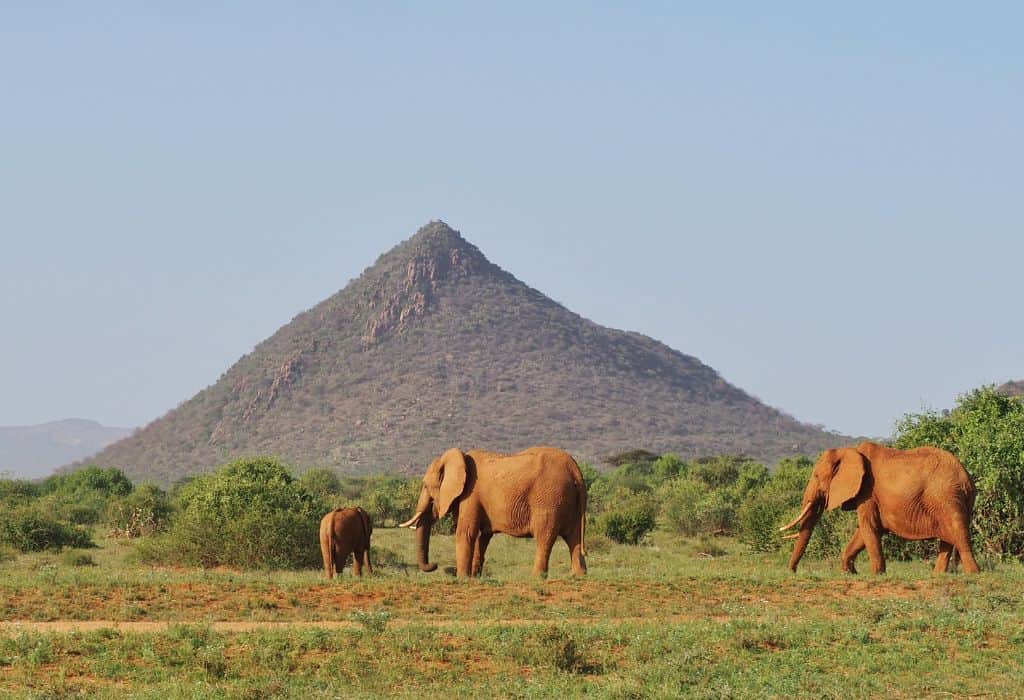
Elephants are everywhere in Kenya — from the giant tuskers of Tsavo to the swamp herds of Amboseli, from the forest elephants of Mount Kenya’s bamboo belt to the river-bathing families of the Masai Mara. But nowhere in Kenya — perhaps nowhere on earth — do you get closer to wild elephants, on their terms and in their own time, than in Samburu National Reserve. This guide is entirely dedicated to Samburu’s extraordinary elephant population and what makes an encounter with them so uniquely, memorably profound.
🌎 Thinking About a Kenya Safari?
Our team is on WhatsApp right now — ask us anything about destinations, dates, or prices. No obligation.
💬 WhatsApp Us Now or call +254 729 837 481
Save the Elephants: Science That Changed Everything
The depth of Samburu’s elephant encounters is not accidental. It is the direct result of over 25 years of dedicated research by Save the Elephants, the internationally renowned conservation organisation founded by Dr Iain Douglas-Hamilton in 1993 and based at Samburu’s research camp on the Ewaso Nyiro River. Since 1997, Save the Elephants researchers have been monitoring, photographing, and studying every individual elephant in the Samburu-Buffalo Springs ecosystem — tracking their movements via GPS collars, documenting family structures, and building the world’s most comprehensive individual-level database of wild elephant behaviour.
This long-term research has produced extraordinary results. First and most importantly for safari visitors: the Samburu elephants are among the most deeply habituated wild elephants on earth. Decades of non-threatening human presence — researchers in vehicles, safari guides who follow the Save the Elephants protocols of patient, non-intrusive observation — have produced elephants that regard a game vehicle with complete, genuine indifference. You do not simply observe these elephants from a respectful distance. You sit in the middle of a breeding herd of forty or fifty individuals as they move around, past, and sometimes directly beneath you, entirely on their own terms.
The scientific knowledge generated by this research has also transformed how our guides interpret what you are seeing. When a vehicle from a Samburu camp approaches a breeding herd, the guide knows the matriarch’s name, her age, the names of her daughters and granddaughters, and the family history spanning decades. The elephant that pauses to watch your vehicle with calm, dark eyes is not an anonymous individual — she is Kulalu, daughter of Kadogo, granddaughter of the matriarch Khadija, a known member of a family group that has been visiting this stretch of the Ewaso Nyiro River for as long as living memory reaches. That context transforms observation into understanding.
The Ewaso Nyiro River: Where the Elephants Come to You
The Ewaso Nyiro River — the lifeblood of the Samburu National Reserve — creates the conditions for the most reliable and intimate elephant encounters in Kenya. As a permanent water source in a semi-arid landscape, the river draws elephants throughout the day for drinking, bathing, and the complex social interactions that happen at water. The Samburu camps on the river bank are positioned to observe this directly — from some properties, elephants drink at the river within fifty metres of the guest tents.
Morning drives along the river consistently produce elephant encounters at close range. In the dry season (June–October), when the surrounding bush has dried out completely, entire family groups converge on the water in a daily rhythm that our guides can predict with impressive accuracy. Afternoons at the river — when the temperature peaks and elephants seek the shade and coolness of the water — often produce extraordinary bathing scenes: young calves learning to use their trunks, teenagers engaging in the boisterous water-play that seems designed purely for joy, old matriarchs standing in the shallows with a patience that feels contemplative.
📅 Get Your Free Safari Proposal
Share your travel dates and interests — we will send you a tailored, fully itemised itinerary within 24 hours.
Bull Elephants: Samburu’s Ancient Giants
Samburu’s bull elephants deserve special mention. Because poaching pressure in the Laikipia-Samburu landscape has been controlled more effectively than in many other Kenya regions, the reserve retains a population of genuinely old bulls — elephants in their forties and fifties with tusks that speak of decades of growth. Seeing a large bull at close range — his bulk filling your field of vision, his tusks curving heavy and yellow in the afternoon light — is a confrontation with deep time that never loses its power no matter how many times you experience it.
Save the Elephants’ GPS collar research has shown that Samburu’s bulls have remarkable ranging behaviour — some individuals travel hundreds of kilometres between the reserve, the Laikipia Plateau, and the Mount Kenya forest on seasonal circuits that follow ancient elephant migration routes. The river is their anchor point, the place they return to from the wider landscape. When you encounter a Samburu bull at the water, you are meeting an animal that has walked more of northern Kenya’s wild landscape than any safari vehicle ever could.
Combining Samburu in a Kenya Safari
Samburu’s elephant magic is best experienced over a minimum of three nights — enough time to develop familiarity with individual animals and to follow the river’s rhythms across multiple morning and afternoon drives. Samburu combines naturally with the Masai Mara on a north-south Kenya circuit (fly between them in under an hour), with Lewa Wildlife Conservancy for rhino and wild dog, or with Mount Kenya for a highland wilderness contrast. See our East Africa safari itinerary guide for circuit options that include Samburu. For budget planning, our Kenya safari cost guide covers Samburu accommodation at every price level.
🏑 Ready to Book Your Kenya Safari?
Sense of Adventure — Kenya-based experts with real local knowledge. Transparent pricing. Personalised itineraries. Guests who return year after year.
Call or WhatsApp: +254 729 837 481