
Lake Nakuru birds built this park’s fame decades before the rhinos arrived — but reducing it to “the flamingo lake” sells the place badly short. More than 450 species crowd Nakuru’s compact 188 km²: great white pelicans fishing in coordinated flotillas, African fish eagles screaming from the shoreline acacias, grey crowned cranes dancing on the flats, and a supporting cast spanning alkaline shallows, euphorbia forest, waterfall gorge and open cliff. The flamingos themselves come and go with water levels — some years a pink rim, some years a scattering — while the rest of the show never cancels. Sense of Adventure birding days here routinely log a hundred species before the picnic.
A Hundred Species Before Lunch
Nakuru’s habitat stack makes fast, easy birding. Tell us it matters and we’ll pace the drive for the list.
Why Lake Nakuru Is a Birding Powerhouse
Nakuru was protected in 1961 first and foremost as a bird sanctuary, and the design still shows. The soda lake concentrates food — algae for flamingos, fish (introduced alkaline tilapia) for pelicans and cormorants — while the fringing habitats pile diversity on top: yellow-barked acacia woodland for turacos, barbets and owls; euphorbia forest unique in Kenyan parks; the Makalia falls area for forest species; and Baboon Cliff’s rock faces for swifts and raptors. Water levels transformed the lake after 2013’s dramatic rise, pushing flamingos toward Bogoria in some seasons — but pelican numbers boomed on the deeper, fresher water, and the overall list only grew.

The flamingos were actually the least of it — we watched two hundred pelicans herd fish like a single animal, then a fish eagle robbed a cormorant mid-air. Our guide called every bird before the binoculars came up. 117 species by 2 pm.
— Sense of Adventure guest, Rift lakes birding day
The 5 Essential Bird Sightings at Lake Nakuru
The Pelican Fishing Fleet — coordinated squadrons at work
Great white pelicans hunt Nakuru’s tilapia in synchronised horseshoe formations — dozens of birds dipping in unison, driving fish into the shallows. It is one of Kenya’s great bird spectacles and utterly reliable on today’s deeper lake. Morning light on a working fleet, rhinos grazing behind, is peak Nakuru.
Flamingos (When They Choose You) — the famous pink rim, managed honestly
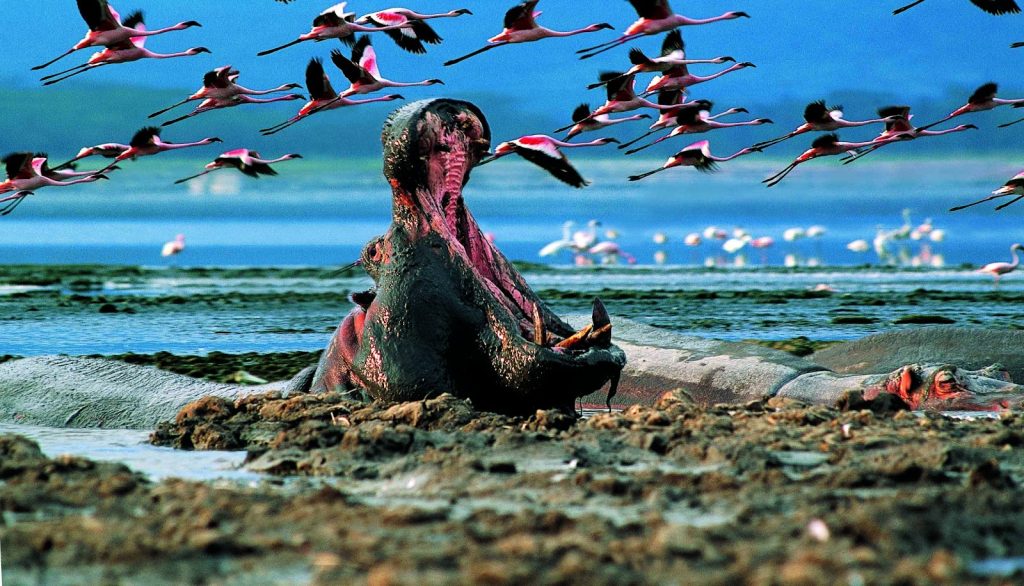
Lesser flamingos graze algae in the alkaline shallows and greater flamingos sieve invertebrates beside them — in strong years a million birds have rimmed this lake pink. Numbers now swing with water levels between Nakuru, Bogoria and Elementaita. We set expectations straight and, when the flamingos are elsewhere, the Rift loop goes to them.
Fish Eagle Piracy — the voice of Africa, behaving badly
Nakuru’s shoreline acacias each seem to hold a pair of African fish eagles, whose yodelling duet is the Rift Valley’s anthem. Watch long enough and you will see the piracy: eagles ambushing pelicans and cormorants to steal catches mid-air. Guides know the regular perches for point-blank portraits.
Grey Crowned Cranes Dancing — East Africa’s most elegant bird
Pairs of grey crowned cranes — gold crowns, scarlet wattles, impossible grace — display on Nakuru’s lake flats year-round: bowing, leaping and trumpeting in courtship dances they perform even outside breeding season, apparently for joy. The species is endangered; Nakuru is one of your most reliable places to meet it.
Woodland & Cliff Specials — the list-builders
Away from the water the park keeps giving: Schalow’s turaco flashing crimson through the acacias, white-fronted bee-eaters colonising the gorge below Makalia falls, mocking cliff-chats and swifts at Baboon Cliff, Verreaux’s eagles overhead and grey-headed woodpeckers in the euphorbia. This habitat-hopping is how day lists pass 100 without effort.
Chain the Rift Lakes for Maximum Birds
Nakuru + Elementaita + Bogoria in one loop — flamingos found wherever they’re hiding. Ask for the birding routing.

Lake Nakuru Birding Facts
- The list: 450+ species in 188 km² — among the highest densities of any Kenyan park.
- Origins: protected in 1961 specifically for its birdlife; rhinos and fences came decades later.
- Flamingo maths: peak historic counts reached seven figures; today’s numbers depend on water level and algae, shifting between Rift lakes.
- Pelican boom: deeper post-2013 water and alkaline tilapia made Nakuru one of Africa’s great pelican lakes.
- Endangered star: the grey crowned crane — reliably seen displaying on the lake flats.
- Kit note: the shoreline lets vehicles close on waterbirds — 300 mm reaches almost everything.
Building a Rift Valley Birding Trip
Start with the Lake Nakuru day safari or go deeper with our Kenya birdwatching safari guide covering the full Rift chain. The park’s other headline acts are in the Lake Nakuru rhinos guide, and flamingo chasers should read the Lake Bogoria guide — the geyser lake where the big flocks often gather.
450 Species Are Keeping Score
Bring the binoculars and a spare pencil. We’ll bring the guide who makes the list explode.
Frequently Asked Questions
How many bird species are at Lake Nakuru?
Lake Nakuru has recorded more than 450 bird species in just 188 km² — one of Kenya’s densest bird lists. The soda lake, acacia woodland, euphorbia forest, waterfall gorge and cliffs each add their own communities, so day lists above 100 species are routine.
Are the flamingos still at Lake Nakuru?
Flamingos still visit Lake Nakuru, but numbers swing with water levels and algae blooms. Since the lake rose and freshened after 2013, the biggest flocks often gather at Bogoria or Elementaita instead — while Nakuru’s pelicans boomed. Rift-lake loops find the pink wherever it currently is.
What birds can I see at Lake Nakuru besides flamingos?
Beyond flamingos, Lake Nakuru birds include great white pelicans fishing in squadrons, African fish eagles, grey crowned cranes, yellow-billed storks, cormorants, kingfishers, Schalow’s turaco in the acacias, white-fronted bee-eaters at the falls gorge and Verreaux’s eagle over the cliffs.
When is the best time for birdwatching at Lake Nakuru?
Lake Nakuru birding excels year-round, with November to April adding Eurasian migrants to the residents. Mornings are best: pelican fleets fish early, fish eagles call at dawn and the light on the lake flats is superb before ten o’clock.
Why did Lake Nakuru’s flamingos leave?
Lake Nakuru’s flamingo numbers dropped after 2013 when heavy inflows raised the lake by several metres and diluted its alkalinity, reducing the blue-green algae lesser flamingos eat. The flocks shifted to other Rift soda lakes like Bogoria; they still return to Nakuru when conditions favour algae blooms.