Nile crocodile behaviour is built on patience: the crocodile you watch lying motionless in a Kenyan river is saving energy by design. It is an ambush predator, resting with most of its body submerged for hours, waiting for one good chance rather than chasing prey. When it strikes, the bite is extraordinary. Scientists have estimated that the largest Nile crocodiles could bite with a force of around 22 kilonewtons, among the strongest of any living animal.
After the strike comes the famous death roll, a full-body spin that tears off pieces of a large carcass. Adult males typically reach 3.5 to 5 metres and 225 to 750 kg. Picture a crocodile that has lain still for your whole game drive suddenly closing its jaws in under a second. Sense of Adventure explains this patient hunting strategy at every river or lake stop.
✅ Nile Crocodile Behaviour: Quick Answer
- Hunting style: ambush from the water, not pursuit.
- Feeding: large prey is torn apart with the death roll, often with several crocodiles at one carcass.
- Social life: a size-based pecking order decides who gets the best basking and feeding spots.
- Best place to watch: the Mara River during Great Migration crossings, usually July to October.
- Other good sites: Mzima Springs in Tsavo West, Lake Baringo and remote Lake Turkana.
- Safety: never swim in Kenyan rivers or lakes, and keep well back from the water’s edge.
Want to watch crocodiles at a Mara River crossing point with a guide who reads the river?
Patience as a Hunting Strategy
Nile crocodiles hunt almost entirely through patience rather than pursuit. They lie with only the eyes, ears and nostrils above the surface, sometimes for hours, waiting for prey to come down to drink. A slow heart rate and a cold-blooded body let them wait at very little energy cost, which is the heart of Nile crocodile behaviour.
Adult males typically measure 3.5 to 5 metres and weigh 225 to 750 kg, while females are noticeably smaller. Rare giants over 6 metres have been reported, though some old records are hard to verify. When a crocodile does strike, it explodes forward with the tail and clamps its jaws on a leg or muzzle, then drags the animal into deeper water.
Bite force is where the numbers get exciting, and where care is needed. Researchers who measured bites across many crocodile species estimated that the largest Nile crocodiles could reach around 22 kilonewtons. That is a scientific estimate for very large individuals, not a figure every crocodile produces, but it still places them among the hardest-biting animals alive.
How Nile Crocodile Behaviour Actually Works
Ambush Hunting — Patience Over Pursuit — submerged and motionless, sometimes for hours
Nile crocodiles rely on stillness and concealment rather than active pursuit, striking only once prey is genuinely within reach.
The Death Roll — Feeding on Large Prey — a crushing bite, then a violent twisting spin
Because crocodile jaws can’t chew, large prey is torn apart with a full-body spin, often while other crocodiles grip the same carcass and provide leverage.
Size-Based Hierarchy — the biggest males control basking spots and feeding access
Nile crocodiles are more socially structured than most visitors expect, with strict size-based dominance governing access to the best resources at a given river or lake stretch.
Lake Turkana — A Remote Northern Stronghold — often estimated at around 12,000 crocodiles
Lake Turkana holds one of Kenya’s largest Nile crocodile populations, far from the standard safari circuit, with an important breeding area on Central Island. See our Central Island National Park guide for Lake Turkana context.
The Death Roll and Group Feeding
A crocodile cannot chew. It swallows small prey whole, but a wildebeest or zebra has to be broken into pieces first. The crocodile clamps its jaws on a limb or a flap of skin and spins its whole body in the water until a piece tears free. This is the death roll, and it is the most dramatic piece of Nile crocodile behaviour you can witness.
At a big carcass, several crocodiles often feed together. One may hold the body while another rolls, so each benefits from the others’ grip. It can look like teamwork, though researchers debate how deliberate it is. Bigger animals still feed first, and smaller crocodiles wait their turn or snatch scraps.
Why Nile crocodile behaviour changes in migration season
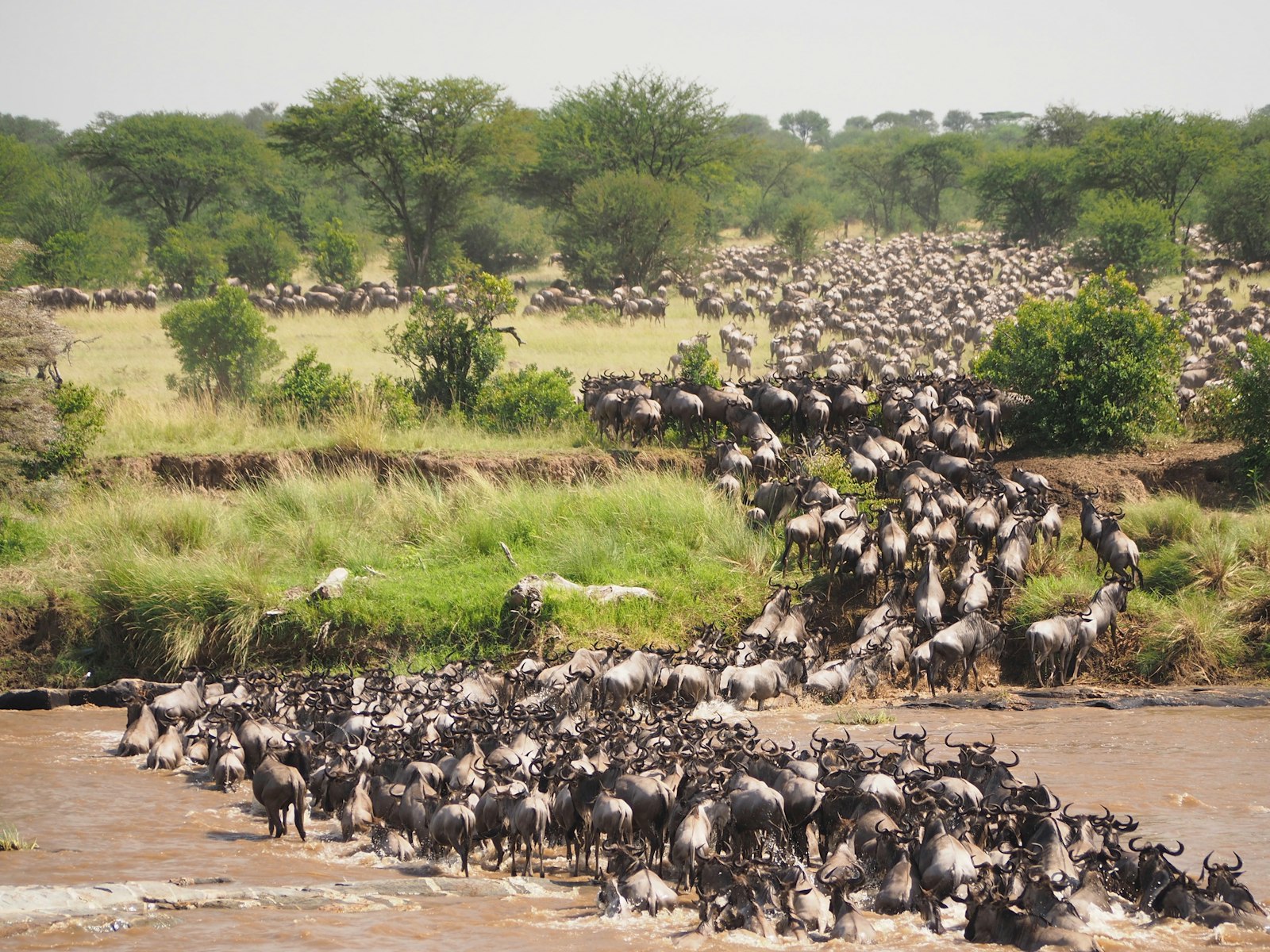
For much of the year, crocodiles in the Mara River live largely on fish. When the wildebeest and zebra arrive, usually from July to October, a short season of huge meals begins. Large crocodiles can then survive long periods between big feeds, which is why they can afford to wait so patiently at the crossing points.

Basking, Gaping and Social Rank
Much of the Nile crocodile behaviour you see on a game drive is not hunting at all. Crocodiles spend long periods basking on sandbanks to warm up, then slip back into the water to cool down. Many lie with their mouths wide open. This gaping helps them shed heat and is not a threat, although it makes for dramatic photos.
Watch a group for a while and you will notice the pecking order. The largest males hold the best basking spots and feeding positions, while smaller animals keep their distance. Head-slaps on the water, low rumbles and raised postures are part of how dominance is settled, usually without serious fights.
Nesting and parental care
Female Nile crocodiles dig nests in sandbanks and lay clutches of eggs, then guard them for roughly three months. Nest temperature decides whether the young become male or female. When the hatchlings call from inside the eggs, the mother digs them out and often carries them to the water in her mouth, a gentle side of Nile crocodile behaviour that surprises many visitors. Nile monitor lizards are among the main nest raiders, as explained in our monitor lizards of Kenya guide.
Mara River, Mzima Springs or Lake Turkana?
Each place shows a different side of Nile crocodile behaviour. Tell us your dates and travel style, and we will suggest where you will see crocodiles best, from easy game drives to a remote northern expedition.
Where to Watch Nile Crocodile Behaviour in Kenya
Nile crocodiles live in most of Kenya’s larger rivers and many lakes, but a few places make Nile crocodile behaviour easy to watch safely.
The Mara River, Masai Mara
The Mara River is the classic stage for Nile crocodile behaviour, with large crocodiles waiting at the crossing points for the herds. The Masai Mara is a national reserve run by Narok County, not KWS. Read our Mara River wildlife guide, and compare trips on our Masai Mara safari packages page.
Mzima Springs and the Galana River, Tsavo
At Mzima Springs in Tsavo West, an underwater viewing chamber lets you look into the clear pools where crocodiles and hippos live. In Tsavo East, crocodiles bask along the Galana River near Lugard Falls. Our Tsavo safari page explains both parks.
Lake Baringo, Samburu and Lake Turkana
Lake Baringo is known for crocodiles along its shores, best seen from a guided boat. In Samburu, they bask on the sandbanks of the Ewaso Ng’iro river. Lake Turkana and Central Island are for adventurous travellers on a custom northern trip.
Nile Crocodile Behaviour Compared by Site
This table compares the main places to see Nile crocodile behaviour in Kenya, and what each one shows you.
| Site | What you see | Best time | Effort |
|---|---|---|---|
| Mara River | Ambushes at crossings, group feeding | July to October | Easy on any Mara trip |
| Mzima Springs | Crocodiles in clear water | All year | Easy on a Tsavo trip |
| Galana River | Basking and gaping | Dry seasons | Easy on a Tsavo East trip |
| Lake Baringo | Crocodiles from a boat | All year | Moderate, Rift Valley detour |
| Lake Turkana | Large population, nesting areas | Calm, drier months | Expedition |
| Nairobi Snake Park | Captive crocodiles up close | All year | Very easy, in the city |
Reading Nile Crocodile Behaviour From the Vehicle
Good guides read Nile crocodile behaviour the way they read lion body language. A few simple signs help you understand what you are watching.
- Only eyes and nostrils showing: the crocodile is alert and may be hunting.
- Slide marks on a bank: fresh tracks show where crocodiles enter the water, often at crossing points.
- Mouth wide open on a sandbank: it is cooling down, not threatening you.
- Several crocodiles drifting towards one spot: they may have sensed a carcass or a coming crossing.
- Sudden stillness after movement: a crocodile freezing near the edge often means prey is close.
Once you know these signs, Nile crocodile behaviour becomes a story you can follow rather than a sudden blur, and the long waits at the river start to make sense.
Crocodile Safety on Safari
Nile crocodiles are genuinely dangerous to people, and most incidents in Africa involve local people collecting water, fishing or washing at the river’s edge. Visitors on a guided safari are at very low risk if they follow simple rules. Understanding Nile crocodile behaviour is the best protection: crocodiles strike from the edge of the water, so keeping your distance from that edge is what keeps you safe.
- Never swim, paddle or wade in Kenyan rivers or freshwater lakes unless your guide confirms it is safe.
- Stay well back from the water’s edge, especially at dawn and dusk, and never stand on low banks.
- Stay in the vehicle at river crossings; never get out to photograph crocodiles.
- On boat trips, keep hands and feet inside the boat and follow the crew’s instructions.
- At riverside camps, do not walk along the bank after dark.
Best Time to See Nile Crocodile Behaviour
You can see crocodiles all year, but the best Nile crocodile behaviour depends on the season.
- July to October: the Great Migration reaches the Mara, and crossings give the best chance of seeing ambushes and group feeding. Crossings are never guaranteed, so allow several days.
- January to March: dry and warm, with low rivers and crocodiles basking on exposed sandbanks.
- March to May and November: rains raise the rivers and crocodiles spend more time in the water, but parks are quieter.
For timing the herds, read our Great Migration 2027 guide.
What a Crocodile-Watching Safari Costs
No park charges extra for watching Nile crocodile behaviour, so your budget depends on where you go. Published starting prices on our site:
- Masai Mara entry: USD 100 per adult per day in low season and USD 200 in peak season, paid to Narok County.
- 3-Day Masai Mara Safari: from USD 650 per person; the Masai Mara & Lake Nakuru Camping Safari (4 days) starts from USD 750.
- Tsavo East & West Safari (3 days): from USD 600 per person, including Mzima Springs; see the Tsavo East and West itinerary.
- Nairobi National Museum & Snake Park Tour: from USD 70 per person; see the Nairobi museum tour.
Lake Turkana trips are planned individually because flights, boats and logistics vary, and we confirm current park fees in every written quote.
Planning Around the River Crossings?
Camps near the Mara River are popular in August and September, so it pays to ask early. Send your dates and we will reply with a written quote and honest advice on crossing season and Nile crocodile behaviour at the river.
Nile Crocodile Behaviour: Key Facts
- Bite force: estimated at around 22 kilonewtons for the very largest individuals, among the strongest bites of any living animal.
- Adult male size: typically 3.5-5 metres and 225-750kg; females are noticeably smaller.
- Largest recorded: rare giants over 6 metres have been reported, though some old records are hard to verify.
- Hunting strategy: ambush-based, lying concealed and motionless for extended periods before striking.
- Feeding technique: the “death roll”, a violent full-body spin used to tear apart large prey, often with several crocodiles at one carcass.
- Lifespan: commonly cited as 70 years or more; claims of 100 years are unproven.
- Lake Turkana: one of Kenya’s largest populations, commonly estimated at around 12,000 crocodiles.
- Conservation status: listed as Least Concern on the IUCN Red List, though local populations face habitat loss and conflict.
For species status, see the IUCN Red List; for park rules and fees, see the Kenya Wildlife Service; and for wider trip ideas, Magical Kenya.
Seeing Crocodiles With Real Context
Read our Mara River wildlife guide for crocodile viewing during Great Migration river crossings, and our Central Island National Park guide for Lake Turkana’s remote crocodile population.
Understanding Nile crocodile behaviour turns a quick photo stop into one of the best stories of your trip. A private Kenya safari gives you time to wait at the river, or browse every Kenya safari from Nairobi. Apply for your eTA only on the official Kenya eTA portal.
See the Ambush, Understand the Strike
From the Mara River crossings to the clear pools of Mzima Springs, we will plan a safari with guides who explain Nile crocodile behaviour as it happens, safely and in depth.
Frequently Asked Questions
How strong is a Nile crocodile’s bite?
Scientists have estimated that the very largest Nile crocodiles could bite with a force of around 22 kilonewtons, among the strongest of any living animal. That figure is an estimate for big individuals rather than a typical measurement, but even an average adult has a bite that can easily hold large prey such as wildebeest.
What is a crocodile “death roll”?
The death roll is a violent full-body spin that Nile crocodiles use to tear apart prey too large to swallow whole, because their jaws grip but cannot chew. Several crocodiles often feed on one carcass, and one may hold it while another rolls, which gives each of them extra leverage.
How big do Nile crocodiles get?
Adult male Nile crocodiles typically reach 3.5 to 5 metres and 225 to 750 kg, while females are noticeably smaller. Rare giants over 6 metres have been reported, though some old records are hard to verify. The biggest crocodiles you see in the Mara River are usually dominant males.
Where is Kenya’s largest Nile crocodile population?
Lake Turkana in the remote north holds one of Kenya’s largest Nile crocodile populations, commonly estimated at around 12,000 animals, with an important breeding area on Central Island. For most visitors, the Mara River, Tsavo and Lake Baringo are far easier places to watch crocodiles.
How long do Nile crocodiles live?
Nile crocodiles are long-lived, and a lifespan of 70 years or more is commonly cited for the oldest individuals. Claims that they reach 100 years are unproven. In the wild, many die much younger, and hatchlings face very high losses to birds, fish, monitor lizards and other crocodiles.
When is the best time to see Nile crocodile behaviour in Kenya?
July to October is best for dramatic Nile crocodile behaviour, when the Great Migration crosses the Mara River and crocodiles ambush the herds. Crossings are never guaranteed. In the dry months of January to March, crocodiles bask on exposed sandbanks and are easy to see in many parks.
Is it safe to see crocodiles on a Kenya safari?
Yes, if you follow your guide. Watch from the vehicle or a viewing point, never swim in rivers or freshwater lakes, and stay well back from the water’s edge. Most crocodile incidents involve people working at the river, not visitors on guided game drives or boat trips.