
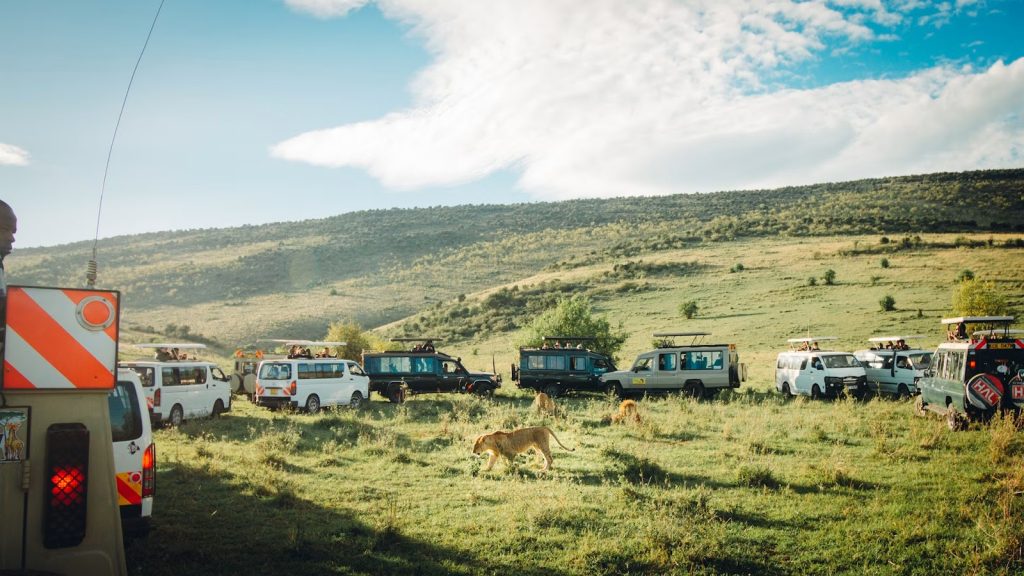
The vehicle you spend your game drives in shapes the whole safari, and Kenya has settled firmly on one standard: the 4×4 Toyota Land Cruiser with a pop-up roof. The typical configuration seats six passengers plus a driver-guide, with every seat positioned at a window rather than in a middle row with a restricted view — a deliberate design choice, not an accident. The signature feature is the pop-up roof itself: a hinged panel that lifts so passengers can stand and look out with an unobstructed 360-degree view, transforming a standard drive into genuine open-air wildlife viewing the moment something worth stopping for appears. Picture standing through the roof hatch as a herd crosses ahead, rather than pressing against a closed window from a seated position. Sense of Adventure uses properly equipped Land Cruisers on every game drive.
Ride in a Properly Equipped Vehicle
Message us — every Sense of Adventure game drive uses a genuine 4×4 pop-up-roof Land Cruiser.
Why the Land Cruiser Became the Standard
The Toyota Land Cruiser Hardtop, typically the 75 or 78 model, dominates Kenya’s safari vehicle fleet because it handles rough terrain that would genuinely trouble a standard minivan — the C12 road into the Masai Mara and the volcanic dust of Amboseli both favour the Land Cruiser’s 4×4 capability over lighter alternatives. Standard configuration seats six passengers plus the driver, arranged so every single seat has direct window access (two behind the driver, two in the middle row, two at the back) rather than compromising some passengers with a central, obstructed view — a shorter “shortie” chassis variant exists too, seating 3-4 for smaller groups. The pop-up roof is the feature that actually changes the safari experience: a hinged panel lifting to let passengers stand and observe with an unobstructed 360-degree field of view, alongside winding side windows for closed-roof driving between sightings. Most vehicles also include a front roof hatch for additional unobstructed viewing angles, and private safari vehicles — booked exclusively for one group rather than shared — add genuine flexibility over shared-vehicle logistics.
We’d assumed “safari vehicle” just meant any 4×4 until our guide popped the roof for the first time and suddenly we were standing, fully unobstructed, watching a pride of lions instead of peering through a window — that single feature changed how every sighting felt for the rest of the trip.
— Sense of Adventure guest, Masai Mara safari
What a Proper Safari Vehicle Includes
The Pop-Up Roof — The Feature That Matters Most — 360-degree standing views the moment you need them
A hinged roof panel that lifts open, letting passengers stand and observe with a completely unobstructed field of view — the single biggest difference between a real safari vehicle and a standard car.
Window Seats for Everyone — no compromised middle-row views
The standard 6-passenger Land Cruiser layout is specifically designed so every seat has direct window access, not just the ones on the outer edges.
Genuine 4×4 Off-Road Capability — built for the C12 road, Amboseli dust and worse
Kenya’s rougher park roads and off-track game-viewing terrain genuinely require 4×4 capability — this isn’t a marketing feature, it’s what actually gets you to the sighting.
Private vs Shared Vehicles — exclusive booking for your group only, if wanted
A private vehicle, booked solely for your party rather than shared with other travellers, offers more flexibility on timing, stops and pace. See our walking safari alternatives guide if you want to get out of the vehicle entirely on part of your trip.
Every Game Drive, Properly Equipped
Message us to book a safari with genuine 4×4 pop-up-roof vehicles throughout.
Kenya Safari Vehicle Facts
- Standard vehicle: Toyota Land Cruiser Hardtop, typically the 75 or 78 model.
- Standard capacity: 6 passengers plus the driver, with every seat at a window.
- Shorter variant: a “shortie” chassis seating 3-4, used for smaller groups.
- Pop-up roof: a hinged panel lifting to allow standing, unobstructed 360-degree viewing.
- Why 4×4 matters: roads like the C12 into the Masai Mara and Amboseli’s volcanic dust genuinely require off-road capability.
- Private vs shared: private vehicles offer more scheduling flexibility, booked exclusively for one group rather than shared.
Planning a Well-Equipped Kenya Safari
Read our self-drive vs guided safari guide for a related decision, and our Kenya safari checklist for what to pack alongside your vehicle setup.
The Right Vehicle for Real Game Viewing
Message us to book a Kenya safari with properly equipped 4×4 vehicles throughout.
Frequently Asked Questions
What vehicle is used on safari in Kenya?
The standard safari vehicle in Kenya is a 4×4 Toyota Land Cruiser Hardtop with a pop-up roof, typically seating six passengers plus the driver, with every seat positioned at a window.
What is a pop-up roof on a safari vehicle?
A pop-up roof is a hinged panel that lifts open, allowing passengers to stand and view wildlife with an unobstructed 360-degree field of view — it’s the single most important feature distinguishing a real safari vehicle from a standard car.
Why are Land Cruisers used instead of vans?
Land Cruisers offer genuine 4×4 off-road capability that Kenya’s rougher park roads and off-track terrain require, handling routes like the C12 road into the Masai Mara and Amboseli’s volcanic dust better than a standard minivan.
How many people fit in a standard safari vehicle?
The standard Land Cruiser configuration seats six passengers plus the driver, with a shorter “shortie” chassis variant available seating 3-4 for smaller groups.
Should I book a private safari vehicle?
A private vehicle, reserved exclusively for your group rather than shared with other travellers, offers more flexibility on timing, stops and pace — worth considering if scheduling control matters to your trip.