
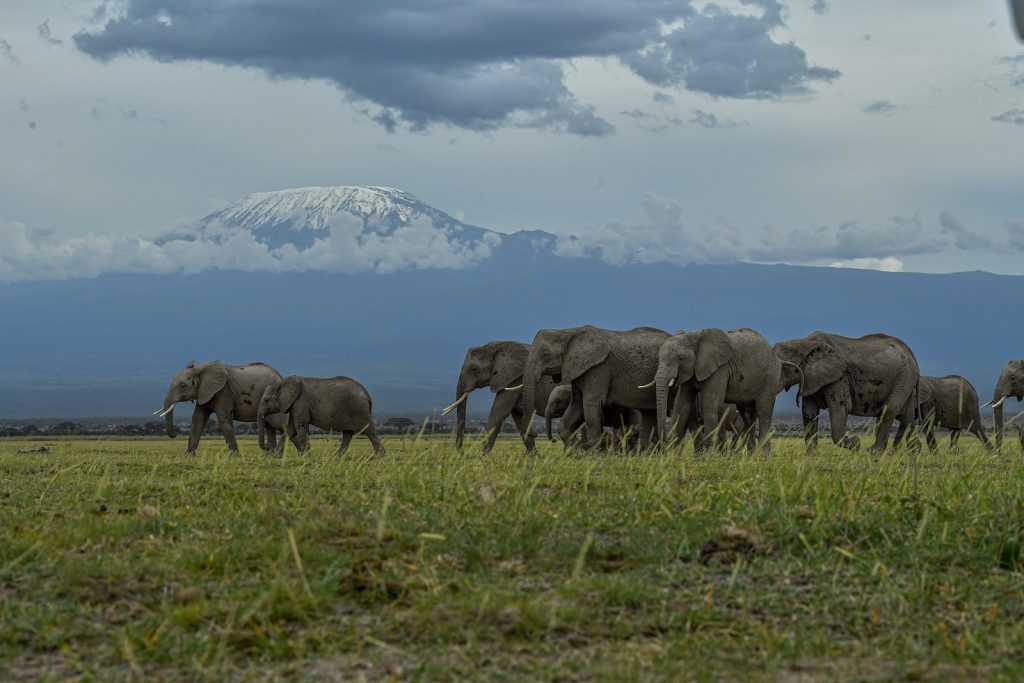
Amboseli elephants are the most studied, most photographed and arguably the most impressive on earth. Nowhere else can you watch hundred-strong herds wade chest-deep through papyrus swamps while Kilimanjaro floats above them — and nowhere else are the elephants themselves so well known. Every one of the ecosystem’s 1,900-plus elephants is identified by researchers who have tracked their families continuously since 1972, the longest elephant study in history. This is the land of Echo, the world’s most famous matriarch, and of bulls carrying tusks that brush the ground. Sense of Adventure has been bringing guests to these giants for years, and the awe never wears off.
Meet the World’s Most Famous Elephants
Swamp crossings at midday, Kilimanjaro backdrops at dawn — we plan Amboseli days around the herds’ own timetable.
Why Amboseli Elephants Are Unlike Any Others
Amboseli’s magic is hydrological: meltwater and rain from Kilimanjaro travel underground for decades before surfacing in the park as permanent swamps — Enkongo Narok, Longinye and Olokenya. Those swamps kept Amboseli’s elephants alive through droughts and, crucially, the population escaped the worst of the 1970s-80s poaching, so its bulls survived long enough to grow enormous tusks and its families kept their matriarchal knowledge intact. The result is a rare window on undisturbed elephant society: stable families, four generations walking together, and bulls in their fifties carrying ivory almost nobody alive has seen elsewhere.

At eleven o’clock the herds started streaming from the woodlands toward the swamp — we counted over eighty elephants in one line, babies swinging trunks, Kilimanjaro behind. Our guide called individual families by name. I cried behind my camera. Worth the whole trip.
— Sense of Adventure guest, Amboseli photographic safari
The 5 Essential Amboseli Elephant Experiences
The Midday Swamp March — Amboseli’s daily parade
Late morning, family after family leaves the dry woodlands and files across open pans toward the central swamps — often merging into processions a hundred strong. They spend the heat of the day chest-deep in green water, eating and spraying. It is the most predictable great elephant spectacle in Africa, and your vehicle can be waiting right along the route.
A Big Tusker at Close Range — ivory from another century
Amboseli is one of the last places on earth with “hundred-pounder” class bulls — tusks so long they sweep the dust. Meeting one calmly feeding beside the track rearranges your understanding of what elephants are supposed to look like. Guides know each great bull by name and range, and finding one is always the day’s quiet mission.
Kilimanjaro Backdrops at Dawn — the photograph that made Amboseli famous
The classic frame — elephants crossing dusty flats beneath the snows of Kilimanjaro — happens in the first two hours of light, before cloud wraps the summit. We position on the pans south of the swamps, mountain behind, herds ahead. When the line of grey crosses the frame, you take the picture every wildlife photographer owns a version of.
The Research Families — elephants with biographies
Since 1972 the Amboseli Trust for Elephants has identified every individual — over 3,500 elephants across five decades — from Echo, star of BBC documentaries, to today’s matriarchs. Guides share the family histories at sightings: which grandmother led the drought exodus, which calf was born to which daughter. It turns watching into storytelling.
Dust-Bath Theatre — grey giants, red powder
After the swamp soak comes the powder room: Amboseli’s alkaline dust flung over wet skin in silver-grey clouds. Backlit at 5 pm it is the most photogenic behaviour in the park — calves practising with hopeless aim, matriarchs disappearing in their own storms. Position west of a dusting herd and shoot into the light.
Photograph Elephants Under Kilimanjaro
Dawn positions, midday swamp crossings, dust baths at golden hour — see our dedicated Amboseli elephant photographic safari.
Amboseli Elephant Facts
- Population: about 1,900 elephants use the ecosystem — every single one individually known to researchers.
- The study: the Amboseli Elephant Research Project has run continuously since 1972 — the longest-running elephant study anywhere.
- Echo: the matriarch Echo, followed for 36 years until 2009, became the most famous wild elephant in the world.
- Water engine: Kilimanjaro’s underground meltwater feeds the permanent swamps that make the daily marches possible.
- Survivors: Amboseli largely escaped the poaching holocaust — which is why its bulls still carry near-ground-length tusks.
- Timing: herds move woodland-to-swamp late morning and back toward evening; dawn and dusk deliver the Kilimanjaro backdrops.
Planning Your Amboseli Elephant Safari
Dedicated photographers should take the 4-day Amboseli Elephant Photographic Safari; time-short travellers can meet the herds on an Amboseli day safari from Nairobi. Our full Amboseli safari guide covers logistics and lodges, and the Masai Mara elephants guide makes a fine comparison read.
The Herds March Daily — Join Them
Amboseli is a 4-hour drive or 40-minute flight from Nairobi. Message us and you could be watching the swamp parade this week.
Frequently Asked Questions
Why is Amboseli famous for elephants?
Amboseli is famous for elephants because its 1,900-strong population is the world’s most studied — every individual known since 1972 — and because it escaped heavy poaching, so its bulls grew some of Africa’s biggest tusks. Daily herd marches to Kilimanjaro-fed swamps complete the spectacle.
How many elephants live in Amboseli?
The Amboseli ecosystem supports roughly 1,900 elephants, tracked individually by the Amboseli Trust for Elephants. Over 3,500 individuals have been identified across five decades of continuous research — the longest-running elephant study in the world.
Who was Echo the Amboseli elephant?
Echo was Amboseli’s most famous matriarch, followed by researcher Cynthia Moss for 36 years and starring in multiple BBC documentaries. She led the EB family through droughts and births until her death in 2009; her daughters and granddaughters still walk Amboseli today.
When is the best time to see Amboseli’s elephants?
Amboseli elephants perform daily year-round: dawn for Kilimanjaro-backdrop crossings, late morning for the spectacular swamp marches, and late afternoon for dust baths. For clear mountain views, June-October and January-February mornings are most reliable.
Are there still big tuskers in Amboseli?
Yes — Amboseli remains one of the last strongholds of Africa’s giant tuskers, bulls whose tusks approach or exceed 45 kg a side and nearly touch the ground. Researchers and guides monitor each great bull closely, and sightings are a realistic hope on any multi-day visit.