Masai Mara gates decide more about your safari than most first-timers realise. Choose the wrong entry for your camp’s location and you can add three hours of rough track to an already long drive from Nairobi; choose right and you roll from the gate into game viewing within minutes.
The reserve has six main entry points — Sekenani, Talek, Oloolaimutia, Musiara, Ololoolo and Sand River — each serving different camps, airstrips and corners of the 1,510 km² reserve. This guide maps the Masai Mara gates plainly, with road routes, airstrips, opening hours, fees and which gate suits which camp. Book with Sense of Adventure and the routing maths is done for you, gate fees and all.
✅ Masai Mara Gates Quick Answer
- Main gate: Sekenani, about 5 to 6 hours by road from Nairobi via Narok, serving the eastern camps.
- Six main gates: Sekenani, Talek, Oloolaimutia, Musiara, Ololoolo (for the Mara Triangle) and Sand River.
- Hours: gates open at about 6:00 am and close at around 6:30 to 7:00 pm; no driving in the reserve after dark.
- Golden rule: choose your camp first and let the camp decide the gate.
- From: our 3-Day Masai Mara Safari starts at USD 650 per person with transport, park fees and camp included.
Skip the Routing Homework
Tell us your dates and comfort level — we match camp, gate and transport so the journey is part of the holiday.
The Masai Mara’s Gates, Mapped Simply
Think of the reserve as a rough triangle. The eastern side, closest to Nairobi, holds the busiest gates: Sekenani (the main gate, end of the tarmac-then-murram B3/C12 route, 5-6 hours from Nairobi), with Talek and Oloolaimutia nearby serving the camp clusters along the Talek river and eastern boundary. The northern point is Musiara gate, handy for the marsh area and Governors’ camps.
The western side across the Oloololo escarpment is reached through Ololoolo gate, serving the quieter Mara Triangle. Finally Sand River gate sits on the southern Tanzania border near the Serengeti line. Each of the Masai Mara gates has a ranger post that checks tickets and collects park fees.
Masai Mara Gates at a Glance
Use this table to match the Masai Mara gates to the area you want to explore. Road times are typical in dry weather and can be longer after rain.
| Gate | Side of reserve | Best for |
|---|---|---|
| Sekenani | East | Main road entry from Nairobi and the eastern camps |
| Talek | North-east | Camps along the Talek river and the central plains |
| Oloolaimutia | East | Eastern-corner lodges and quieter hilly country |
| Musiara | North | Musiara marsh, Mara River camps and northern conservancies |
| Ololoolo | West | The Mara Triangle and the escarpment camps |
| Sand River | South | Southern plains on the Tanzania border |
The 6 Masai Mara Gates and Who Should Use Each
Sekenani Gate — the main door, first tarmac choice
The principal of the Masai Mara gates, at the end of the Narok route, serving the big cluster of camps along the eastern boundary and the central plains. If your camp is unspecified or central-east, this is your default. Expect the most traffic at 6-6:30 am opening — worth it, because you are into cat country within minutes of the barrier.
Talek Gate — for the Talek river camp cluster
Dozens of mid-range and budget camps line the Talek river outside the reserve, and this gate drops them straight into the predator-rich central plains. The Narok-Talek road is rough murram, so allow extra time. For value safaris this gate is the workhorse — and dawn entries here reach the famous crossing points efficiently in season.
Oloolaimutia Gate — the eastern corner and budget lodges
Serving Mara Sopa and the eastern-corner lodges, Oloolaimutia connects via Narok or the longer Ewaso Ngiro route. The hilly country inside this gate is scenic and quieter than the central plains. Combine entry here with an exit at Sekenani or Talek for a satisfying loop of the eastern reserve.
Musiara Gate — marsh country and the north
The northern gate beside the famous Musiara marsh — elephant and lion country made famous by decades of documentaries. It serves Governors’, Mara River camps and the northern conservancy crowd. Fly-in guests landing at Musiara airstrip effectively start their safari here, minutes from the marsh.
Ololoolo Gate — the Mara Triangle’s quiet door
Across the reserve on the western escarpment, Ololoolo opens into the Mara Triangle — the best-maintained roads and lowest vehicle density in the ecosystem. Reached via the longer Lemek-Aitong route or Kichwa Tembo airstrip. If crowds are your allergy, enter here and you may share a lion with nobody at all.
Sand River Gate — the Serengeti border post
Tucked on the southern boundary where the Sand River meets Tanzania, this quiet gate serves Sand River camps and the southern plains. Tourists cannot drive across into the Serengeti here — road crossings for visitors happen at official border posts such as Isebania, or travellers connect by air — but the southern plains it opens are gloriously empty.
Fly or Drive — We’ll Route It Right
Road safari with buffer time, or a short flight to the right airstrip? Get a routing that matches your camp and budget.
Gate Practicalities Worth Knowing
- Hours: gates operate roughly 6:00 am to 6:30-7:00 pm — no entry or exit after dark, so time your arrival with margin.
- Fees: non-resident reserve fees are charged per 24 hours and are payable at the gate or pre-arranged by your operator; carry your passport.
- Road time: Nairobi to Sekenani runs 5-6 hours; Talek and Oloolaimutia add rough-road time; the Triangle via Ololoolo is longest by road.
- Fly-in option: daily flights of about 45 to 60 minutes from Nairobi Wilson serve airstrips such as Keekorok, Ol Kiombo, Musiara and Kichwa Tembo — each aligned to specific gates and camps.
- Border note: tourists cannot drive into the Serengeti at Sand River; cross-country itineraries route via an official border post such as Isebania, or fly.
- Rule of thumb: book camp first, then let the camp dictate which of the Masai Mara gates you use — never the reverse.
Paying Fees at the Masai Mara Gates
The Masai Mara National Reserve is run by county authorities rather than the Kenya Wildlife Service, with the Mara Triangle managed separately on the western side. Fees are charged per person for each 24-hour period, and rates differ for non-residents, residents and citizens, and by season. Rates are reviewed from time to time, so always check the current figures before you travel.
At the Masai Mara gates, rangers check passports, count passengers and confirm how long you are staying. Payment is increasingly electronic, so do not rely on cash. On a booked safari, your operator normally pays in advance and carries the receipts, which keeps the stop quick. For current park and conservancy charges, see our guide to Kenya park fees for 2026 and conservancy fees in Kenya.
How 24-hour fee periods work at the Masai Mara gates
Your ticket is timed from the moment you enter. If you arrive at 2:00 pm, your first 24 hours run until 2:00 pm the next day. This is why a well-planned itinerary times its entry and exit carefully, so you do not pay for an extra day you barely use. If you stay outside the reserve, every re-entry within your paid period is normally covered.
Road Routes to the Masai Mara Gates
Most road safaris leave Nairobi early, drop down into the Great Rift Valley with a stop at the viewpoint, and continue to Narok, the last big town for fuel and supplies. From Narok, the route divides depending on which of the Masai Mara gates you need.
Nairobi to Sekenani, Talek and Oloolaimutia
The quickest road route runs from Narok to Sekenani, and from there tracks lead on to Talek and Oloolaimutia. This is the standard route for most road safaris and takes about five to six hours in total from Nairobi. The last section can be rough, especially after rain, so a 4×4 vehicle is the comfortable choice.
Nairobi to Musiara and the northern conservancies
For the north, the usual route heads west from Narok through Lemek and Aitong towards Musiara gate and the conservancies along the northern boundary. The drive is longer and slower than the Sekenani road, so many guests heading to the north choose to fly instead.
Reaching Ololoolo and the Mara Triangle
The Mara Triangle sits on the far side of the Mara River, below the Oloololo escarpment. By road it is the longest journey from Nairobi, so most Triangle guests fly to the Kichwa Tembo or Serena airstrips. Road safaris can also cross from the Narok side over the bridge at Purungat, near the Mara Bridge in the south, if the itinerary includes both sides.
Flying In: Airstrips and the Nearest Masai Mara Gates
Scheduled light aircraft fly from Nairobi’s Wilson Airport to several airstrips in and around the reserve, and your guide meets you on landing. Some airstrips, such as Keekorok and Ol Kiombo, are inside the reserve, so your fees apply from the moment you land. Others, such as Musiara and Kichwa Tembo, sit close to specific Masai Mara gates. Flights carry a soft-bag luggage limit of about 15 kg. Read our Masai Mara airstrips guide for details on each one.

Reserve Rules That Start at the Gate
Once you pass any of the Masai Mara gates, the reserve’s rules apply. Your guide will follow them, but knowing them helps you understand why sightings are managed the way they are.
- Stay on the tracks: off-road driving is not allowed in the reserve, except where specific rules permit it.
- Stay in the vehicle: you may only get out at designated points, such as picnic sites or ranger-guided spots.
- Respect the animals: keep a safe distance, keep noise down and never feed wildlife.
- No night driving: vehicles must leave the reserve or be back at camp before the gates close.
- No drones: flying drones in Kenya’s parks and reserves requires special permits, so leave yours at home.
Best Time to Arrive at the Masai Mara Gates
Timing your arrival makes a real difference. Leave Nairobi by 7:00 am and you should reach the Masai Mara gates by early afternoon, with time for lunch at camp and an afternoon game drive. A late start risks arriving close to closing time, with little time for wildlife on your first day.
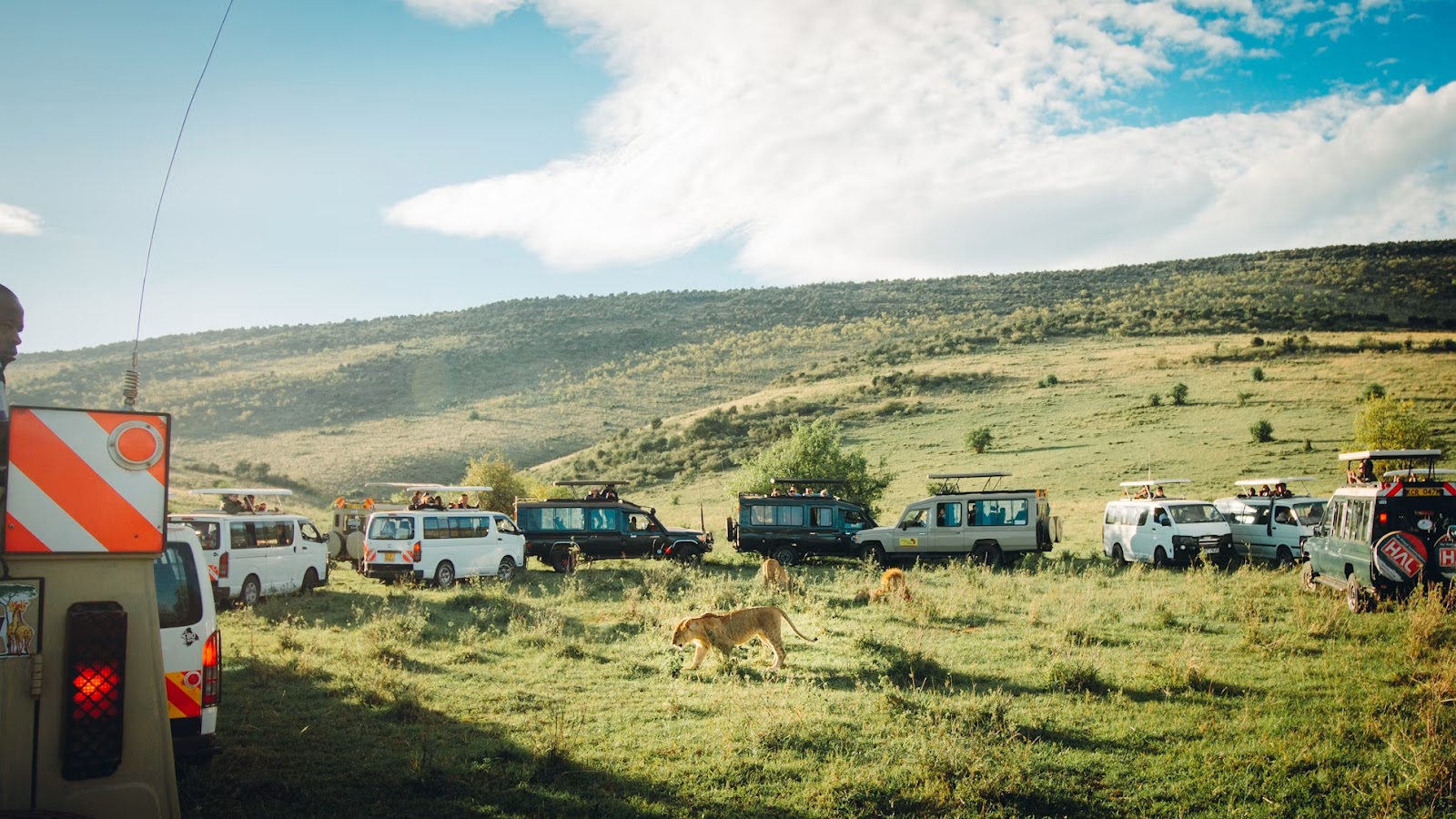
From July to October, the migration season, queues at the busiest Masai Mara gates are longer, especially at opening time. In the long rains of April and May, and sometimes in November, rough tracks near the gates can turn to mud. Our guides check road conditions daily. See our guide to the best time to visit the Masai Mara for the full seasonal picture.
Which Masai Mara Gate Suits Your Safari?
Rather than choosing a gate first, think about the kind of safari you want. These are the patterns we see most often among our guests:
- Short road safari on a budget: Sekenani or Talek, with a camp just outside the reserve boundary.
- Migration river crossings: camps near the Mara River, reached via Talek, Musiara or Ololoolo depending on the camp.
- Quiet game viewing: Ololoolo for the Mara Triangle, or a camp in the northern conservancies near Musiara.
- Families with young children: a fly-in arrival or the shortest road route to Sekenani, to keep travel time down.
- Luxury fly-in: the airstrip closest to your camp, with no long road transfer at all.
If you are torn between staying inside the reserve or in a conservancy, read our comparison of the reserve and the conservancies.
Putting Gates, Camps and Routes Together
Choosing between the Masai Mara gates flows from your itinerary. Our Masai Mara from Nairobi guide covers the road and air options in detail, the camps and lodges guide maps accommodation to reserve areas, and our 3-day Mara package handles the whole equation — transport, gate fees and camp — in one price.
Masai Mara Safari Costs and Packages
Every package below includes transport, a driver-guide, accommodation, park fees and game drives, so the Masai Mara gates are simply a stop on the way in. Prices are starting prices per person and depend on season, group size and camp:
- Masai Mara & Lake Nakuru Camping Safari (4 Days) — from USD 590 per person.
- 3-Day Masai Mara Safari — from USD 650 per person.
- Great Migration Safari – Masai Mara (5 Days) — from USD 1,450 per person, timed for July to October.
- Fly-in Masai Mara Luxury Safari (4 Days) — from USD 3,200 per person.
Compare every option on our Masai Mara safari packages page. For your own vehicle and flexible timings, see our private Kenya safari trips, or start with our guide to a Kenya safari from Nairobi.
Plan Your Trip to Kenya
Most visitors need a Kenya eTA from the official eTA Kenya portal. UK travellers should check the latest GOV.UK travel advice for Kenya, and you can find more about the reserve and other parks on Magical Kenya.
The Right Gate Saves Half a Day
Tell us where you dream of staying and we’ll handle every kilometre in between.
Frequently Asked Questions
How many gates does the Masai Mara have?
The Masai Mara National Reserve has six main entry gates: Sekenani (the principal gate), Talek, Oloolaimutia and Musiara on the eastern and northern sides, Ololoolo serving the Mara Triangle in the west, and Sand River on the southern Tanzania border.
Which is the main gate into the Masai Mara?
Sekenani Gate is the Masai Mara’s main entrance, reached from Nairobi via Narok in roughly 5-6 hours. It serves the large cluster of camps along the eastern boundary and opens directly into the reserve’s central game-viewing circuits.
What time do Masai Mara gates open and close?
Masai Mara gates generally open about 6:00 am and close between 6:30 and 7:00 pm. Vehicles cannot enter or leave the reserve after dark, so road arrivals from Nairobi should depart early and build in buffer time for the rough final stretch.
Which Masai Mara gate is best for the Mara Triangle?
Ololoolo Gate, below the Oloololo escarpment on the western side, is the entry for the Mara Triangle — the quietest, best-maintained third of the reserve. Most Triangle guests fly into Kichwa Tembo airstrip or take the longer road route via Lemek and Aitong.
Can you drive from the Masai Mara into the Serengeti?
Not directly for tourists. The Sand River gate sits on the Tanzania border, but visitors cannot drive across into the Serengeti there. Combined Masai Mara-Serengeti itineraries cross by road at an official border post such as Isebania or connect by scheduled flights.
Do I need my passport at the Masai Mara gates?
Yes. Rangers at the Masai Mara gates check passports to confirm whether you pay non-resident, resident or citizen rates, so keep yours with you rather than packed deep in a bag. On a booked safari your guide handles the paperwork and payment, and the stop usually takes only a few minutes.
Can I pay cash at the Masai Mara gates?
Do not rely on it. Payment at the Masai Mara gates is increasingly electronic, and arrangements change from time to time. If you are on a booked safari, your operator normally pays the fees in advance. Independent travellers should check the current payment methods before setting off from Nairobi or Narok.
Which Masai Mara gate is closest to Nairobi?
Sekenani is the closest of the Masai Mara gates to Nairobi by road, at about five to six hours via Narok. Talek and Oloolaimutia are close by but add some time on rough tracks. Musiara and Ololoolo, in the north and west, take longer by road, so many guests fly instead.