
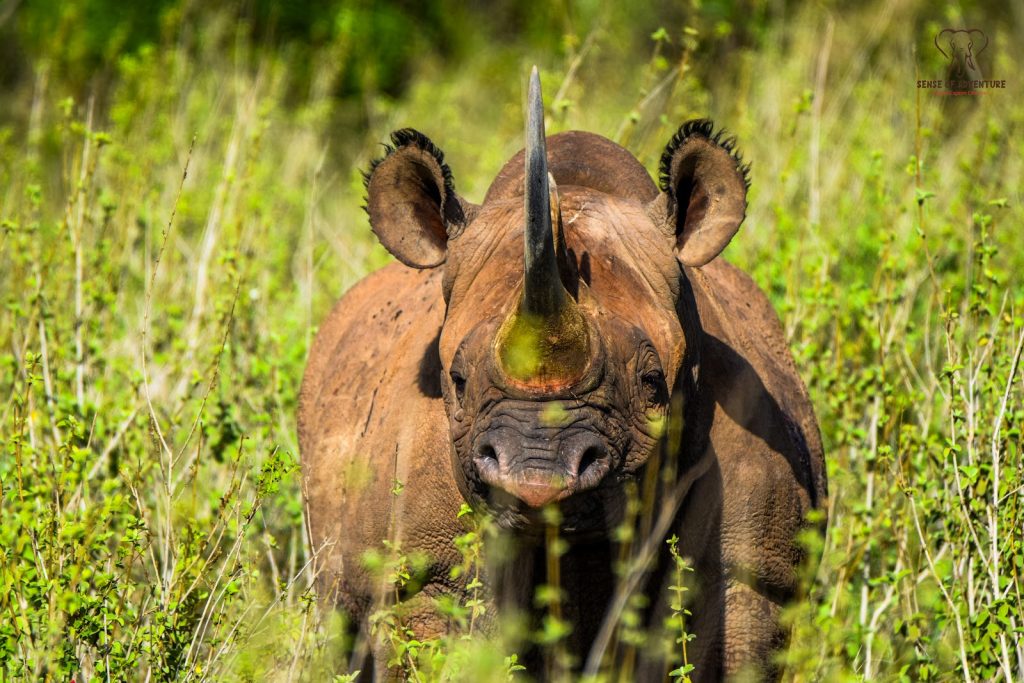
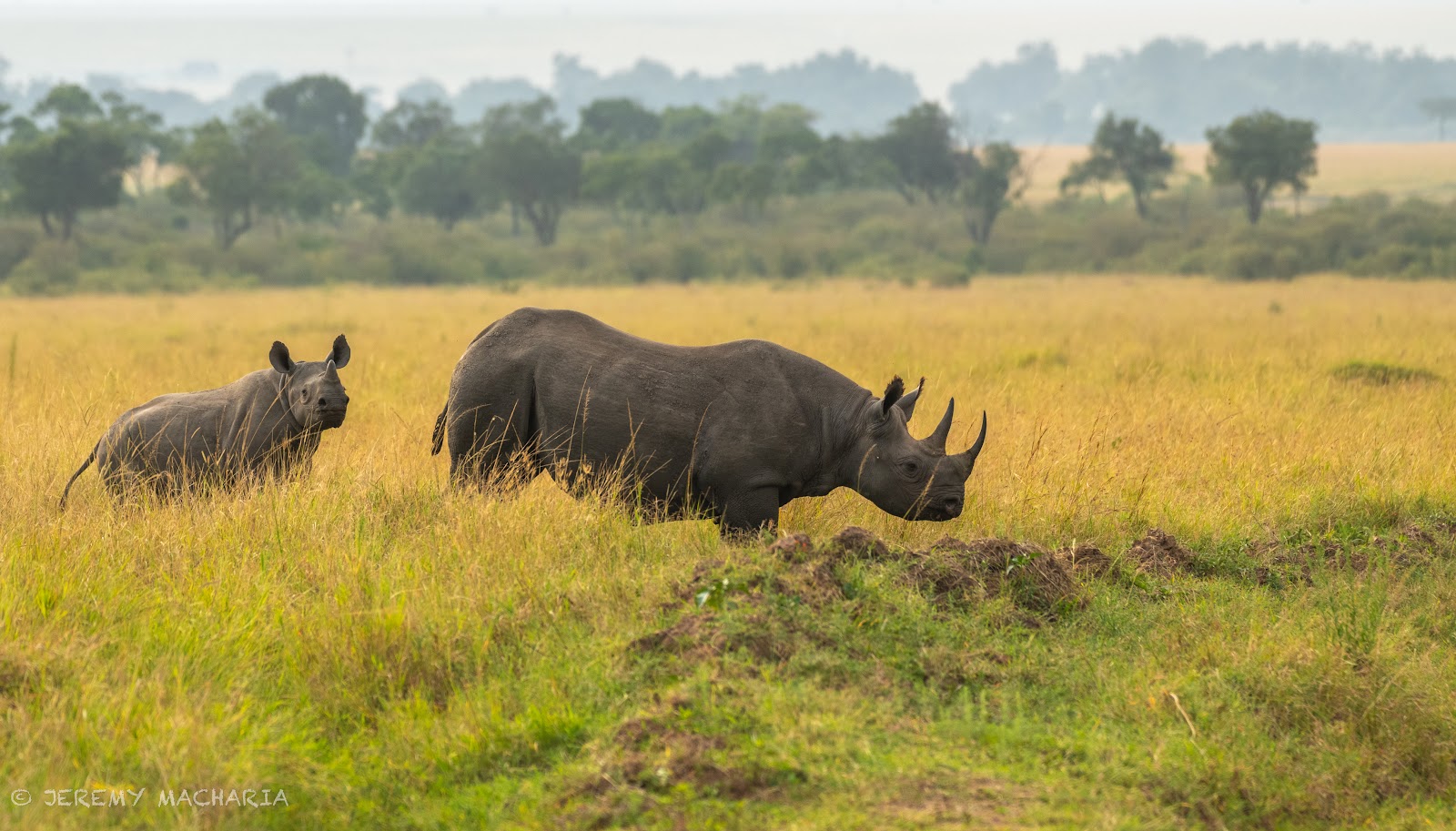
White rhino and black rhino are both grey, so colour tells you nothing. The quickest clue is the mouth: a white rhino has a wide, square lip for grazing grass, while a black rhino has a pointed, hooked lip for browsing leaves. White rhinos are also larger, more social and carry their heads low.
Sense of Adventure is a TRA-licensed private safari company based at Mountain Mall on Thika Road, Nairobi. We take guests to Kenya’s rhino sanctuaries throughout the year. This guide explains the black rhino vs white rhino differences you can actually see from a vehicle, the story behind the names, and the places where you can watch both species on one trip.
Black rhino vs white rhino: the quick answer
- Lip: white rhino wide and square; black rhino pointed and hooked.
- Diet: white rhino grazes grass; black rhino browses shrubs and trees.
- Size: the grazing species is the larger of the two.
- Behaviour: white rhinos are calmer and often in groups; black rhinos are solitary and more nervous.
- Where in Kenya: Ol Pejeta, Lewa, Lake Nakuru and Solio hold both.
Want to see both rhino species on one trip? Tell us your dates and we will plan the right sanctuaries.
Plan my rhino safariHow to Tell a White Rhino From a Black Rhino
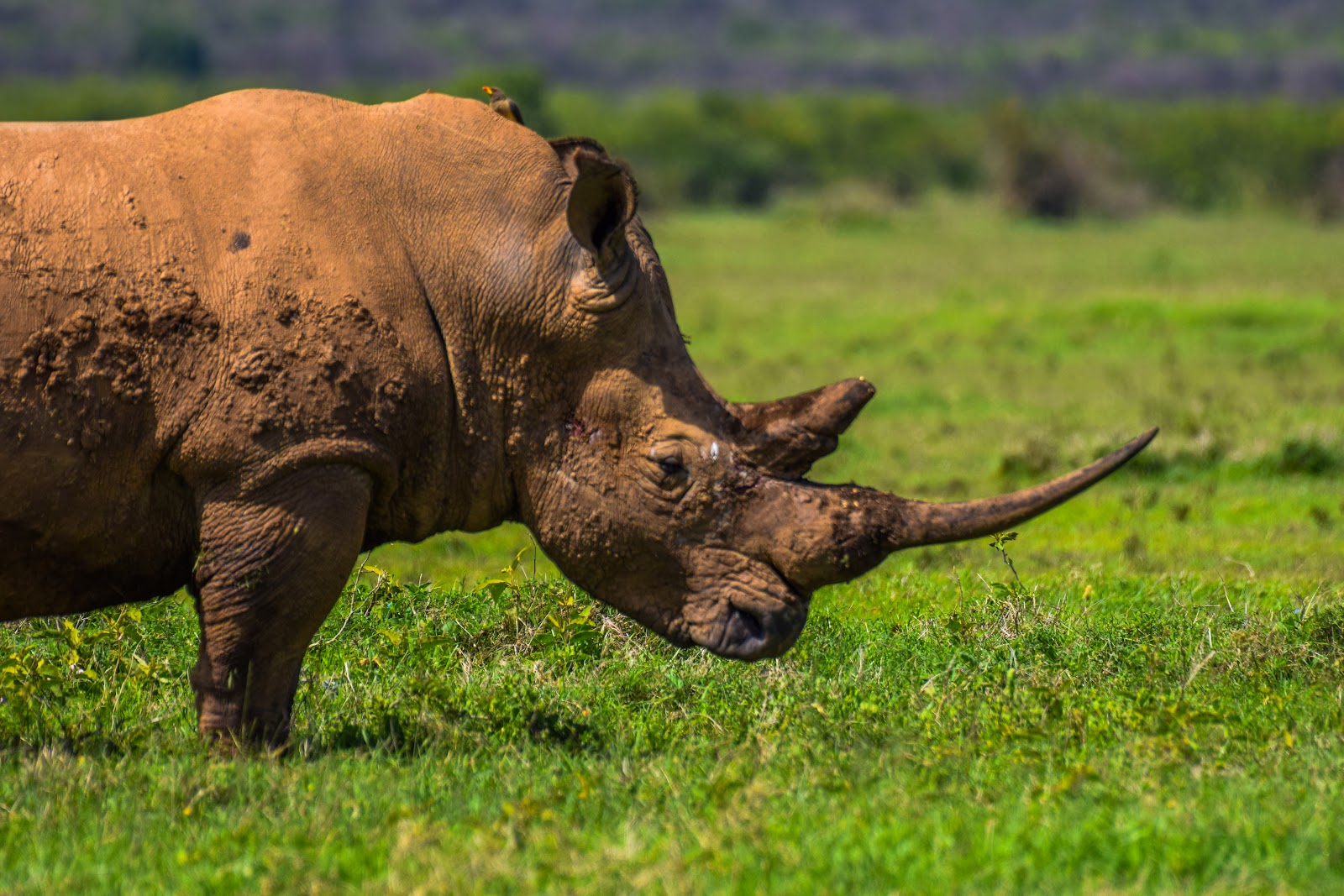
Look at the mouth and the way the head is held: those two clues identify either species in seconds.
A white rhino has a broad, flat, square upper lip. It spends much of the day with its head close to the ground, cropping short grass. A black rhino has a narrow, pointed upper lip that can wrap around twigs. It usually holds its head higher, browsing shrubs and low trees. Once you know these clues, the names stop being confusing.
Other Clues From the Vehicle
- Head shape: the grazer has a long head and a pronounced hump on the neck.
- Ears: the grazer’s ears are more tubular; the browser’s are rounder.
- Calves: a grazing rhino’s calf often walks in front of its mother; a black rhino calf usually follows behind.
- Habitat: white rhinos like open grassland; black rhinos prefer thick bush.
- Groups: seeing several rhinos together usually means white rhinos.
Black Rhino vs White Rhino at a Glance
This table compares the two species side by side, using ranges from conservation bodies rather than single headline figures.
| Feature | White rhino | Black rhino |
|---|---|---|
| Scientific name | Ceratotherium simum | Diceros bicornis |
| Lip | Wide and square | Pointed and hooked |
| Diet | Grazer (grass) | Browser (leaves, twigs, shrubs) |
| Typical adult weight | Roughly 1,800 to 2,500 kg | Roughly 800 to 1,400 kg |
| Head carriage | Low, near the ground | Higher, at shrub level |
| Social life | Often in small groups | Mostly solitary |
| Temperament | Usually calmer | Nervous, quicker to charge |
| IUCN status | Near Threatened (southern) | Critically Endangered |
| Native to Kenya? | Southern white rhinos were introduced | Yes, the eastern black rhino |
Weights and statuses come from the International Rhino Foundation and the IUCN Red List. Individual animals vary, and assessments are updated over time.
Why Is It Called a White Rhino if It Is Grey?
Nobody knows for certain why the white rhino got its name, and the popular explanation may be a myth.
You will often hear that “white” is a mistranslation of a Dutch or Afrikaans word meaning “wide”, describing the lip. It is a neat story, but historians of language have found little solid evidence for it. Another idea is that early observers saw rhinos coated in pale dust or mud. Black rhino seems to have become the name for the other species simply to tell them apart.
In real life, both look grey or brownish, and they often take on the colour of the soil where they wallow. A rhino wallowing in red earth can look rusty, and a black rhino after a mud bath in Lake Nakuru can look almost dark. Colour is the one clue you should ignore.
Diet, Behaviour and Temperament
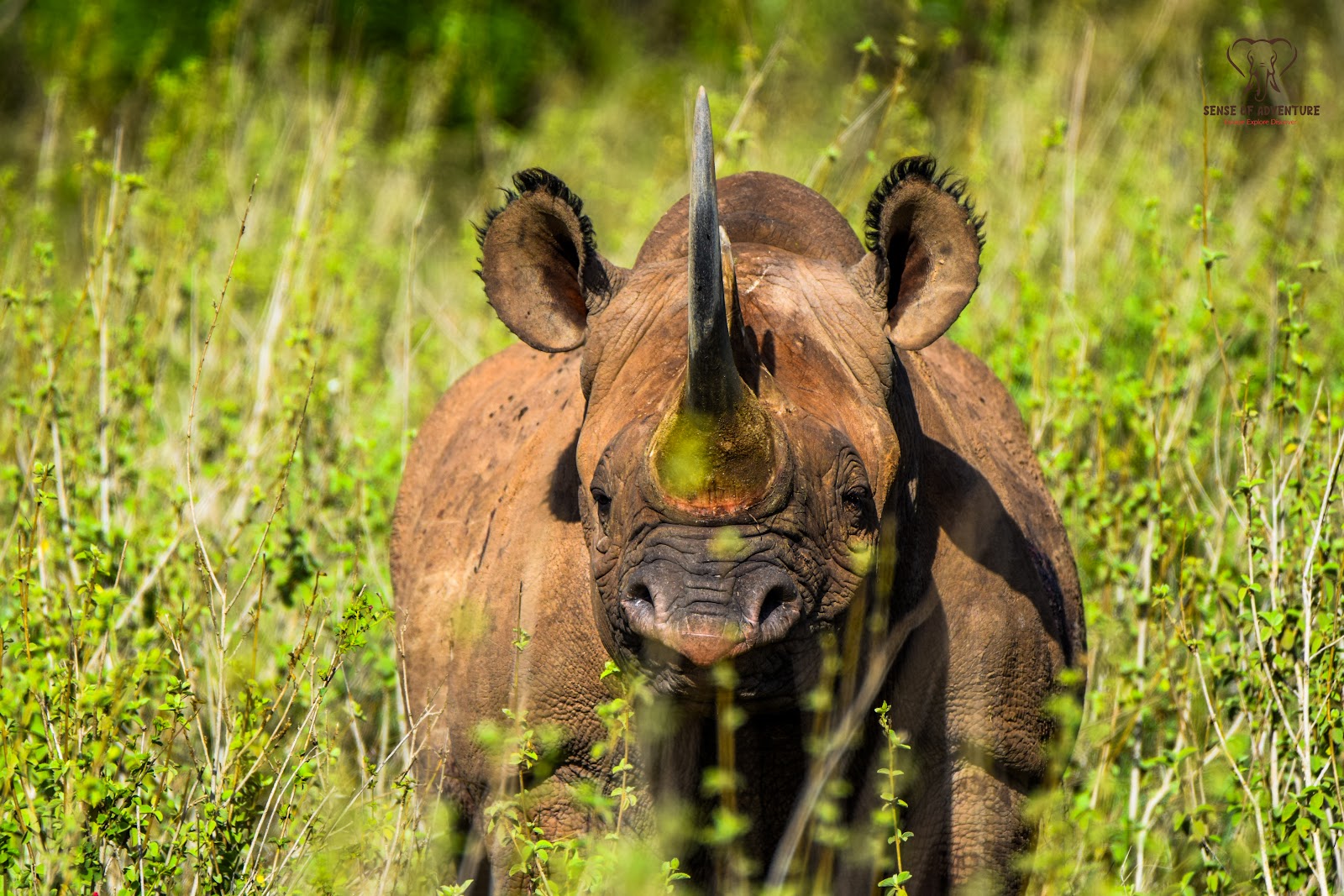
Diet explains most other differences: the white rhino is a grass specialist, while the black rhino is a fussy browser.
The Grazing White Rhino
White rhinos graze for long hours on open, short grassland. Because grass is spread widely and is easy to see, they can afford to live in loose groups, called crashes. Females with calves often stay together. They tend to be calm around vehicles, which makes them good subjects for photographers.
The Browsing Black Rhino
Black rhinos pick leaves, shoots and twigs from shrubs and acacias. They live in thicker bush, where visibility is low, and they react quickly to sound and smell. That is why they have a reputation for charging. Guides keep a respectful distance, switch off the engine and let the rhino decide how close it is comfortable.
Which sanctuary suits your trip?
Ol Pejeta, Lewa, Lake Nakuru and Solio all offer rhinos, but each feels different. Tell us how many days you have and we will suggest the best rhino stop for your route.
Rhino Conservation in Kenya
Kenya’s rhinos have recovered strongly in guarded sanctuaries and conservancies, but both species still depend on constant protection.
In the 1970s and 1980s poaching for horn devastated Kenya’s black rhinos. Today they live mainly in fenced or closely guarded areas run by the Kenya Wildlife Service and private or community conservancies. Figures reported in 2025 put Kenya’s total rhino population at around 2,100 animals, counting black and southern white rhinos together.
The southern white rhinos you see in Kenya were brought in from South Africa. The northern white rhino, a separate subspecies, is functionally extinct in the wild. The last northern white rhinos live under guard at Ol Pejeta Conservancy, where scientists are working on assisted reproduction to try to save them. Read our Ol Pejeta Conservancy guide for how visits work.

Rhino Viewing Etiquette on Safari
Good rhino viewing is quiet, patient and done at a distance that lets the animal carry on as normal.
- Keep your voice low: rhinos have poor eyesight but excellent hearing and smell.
- Stay seated: standing up through the roof hatch is fine, but avoid sudden movements.
- No flash: it startles animals and rarely improves the photo in daylight.
- Do not crowd: if several vehicles arrive, ask your guide to wait or move on.
- Never share locations online: geotagged rhino photos can help poachers, so switch off location data before posting.
Walking with rhinos is possible in a few places, such as Sera, Lewa and some Laikipia conservancies, always with trained armed rangers. These walks are tightly controlled and the rules are strict, which is exactly why they are so special. Read our walking safari safety rules before you go.
Where to See a White Rhino and a Black Rhino in Kenya
The best places to see both are guarded sanctuaries in Laikipia and the Rift Valley, ideally combined with the Masai Mara for big cats.
| Place | White rhino | Black rhino | Notes |
|---|---|---|---|
| Ol Pejeta Conservancy | Yes | Yes | Also home to the last northern white rhinos |
| Lewa Wildlife Conservancy | Yes | Yes | Exclusive, with walks and fewer vehicles |
| Lake Nakuru National Park | Yes, easy | Yes, harder | Good day or overnight stop from Nairobi |
| Solio Ranch | Yes | Yes | Private sanctuary near Nyeri |
| Nairobi National Park | Yes | Yes | Close to the city; good for short stays |
| Sera Rhino Sanctuary | Yes | Yes | Track rhinos on foot in Samburu country |
| Masai Mara | No | Few | Rhinos are rare; enjoy them as a bonus |
Compare options in our Ol Pejeta vs Lewa and Lake Nakuru vs Ol Pejeta guides, or read about walking with rhinos at the Sera Rhino Sanctuary. Our best national parks for rhinos in Kenya guide ranks every option. For tourism information, see Magical Kenya.
Horns, Senses and Calves: More Ways the Two Species Differ
Beyond the lip and the head, a few less obvious details help you understand how each rhino lives.
Horns
Both species have two horns, with the front horn usually the longer. Rhino horn is made of keratin, the same protein found in human hair and nails, and it keeps growing throughout life. Horns vary so much between individuals that guides do not use them to tell the species apart. In some sanctuaries, rhinos are fitted with small transmitters or ear notches so rangers can identify and track each animal.
Senses and Their Bird Partners
Rhinos see poorly but hear and smell extremely well. Oxpeckers often ride on their backs, eating ticks and calling loudly when people approach. In Swahili the oxpecker is sometimes called the rhino’s guard for that reason. If you hear oxpeckers hissing near thick bush, your guide may slow down: a black rhino could be close.
Calves and Family Life
Both species have a pregnancy of around 15 to 16 months and usually produce a single calf every few years. That slow breeding rate is why poaching hits rhinos so hard and why every calf born in a Kenyan sanctuary matters. Calves stay with their mothers for two to three years, learning where to feed, drink and wallow.
Back at camp, it is fun to check your photos and confirm which species you saw. Look first at the shape of the upper lip, then at how high the head is held and whether there is a clear hump on the neck. Habitat in the background, open grass or thick bush, is a useful final clue.
How Your Safari Helps Protect Rhinos
Rhino protection in Kenya is expensive. Ranger teams, fencing, tracking dogs, aircraft and veterinary care all cost money, and much of it comes from visitors.
- Conservancy and park fees help pay for patrols and monitoring in places such as Ol Pejeta, Lewa and Lake Nakuru.
- Staying in conservancy camps supports community land leases and local jobs, which build support for wildlife.
- Visiting the northern white rhinos at Ol Pejeta, Najin and Fatu, the last two of their subspecies, supports the work to save them.
- Choosing guides who keep their distance reduces stress on rhinos and keeps sightings calm.
Simple choices add up. A responsible trip shows that living rhinos are worth far more to Kenya than any horn, and it gives you a closer understanding of why both species need protection.
Planning a Rhino Safari: Timing, Days and Costs
Two nights in a rhino sanctuary is usually enough to see a white rhino and have a good chance of a black rhino.
- Best months: the dry seasons from late June to October and January to February, when bush is thinner.
- Getting there: Ol Pejeta is about four hours by road from Nairobi; Lake Nakuru about three to four.
- How many nights: two in Laikipia or Nakuru, then on to the Mara or Samburu.
- Fees: conservancies set their own fees; see our Kenya national parks entrance fees 2026 guide.
- Who it suits: photographers, families and anyone who wants the full Big Five.
Expert tip from our Nairobi team
Go out early. Rhinos are most active in the cool morning hours, and black rhinos are easier to find before they retreat into thick bush. Ask your guide to stop at a distance, switch off the engine and wait. Calm, quiet sightings are both safer and far more rewarding.
We include rhino sanctuaries in a private Kenya safari or luxury Kenya safari, often paired with our Masai Mara safari packages. Our Kenya Highlights Safari (9 days) includes Ol Pejeta and Lake Nakuru. Starting in the capital? See our Kenya safari from Nairobi options, and learn why rhinos earned their place in our guide to why they are called the Big Five.
Get your rhino safari quote
Small camps in Laikipia and near Lake Nakuru fill early in the dry season. Send your dates and we will reply with a written quote and the best rhino stop for your route.
White Rhino and Black Rhino FAQs
What is the main difference between a black rhino and a white rhino?
The mouth. A white rhino has a wide, square upper lip for grazing grass, while a black rhino has a pointed, hooked lip for browsing leaves and twigs. White rhinos are also larger, hold their heads lower and are more social. Both species are grey, so colour is no help.
Why is it called a white rhino?
Nobody knows for certain. A popular story says white comes from a Dutch or Afrikaans word for wide, describing the lip, but there is little solid evidence for it. Other ideas involve pale dust or mud. The black rhino name probably arose simply to distinguish the second species.
Which is bigger, the black rhino or the white rhino?
The white rhino is bigger. Adults typically weigh roughly 1,800 to 2,500 kilograms, while black rhinos usually weigh roughly 800 to 1,400 kilograms. The white rhino is one of the largest land mammals after the elephants, with a long head and a distinct hump on the neck.
Is the black rhino more dangerous than the white rhino?
Black rhinos are generally more nervous and quicker to charge, partly because they live in thick bush with poor visibility. White rhinos are usually calmer. Both are wild and powerful, so you should always view them from a vehicle or with an armed guide and keep a respectful distance.
Where can I see both black and white rhinos in Kenya?
Ol Pejeta Conservancy, Lewa Wildlife Conservancy, Lake Nakuru National Park, Solio Ranch and Nairobi National Park all hold both species. Ol Pejeta also protects the last northern white rhinos. Many travellers spend two nights in one sanctuary, then continue to the Masai Mara for big cats.
Are white rhinos native to Kenya?
The southern white rhinos seen in Kenya today were introduced from South Africa. The northern white rhino, a different subspecies, once lived further north and west in Africa and is now functionally extinct in the wild. The eastern black rhino is Kenya’s native rhino and remains Critically Endangered.
Can you walk with rhinos in Kenya?
Yes, in a few places. Sera Rhino Sanctuary in Samburu offers rhino tracking on foot, and some Laikipia conservancies, including Lewa, run guided walks. These are always led by trained, armed rangers with strict rules on distance and noise. Most visitors watch rhinos from a vehicle, which is safe and very rewarding.
See both rhinos with expert guides
Travel with Kenyan guides who know the sanctuaries and how to watch rhinos calmly and safely. Sense of Adventure is a TRA-licensed private safari company in Nairobi.
Kenya-based experts. Real local knowledge. Transparent pricing.