Vulture species in Kenya rarely make anyone’s safari wish list, yet they are part of one of Africa’s most urgent conservation stories. Four of the vultures you can see in Kenya, the white-backed, Rüppell’s, white-headed and hooded vultures, are listed as Critically Endangered, and the lappet-faced vulture is Endangered. A continent-wide study published in 2016 found that most African vulture species had fallen steeply over about three generations, several by 80% or more, mainly through poisoning. Picture watching a vulture “committee” drop onto a kill and knowing exactly why it matters. Sense of Adventure guides make a point of explaining it.
✅ Vulture Species in Kenya: Quick Answer
- How many? Eight vulture species in Kenya have been recorded; six are regular on the main safari circuits.
- Critically Endangered: white-backed, Rüppell’s, white-headed and hooded vultures. Lappet-faced and Egyptian vultures are Endangered.
- Main threat: poisoned carcasses, often meant for lions or hyenas that kill livestock.
- Best place to see them: the Masai Mara, especially from July to October, when kills are frequent.
- Other good areas: Samburu, Tsavo, Amboseli and Laikipia.
- From: our 4-day Masai Mara & Lake Nakuru Camping Safari starts at USD 590 per person.
Want a guide who will stop and explain the vulture species in Kenya, not drive past them?
Ask About Vulture SafarisWhy Vultures Matter More Than Their Reputation Suggests
Vultures are nature’s clean-up crew. Soaring high on thermals, they spot carcasses and each other from great distances, then gather fast and strip a carcass to bone, often within an hour. Classic studies in the Serengeti suggested vultures there ate more carrion than all the mammal scavengers combined.
That speed matters. Rotting carcasses can spread diseases such as anthrax, and where vultures have vanished, as in parts of South Asia, feral dog numbers and disease risk have risen. Healthy vulture populations are a quiet sign of a healthy ecosystem.
Each of the vulture species in Kenya plays a different role at a kill. Big, strong-billed birds open tough hide; medium-sized species eat the soft meat; small, slim-billed birds pick up scraps. Watching that order unfold is one of the most fascinating, if grisly, scenes on safari.
How Fast Are Vulture Species in Kenya Declining?
The strongest evidence comes from a continent-wide analysis led by Darcy Ogada and published in 2016. Pulling together road counts and other surveys from across Africa, it estimated that most widespread African vultures had declined by an average of about 62% over roughly three generations, and that several species had fallen by 80% or more.
These are Africa-wide estimates over several decades, not exact counts for Kenya alone, and they are the reason BirdLife International and the IUCN moved four African vultures to Critically Endangered in 2015. Earlier versions of this page gave Kenya-only percentages for individual species; we have removed them because they could not be tied to a reliable source.
What is driving the decline of vulture species in Kenya
Poisoning is the leading cause. When lions, hyenas or leopards kill livestock, some herders lace the carcass with cheap agricultural pesticide to kill the predator. Vultures feeding on the same carcass die in large numbers, sometimes dozens or hundreds in a single incident. Other threats include the trade in vulture parts for traditional medicine, collisions with power lines and loss of nesting trees.
The 8 Vulture Species in Kenya and Their Status
Hooded Vulture — Small and Slim-Billed — Critically Endangered
The smallest regular species, with a pink face and a downy “hood”. It waits at the edge of a feeding crowd for scraps. The 2016 study placed it among the species with the steepest Africa-wide declines.
White-backed Vulture — Africa’s Most Numerous, Still Collapsing — Critically Endangered
Historically the most common vulture on African savannahs and still the bulk of most crowds at Mara kills, but declining sharply across its range. See our Masai Mara vultures & scavengers guide.
Rüppell’s Vulture — The Highest-Flying Bird on Record — Critically Endangered
Holds the bird altitude record after one struck an aircraft at about 11,300 metres over West Africa in 1973. It nests on cliffs and has suffered heavy Africa-wide declines, despite earlier claims on this page of a “relatively slow” fall.
Lappet-faced Vulture — Kenya’s Largest Vulture — Endangered
The biggest vulture in Kenya, with a bare pinkish-red head and a massive bill that opens tough hide other species cannot. Its size has not protected it from the same poisoning pressure.
White-headed Vulture — The Rare Beauty — Critically Endangered
A striking bird with a pale head and a red-and-blue bill. Usually seen alone or in pairs, it is scarce everywhere, so a sighting is a real prize.
Egyptian, Palm-nut and Bearded Vultures — The Specialists — scarce to rare
The small, white Egyptian vulture (Endangered) is famous for using stones to crack ostrich eggs. The palm-nut vulture eats oil-palm fruit and is found mainly near the coast. The bearded vulture, or lammergeier, is now extremely rare in Kenya.
Which Vultures Can You Realistically See?
Tell us which vulture species in Kenya are on your list and how many days you have. We will tell you honestly where your best chances are, from the Mara’s feeding crowds to scarcer birds in the north.
How to Identify Vulture Species in Kenya at a Kill
Identifying the vulture species in Kenya gets much easier once you look at three things: overall size, the colour of the bare head and face, and the bill. Your guide will help, but these pointers will have you naming birds by your second kill.
Big and dominant: lappet-faced vulture
Look for the giant with a red, wrinkled head and a huge bill. Other birds give way when it lands, and it is usually seen in ones or twos.
The crowd: white-backed and Rüppell’s vultures
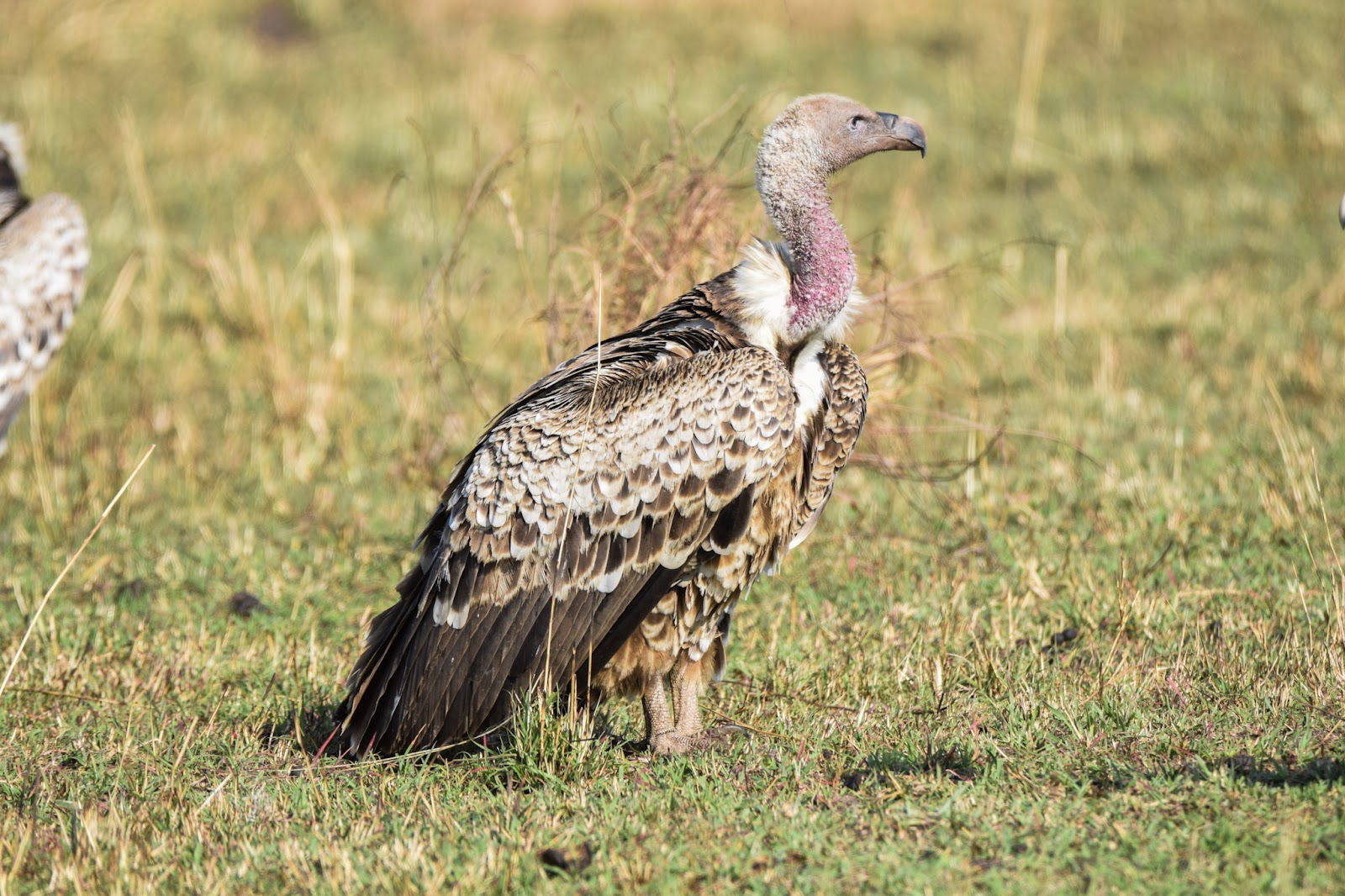
White-backed vultures are plain brown with a dark face and a white lower back that shows in flight. Rüppell’s vultures look scaly, because each feather has a pale edge, and have a pale yellowish bill.
The edges: hooded and white-headed vultures
Hooded vultures are small, with thin bills and pink faces. White-headed vultures stand out with a pale head and a red-and-blue bill. The marabou stork often joins the crowd too, but it is a stork, not a vulture.
Vulture Species in Kenya Compared
This table sums up the vulture species in Kenya you are most likely to meet on safari, how to recognise them and their IUCN status.
| Species | Key features | Where in Kenya | IUCN status |
|---|---|---|---|
| White-backed | Brown, dark face, white back in flight | Mara, Samburu, Tsavo, Amboseli | Critically Endangered |
| Rüppell’s | Scaly look, pale bill, cliff nester | Mara, Rift Valley cliffs, north | Critically Endangered |
| Lappet-faced | Huge, red bare head, heavy bill | Mara, Samburu, Tsavo | Endangered |
| White-headed | Pale head, red-and-blue bill | Mara, Tsavo, Samburu (scarce) | Critically Endangered |
| Hooded | Small, thin bill, pink face | Mara and other savannah parks | Critically Endangered |
| Egyptian | Small, white, yellow face | Dry north and Rift Valley (scarce) | Endangered |
Where to See Vulture Species in Kenya
Masai Mara: the best vulture viewing in Kenya
The Mara’s big predator populations mean frequent kills, and from July to October the Great Migration adds thousands of carcasses along the plains and the Mara River. Large, mixed feeding crowds are an almost daily sight in peak season. Watch the sky: a column of birds dropping fast usually means a fresh kill.
Samburu, Tsavo and Amboseli
These drier parks hold several vulture species in Kenya, including good numbers of lappet-faced and white-backed vultures, and Samburu is one of the better places for white-headed vultures. Watch for birds perched in tall acacias near water in the heat of the day.
Cliffs and the coast
Rüppell’s vultures nest on cliffs; the gorge at Hell’s Gate was once famous for them, though far fewer remain. Palm-nut vultures are a coastal speciality around forests and creeks south and north of Mombasa.
Best Time to See Vulture Species in Kenya
You can see vulture species in Kenya in every month, but numbers at kills follow the seasons.
- July to October: the Great Migration in the Mara brings frequent kills and river-crossing carcasses, so large vulture crowds are common.
- January to March: warm and dry, with fewer vehicles and resident predators still making regular kills.
- April, May and November: the rainy months bring green scenery and lower rates; kills are harder to find in long grass.
Mid-morning is often best for soaring birds, once the ground warms and thermals rise. For a wider picture, see our birds of the Masai Mara guide.
Getting There and Safari Costs
The Masai Mara is about five to six hours by road from Nairobi, or roughly an hour by light aircraft from Wilson Airport. Samburu is a long day’s drive north or a short flight. You do not need a special trip to see vulture species in Kenya, but more time in the Mara gives you more kills to watch.
These starting prices come from trips on our site; your written quote confirms the price for your dates:
- Masai Mara & Lake Nakuru Camping Safari (4 days): from USD 590 per person.
- 3-Day Masai Mara Safari: from USD 650 per person.
- Kenya Birding Tour (8 days): Rift Valley lakes, Kakamega and the Mara with a specialist bird guide, from USD 2,050 per person.
- Big Cats Photographic Safari (6 days): from USD 2,600 per person, with time to stay at kills.
The Masai Mara, run by Narok County, charges non-resident adults USD 100 per day from January to June and USD 200 per day from July to December.
Price a Mara Safari With Time at Kills
Send your dates and group size, and we will reply with a written quote, with park fees itemised and a private vehicle so you can watch the vulture species in Kenya at a kill as long as you like. Mara fees double in July, so dates matter.
Quote My Mara SafariWatching and Photographing Vulture Species in Kenya
The best vulture viewing usually comes after the predators have eaten. Ask your guide to park at a respectful distance, switch off the engine and wait. The first birds often land some way off or perch in trees, then edge closer as lions or hyenas move away.
For photographs, a 100–400 mm zoom is ideal, with a fast shutter speed for flapping, squabbling birds at the carcass. Try a wider shot too, to show the whole scene of vultures, jackals and marabou storks. Patience pays: the most dramatic moments often come when a lappet-faced vulture arrives and the crowd parts.
In the reserve, vehicles must stay on tracks, so a kill far from a road may be out of reach. In conservancies, guides can drive closer off-road, which is another reason to spend a night or two outside the reserve when watching the vulture species in Kenya.
How Your Safari Can Help Vultures
To protect the vulture species in Kenya, conservation groups, the Kenya Wildlife Service and local communities are working to stop poisoning, train rapid-response teams that clean up poisoned carcasses, compensate herders for livestock losses and protect nest sites. The Peregrine Fund, whose Africa programme is based in Kenya, and BirdLife International lead much of this work.
- Stay in conservancies and camps that share income with local communities, which reduces the conflict behind poisoning.
- Tell your guide if you see dead vultures or a suspicious carcass, so it can be reported.
- Keep your distance at kills and switch off the engine; a bird pushed off food loses a meal it badly needs.
- Never buy wildlife products, including anything sold as traditional medicine.
You can check each species on the IUCN Red List.
Vulture Species in Kenya: Key Facts
- Species in crisis: hooded, white-backed, Rüppell’s and white-headed vultures are listed as Critically Endangered on the IUCN Red List; lappet-faced and Egyptian vultures are Endangered.
- Scale of decline: a 2016 Africa-wide study estimated an average fall of about 62% over roughly three generations, with several species down 80% or more.
- Leading cause: poisoned carcasses meant for predators, followed by killing for traditional medicine.
- Ecosystem role: most vulture species in Kenya remove carcasses quickly, limiting the spread of disease.
- Record holder: a Rüppell’s vulture is the highest-flying bird on record, at about 11,300 metres.
- Mass poisoning risk: because vultures gather in large numbers, one poisoned carcass can kill dozens or hundreds.
Seeing Vultures With Real Context
To learn more about the vulture species in Kenya, read our Masai Mara vultures & scavengers guide and our wider wildlife conservation in Kenya guide for how anti-poaching and community work connect to the poisoning pressure threatening vultures. To understand the rest of the scavenger cast, see our hyenas of the Masai Mara guide.
Compare every Mara trip on our Masai Mara safari packages page, or start from a Kenya safari from Nairobi. Check entry rules on the official Kenya eTA portal before you fly.
See the Clean-Up Crew Before It Is Gone
We will build a private safari with guides who stop for the vulture species in Kenya, explain the pecking order and the threats, and support the camps and communities working to protect them.
Frequently Asked Questions
How many vulture species are critically endangered in Kenya?
Four vulture species found in Kenya, the hooded, white-backed, Rüppell’s and white-headed vultures, are listed as Critically Endangered on the IUCN Red List. The lappet-faced and Egyptian vultures are listed as Endangered. These are global listings, made in 2015 after evidence of steep declines across Africa, and they apply to the birds you see in Kenya.
Why are Kenya’s vultures declining so fast?
The leading cause is poisoning. When predators kill livestock, some herders lace the carcass with pesticide to kill them, and vultures feeding on it die in large numbers. Killing for traditional medicine, power-line collisions and loss of nesting trees add to the pressure. Because vultures breed slowly, populations take many years to recover.
How much have African vultures declined?
A continent-wide study led by Darcy Ogada, published in 2016, estimated that most widespread African vulture species had declined by an average of about 62% over roughly three generations, with several species, including the hooded and white-backed vultures, falling by 80% or more. These are Africa-wide estimates, not Kenya-only counts.
Which vulture species in Kenya are easiest to see?
White-backed vultures are the easiest, as they make up most of the crowd at kills in the Masai Mara, Samburu and Tsavo. Rüppell’s and lappet-faced vultures are also seen regularly at Mara kills. White-headed vultures are scarce, and palm-nut vultures are mainly coastal. Your guide will help you tell them apart.
Why do vultures matter to the ecosystem?
Vultures remove carcasses quickly, which limits the spread of diseases such as anthrax and reduces food for feral dogs and rats. Studies in the Serengeti suggested vultures there ate more carrion than all mammal scavengers combined. Where vultures have disappeared, as in parts of South Asia, disease risks to people and livestock have risen.
Which is Kenya’s largest vulture species?
The lappet-faced vulture is Kenya’s largest vulture. It has a bare, wrinkled red head and a massive bill strong enough to tear open tough hide that smaller species cannot manage. Other vultures usually give way when it lands at a carcass. It is listed as Endangered and is usually seen alone or in pairs.
When is the best time to see vultures in Kenya?
You can see vultures all year, but July to October in the Masai Mara is best, when the Great Migration brings frequent kills and large mixed feeding crowds. January to March is also good, with fewer vehicles. Mid-morning, once thermals rise, is the best time to watch vultures soaring.