Ol Pejeta northern white rhinos are, quite simply, the rarest large mammal encounter on the planet — because there are only two left. Najin and her daughter Fatu, both female, live under 24-hour armed guard on this Laikipia conservancy after the death of the last male, Sudan, in 2018. Meeting them is meeting the entire remaining population of a subspecies, a sobering and strangely moving safari moment.
But Ol Pejeta is far more than a memorial: it is East Africa’s largest black rhino sanctuary, home to more than 160 rhinos of both species, plus lions, Kenya’s only chimpanzee sanctuary, and some of the country’s finest predator viewing on private conservancy land. Sense of Adventure treats a day here as essential, not optional. This guide explains the story of the Ol Pejeta northern white rhinos, the science trying to save them, how a visit works, what it costs and how to fit it into your Kenya route.
✅ Ol Pejeta Northern White Rhinos Quick Answer
- How many are left: two, Najin and her daughter Fatu, both female, at the time of writing.
- Where: a guarded enclosure inside Ol Pejeta Conservancy, Laikipia, about 3 to 3.5 hours north of Nairobi.
- Can you visit: yes, on a ranger-led visit booked through the conservancy.
- The hope: IVF embryos and southern white rhino surrogates, led by international scientists.
- From: our Ol Pejeta Day Safari from Nairobi starts at USD 380 per adult.
Meet the Rarest Mammals Alive
A guided visit to Najin and Fatu, plus East Africa’s biggest black rhino sanctuary in one day. Ask us to build it in.
How Two Rhinos Became the Whole Subspecies
Northern white rhinos once ranged across central Africa in the thousands; poaching for horn collapsed the population to a handful of captive animals by the 2000s. In 2009, the last four — including the male Sudan — were flown from a Czech zoo to Ol Pejeta’s natural habitat and round-the-clock protection, in hope that Laikipia’s conditions might restore breeding.
Age and health worked against it: Sudan died in 2018, leaving Najin and Fatu as the entire subspecies. Neither can carry a pregnancy safely, so science has taken over — stored semen and harvested eggs are being used to create in vitro embryos, to be implanted into closely related southern white rhino surrogates, in an active bid led by international scientists to bring the northern white back from the edge of total extinction.

The 5 Essential Ol Pejeta Experiences
Meeting Najin and Fatu — the last of a subspecies
A dedicated, ranger-escorted visit brings you within safe viewing distance of the world’s only two northern white rhinos, grazing under permanent armed protection. Rangers explain the science working to save the line via IVF and surrogate southern whites. It is Ol Pejeta’s most requested, most solemn, and most important sighting.
East Africa’s Biggest Black Rhino Sanctuary — more than 160 success stories
Beyond the northern whites, Ol Pejeta protects the region’s largest black rhino population inside one conservancy — a genuine recovery story built on secure, monitored, predator-managed land. Game drives regularly meet both black and southern white rhinos going about ordinary, thriving lives, the flip side of the northern whites’ tragedy.
Chimpanzee Sanctuary — Kenya’s only chimps, rescued
Sweetwaters Chimpanzee Sanctuary, inside Ol Pejeta, rehabilitates chimps orphaned or rescued from illegal trade and abuse across Central Africa — Kenya has no wild chimp population, so this sanctuary is the country’s only place to see the species, across two large river-bounded enclosures.
Predators on Private Land — lions, cheetahs and rare wild dogs
Ol Pejeta’s conservancy status means lower vehicle density and activities not allowed in national parks, such as night drives and guided walks. Healthy lion prides, cheetah sightings and the occasional pack of endangered African wild dogs roaming Laikipia make the predator side of a visit every bit as strong as the rhino headline.
Mount Kenya Backdrops — the Laikipia bonus view
On clear mornings Mount Kenya’s peak rises beyond Ol Pejeta’s savannah — a bonus scenic layer most itineraries do not expect. Combine early rhino tracking with the mountain view and a Laikipia game drive delivers one of central Kenya’s most complete single mornings.
History and Hope, One Morning
The last northern whites and a thriving black rhino population — Ol Pejeta tells conservation’s whole story. Add it to your route.

Who Are Najin and Fatu? Meet the Ol Pejeta Northern White Rhinos
The two Ol Pejeta northern white rhinos are mother and daughter. Najin was born in 1989 at Dvůr Králové Zoo in the Czech Republic, and Fatu was born there in 2000. Both arrived at Ol Pejeta in December 2009 with two males, Sudan and Suni, who have since died.
Najin
Najin is the older of the pair and is now in her late thirties. Because of her age and health, scientists stopped collecting eggs from her in 2021. She still lives with Fatu in their guarded enclosure, where keepers know her calm, gentle temperament well.
Fatu
Fatu is the younger female and the main source of eggs for the rescue programme. She cannot carry a calf herself, so every embryo made from her eggs depends on a surrogate mother from the closely related southern white rhino subspecies.
Why the Ol Pejeta northern white rhinos are guarded day and night
Rhino horn still sells for high prices on illegal markets, and losing either animal would be a disaster for science. Armed rangers watch Najin and Fatu around the clock, and the wider conservancy has its own anti-poaching teams and tracking dogs.
The Science Trying to Save the Northern White Rhino
The rescue effort is led by the BioRescue consortium with partners including Ol Pejeta, the Kenya Wildlife Service and the Leibniz Institute for Zoo and Wildlife Research in Berlin. It has three main steps.
- Collecting eggs: vets harvest immature eggs from Fatu under anaesthetic in a carefully planned procedure.
- Making embryos: in a laboratory in Europe, the eggs are fertilised with frozen sperm from northern white bulls that died years ago, and the embryos are frozen.
- Surrogate pregnancy: the embryos are transferred into southern white rhino females at Ol Pejeta, which carry the calf for around 16 months.
In 2024 the team announced the world’s first rhino pregnancy from an IVF embryo transfer, using a southern white embryo as a trial. That success showed the method can work. Visit the Ol Pejeta Conservancy website for the latest news on the Ol Pejeta northern white rhinos and the embryo programme.
Why the Ol Pejeta Northern White Rhinos Matter
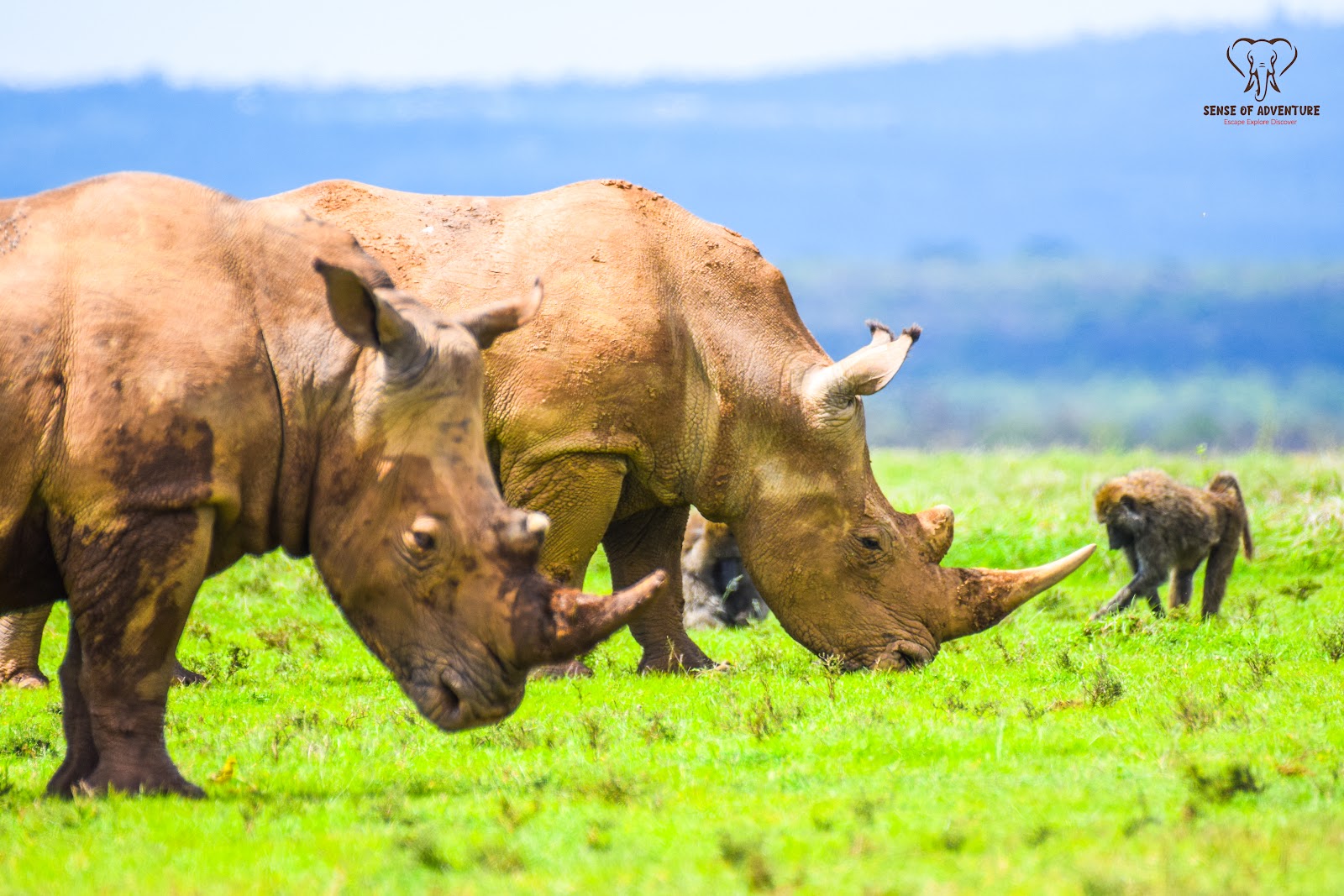
The Ol Pejeta northern white rhinos are a warning about how quickly a large animal can disappear. In the 1960s there were still more than two thousand northern whites in the wild. Civil war, weak protection and the illegal horn trade wiped them out in little more than a generation.
They are also a test of what modern conservation can do. If the embryo programme succeeds, the methods developed for the Ol Pejeta northern white rhinos could help other endangered species with tiny populations. Every visitor fee paid at the enclosure supports the rangers, keepers and science behind that effort.
Finally, they put the rest of your safari in context. Seeing the last two of one subspecies, and then a healthy black rhino with a calf an hour later, shows that protection works when it is well funded and well managed.
How to Visit the Ol Pejeta Northern White Rhinos
A visit to the Ol Pejeta northern white rhinos is a special activity that the conservancy runs separately from normal game drives. It must be booked in advance and is led by the rangers who care for Najin and Fatu.
What happens on the visit
You meet the keepers of the Ol Pejeta northern white rhinos at the enclosure, receive a short safety and conservation briefing, and then view the two rhinos from a safe distance. Keepers explain their daily care, the threats they face and the progress of the science. Visits are small and calm, so the animals are not stressed.
Rules and etiquette
Follow your keeper’s instructions at all times, speak quietly and never try to feed or touch the animals. Photography is usually allowed, but flash and drones are not. Sessions can be cancelled at short notice if the rhinos’ welfare requires it.
Best time of day
Morning and late afternoon are cooler and often more pleasant. Combine the visit with an early game drive to look for black rhino, lion and cheetah, then visit the chimpanzee sanctuary before lunch.
Costs and Ol Pejeta Safari Packages
To see the Ol Pejeta northern white rhinos you pay Ol Pejeta’s own daily conservancy fee, which is separate from Kenya Wildlife Service park fees, while special activities such as the northern white rhino visit are charged on top. Fees change each year, so check our Ol Pejeta Conservancy guide or ask us for current rates.
Ways to visit with Sense of Adventure include:
- Ol Pejeta Day Safari from Nairobi (1 Day) — from USD 380 per adult.
- Kenya Highlights Safari – Samburu, Ol Pejeta, Lake Nakuru & Masai Mara (9 Days) — from USD 2,350 per person sharing.
- Ol Pejeta & Masai Mara Luxury Conservancy Safari (6 Days) — from USD 3,900 per person.
Read our honest guide to an Ol Pejeta day trip from Nairobi if you are short on time, or ask for a private Kenya safari built around the conservancy.
Getting to Ol Pejeta
Ol Pejeta lies near Nanyuki, about 200 kilometres north of Nairobi. The drive takes around three to three and a half hours on good tarmac via Thika and Nyeri. Light aircraft fly daily from Wilson Airport to Nanyuki, about 45 minutes, followed by a short road transfer.
The conservancy sits right on the equator, and most guests stop at the equator sign in Nanyuki on the way. It is an easy stop between Nairobi and Samburu, and links well with the Aberdares and Lake Nakuru.
Best Time to See the Ol Pejeta Northern White Rhinos
You can visit the Ol Pejeta northern white rhinos in any month. The drier seasons, from late June to October and from January to February, offer the easiest game drives and clear views of Mount Kenya. The rains, mainly in April and May and again in November, bring green landscapes and fewer visitors, though some tracks can be muddy.
Where to Stay at Ol Pejeta
The conservancy has a range of camps and lodges, from tented camps beside waterholes to self-catering cottages and campsites. Many overlook a waterhole where rhinos, elephants and buffalo come to drink. Staying at least one night near the Ol Pejeta northern white rhinos lets you add a night drive or a guided walk, which most day visitors miss.

Ol Pejeta & Northern White Rhino Facts
- The population: exactly two northern white rhinos survive — Najin and her daughter Fatu, both female, both at Ol Pejeta.
- Sudan: the last male northern white rhino died at Ol Pejeta in March 2018, aged 45.
- The science: BioRescue and partner teams use harvested eggs, stored sperm and IVF embryos implanted in southern white surrogates to attempt species rescue.
- Scale: Ol Pejeta covers 364 km² and protects over 160 rhinos of both species — East Africa’s largest black rhino sanctuary.
- Chimps: Sweetwaters Chimpanzee Sanctuary is the only place to see chimpanzees in Kenya — none are wild-native to the country.
- Access: about 200 km / 3-3.5 hours from Nairobi, or a short flight to Nanyuki then road transfer.
Building Ol Pejeta Into Your Circuit
Ol Pejeta anchors our Ol Pejeta & Masai Mara luxury conservancy safari, and pairs naturally with the rhinos of Lake Nakuru on a wider Rift-Laikipia loop. See the Laikipia Plateau guide for the region’s other conservancies, and read about Kenya’s northern specials in our Samburu Special Five guide nearby. For the wider picture of rhino recovery, see the work of Save the Rhino International.
The Whole Subspecies Is Waiting at One Fence Line
History, science and hope in a single Laikipia morning. Message us to include Ol Pejeta in your Kenya trip.
Frequently Asked Questions
Are there only two northern white rhinos left?
Yes — Najin and her daughter Fatu, both female, are the last two northern white rhinos on Earth, living under 24-hour guard at Ol Pejeta Conservancy in Kenya. The last male, Sudan, died there in 2018, making natural reproduction of the subspecies impossible.
Can you visit the northern white rhinos at Ol Pejeta?
Yes — Ol Pejeta Conservancy offers a dedicated, ranger-guided visit to Najin and Fatu, viewed at a safe distance under armed protection. Rangers explain the ongoing IVF and surrogate-embryo science attempting to save the northern white rhino lineage. Book ahead, as group sizes are small.
Is there hope of saving the northern white rhino?
Yes, though it is a long road. Scientists use eggs from Fatu, frozen sperm from dead bulls and IVF embryos to be carried by southern white rhino surrogates. A first rhino IVF pregnancy was confirmed in 2024 using a southern white embryo, proving the method can work.
What else can you see at Ol Pejeta besides rhinos?
Ol Pejeta offers East Africa’s largest black rhino sanctuary, Kenya’s only chimpanzee sanctuary (Sweetwaters), healthy lion prides, cheetah sightings, occasional African wild dogs and, on clear days, views of Mount Kenya — making it a complete safari destination beyond its famous rhinos.
How do you get to Ol Pejeta Conservancy?
Ol Pejeta lies about 200 km north of Nairobi, roughly 3 to 3.5 hours by road via Nyeri to Nanyuki, or a short scheduled flight to Nanyuki airstrip followed by a road transfer. Many visitors combine it with Lake Nakuru or the Aberdares on a central Kenya circuit.
Can you see the Ol Pejeta northern white rhinos on a day trip?
Yes. Leaving Nairobi early, you can reach Ol Pejeta by mid-morning, visit the northern white rhinos, take a game drive and see the chimpanzees before driving back in the evening. Our Ol Pejeta Day Safari from Nairobi starts at USD 380 per adult, but an overnight stay is more relaxed.
What is the difference between northern and southern white rhinos?
They are two subspecies of white rhino. Northern whites once lived in central Africa and are now down to two animals, while southern whites recovered from near-extinction to thousands in southern Africa. Northern whites are slightly smaller, and the two have been separated for a very long time.