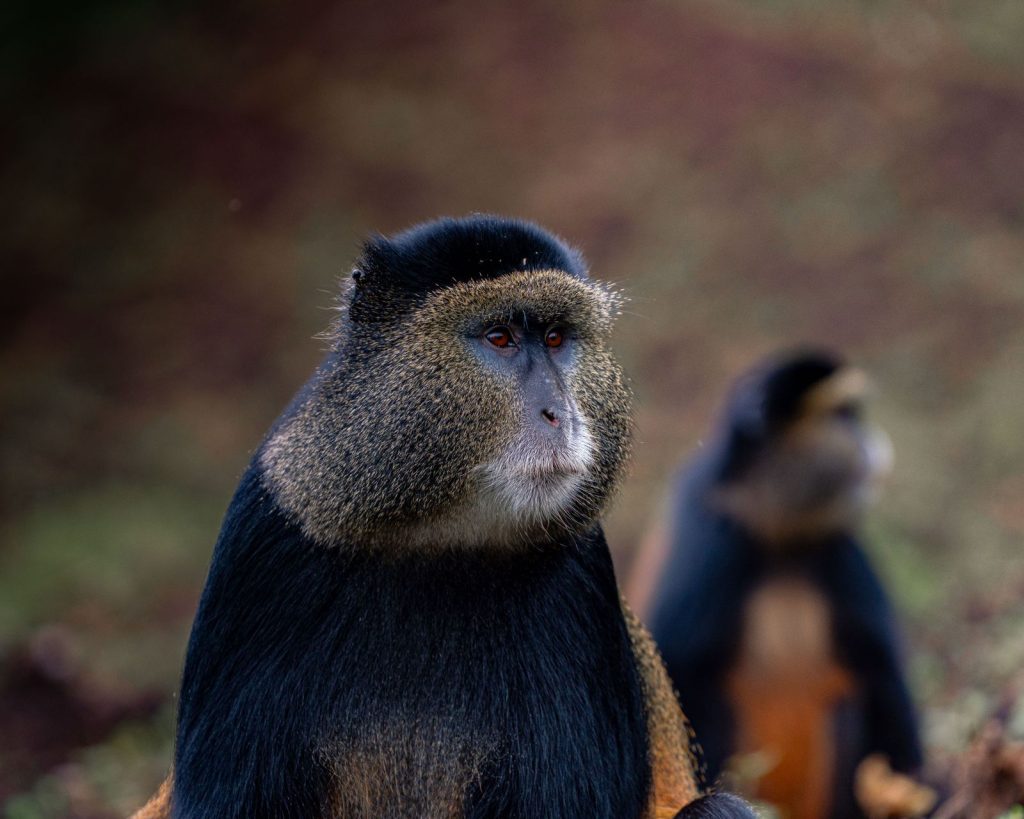
Golden monkey trekking in Rwanda offers something mountain gorilla treks rarely do: pure, chaotic energy. Where a gorilla family radiates calm, golden monkey troops — sometimes numbering sixty or more individuals — erupt through the bamboo in a blur of orange-gold fur, leaping branch to branch, chasing, tumbling and shrieking with what looks unmistakably like joy.
Found mainly in the Virunga volcanoes shared by Rwanda, Uganda and DR Congo, this endangered monkey makes its best-known Rwandan home in Volcanoes National Park’s bamboo zone, and treks here run shorter and gentler than gorilla treks while costing meaningfully less. Sense of Adventure recommends golden monkey trekking as either a standalone primate day or the perfect energetic counterpoint to a calmer gorilla encounter.
✅ Golden Monkey Trekking Quick Answer
- Where: the bamboo zone of Volcanoes National Park, in Rwanda’s north-west near Musanze.
- Trek: usually 1–2 hours to reach the troop, then one hour with the monkeys.
- Difficulty: easier than gorilla trekking, with gentler slopes and shorter walks.
- Best time: the drier months, June to September and December to February.
- From: our 5-day Rwanda Gorillas & Golden Monkeys safari starts at USD 3,100 per adult.
Add the Primate the Gorillas Don’t Prepare You For
Shorter trek, lower cost, non-stop action — ask us to add golden monkey trekking to your Rwanda trip.
Why Golden Monkeys Are Worth Their Own Trek
The golden monkey (Cercopithecus kandti) lives mainly in the bamboo forests of the Virunga volcanoes, an endangered primate found only in a few highland forests of Rwanda, Uganda and DR Congo. Volcanoes National Park has habituated troops for tourism, each numbering into the dozens, and treks typically reach them faster and at gentler gradients than gorilla treks, since the bamboo zone sits lower on the volcanic slopes.
Once found, the experience could not be more different from a gorilla encounter: golden monkeys move constantly, feeding on bamboo shoots, leaves, fruit and insects while young animals wrestle and chase through the canopy at speeds that make photography a genuine challenge — and a genuine joy.

The 5 Essential Golden Monkey Trekking Experiences
The Bamboo Forest Approach — a gentler trek than gorillas
Golden monkey treks typically climb through Volcanoes National Park’s lower bamboo zone, generally shorter and less physically demanding than gorilla treks into higher montane forest. It suits travellers wanting primate trekking without the steepest gorilla-trek terrain, or families with a wider age range.
The Full-Troop Chaos — sixty monkeys, zero stillness
Unlike gorilla families that often rest calmly during your visit hour, golden monkey troops rarely stop moving — feeding, chasing, play-fighting and leaping through the bamboo continuously. It is a completely different rhythm of wildlife encounter, more comedy than contemplation, and just as memorable.
The Golden Coat in Filtered Light — a photographer’s genuine challenge
Sunlight filtering through bamboo onto a golden monkey’s orange-red back and flanks produces striking photographs — when you can get one to sit still. The constant motion makes this one of the more technically demanding primate subjects in Africa, rewarding fast shutter speeds and patient framing.
Pairing With Gorilla Trekking — the complete Volcanoes experience
Most visitors combine golden monkey trekking with gorilla trekking on consecutive days — different permits, different forest zones, wildly different energy. The contrast between a gorilla family’s calm and a monkey troop’s frenzy gives a Volcanoes National Park visit real range.
A Shorter, More Affordable Permit — accessible primate trekking
Golden monkey permits cost significantly less than gorilla permits and the treks run shorter, making this an excellent standalone activity for travellers on tighter budgets or schedules who still want a genuine Virunga primate trekking experience.
One or Both Primates — Your Call
Golden monkeys alone, or paired with gorillas the next day. Ask us to build the Rwanda primate itinerary that fits.

How a Golden Monkey Trekking Day Works
A golden monkey trek follows a similar routine to a gorilla trek, but it is shorter and more relaxed. Here is what happens on the day.
Early briefing at Kinigi
Treks start with a briefing at the park headquarters in Kinigi, usually around 7 am. Rangers explain the rules, talk about the troop you will visit and assign you to a small group. Your driver-guide takes you from your lodge, so plan to leave early.
The walk to the bamboo
From the trailhead you walk through farmland to the park boundary, then into the bamboo forest. Trackers go ahead to find the troop and radio its position to your guide. Most walks take between one and two hours, on paths that can be muddy after rain.
One hour with the troop
Once you reach the monkeys, you have one hour with them. Keep a distance of several metres, talk quietly and follow the ranger. The monkeys move fast, so be ready to walk short distances as they feed through the bamboo.

Golden Monkey Trekking Rules
- Stay with your ranger and group at all times.
- Keep a distance of several metres from the monkeys, even if they come closer.
- Do not eat, drink or smoke near the troop.
- Do not trek if you have a cold, cough or other illness, as primates can catch human diseases.
- Speak quietly, avoid sudden movements and never use flash.
- Your visit lasts one hour once you reach the troop.
Best Time for Golden Monkey Trekking in Rwanda
You can trek golden monkeys all year. The drier months, from June to September and from December to February, give firmer trails and clearer views of the volcanoes. In the wetter months the paths are muddier, but fresh bamboo shoots appear and the troops are often very active as they feed on them.
Whatever the season, bring a waterproof jacket. Volcanoes National Park sits at high altitude, mornings can be cool and rain can arrive at any time.
Golden Monkey Trekking in Rwanda vs Uganda
Golden monkeys live on both sides of the Virunga border. In Rwanda, you trek in Volcanoes National Park, which is easy to reach from Kigali and has a wide choice of lodges. In Uganda, golden monkey tracking takes place in Mgahinga Gorilla National Park in the far south-west, which is quieter but further from the main airports.
For most travellers, golden monkey trekking in Rwanda is the simpler choice, especially when you are already in Volcanoes National Park for gorillas. Compare the two countries in our Rwanda vs Uganda gorilla trekking guide.
How to Get to Volcanoes National Park
Most visitors fly into Kigali International Airport. From Kigali, the drive to Musanze and the park takes about two to two and a half hours on a good, scenic road through the hills. Many travellers spend a night in Kigali first; see our Kigali travel guide for ideas.
From Kenya, flights from Nairobi to Kigali take around an hour and a half, which makes Rwanda an easy add-on after a Masai Mara safari. Our 8-day Kenya & Rwanda Safari combines the two from USD 4,900.
A Sample 3-Day Volcanoes Itinerary
- Day 1: arrive in Kigali, visit the Kigali Genocide Memorial, then drive to Musanze and check in near the park.
- Day 2: golden monkey trekking in the morning, with a free afternoon for a village walk, a visit to the twin lakes of Burera and Ruhondo, or simply rest.
- Day 3: gorilla trek in the morning, then return to Kigali for your flight or continue to Lake Kivu or Akagera.
Doing the golden monkeys first is a gentle warm-up for the steeper gorilla trek, and it gets you used to the altitude and the trail routine.
Golden Monkey Permit and Trip Costs
Golden monkey permits cost a fraction of the price of a gorilla permit, which is USD 1,500 per person in Rwanda. Permits are issued by the Rwanda Development Board; check the current price on the official Visit Rwanda website.
Prices on our site that include golden monkey or gorilla trekking:
- Rwanda Gorillas & Golden Monkeys (5 Days) — from USD 3,100 per adult.
- Kenya & Rwanda Safari – Masai Mara & Mountain Gorillas (8 Days) — from USD 4,900.
Final prices depend on season, lodge choice and group size. Read our gorilla trekking permit cost guide for more detail, or ask us about a private Kenya safari with a Rwanda extension.
What to Wear and Pack
- Footwear: waterproof walking boots with good grip, as trails can be muddy.
- Clothing: long trousers tucked into socks, a long-sleeved top and a light fleece for cool mornings.
- Rain gear: a lightweight waterproof jacket in every season.
- Gloves: simple gardening gloves protect your hands from nettles.
- Camera: a fast lens and a high shutter speed; flash photography is not allowed.
- Porter: hiring a local porter at the trailhead helps you on slopes and supports the community.
Photography Tips for Golden Monkeys
Golden monkeys are among the hardest primates to photograph in East Africa. The bamboo is dense, the light is patchy and the monkeys move quickly. Set a shutter speed of at least 1/500 second, use continuous autofocus and raise your ISO rather than slow down. A zoom of around 70–200 mm is ideal, because you will be fairly close. Focus on the eyes and wait for a monkey to pause while feeding.
Conservation and the Virunga Communities
Golden monkeys depend on the bamboo belt of the Virunga volcanoes, a narrow strip of habitat surrounded by farmland. Permit fees fund rangers and park management, and a share of tourism revenue in Rwanda goes to communities around the park. Hiring porters, buying local crafts and visiting community projects all help local people benefit from protecting the forest.
Before you travel, read the latest GOV.UK travel advice for Rwanda.
Golden Monkey Trekking: Key Facts
- Range: found mainly in the Virunga volcanoes spanning Rwanda, Uganda and DR Congo, with small populations in a few other highland forests.
- Status: listed as Endangered by the IUCN, with habitat loss the primary threat.
- Troop size: habituated Volcanoes National Park troops can number 60 or more individuals.
- Trek difficulty: generally shorter and gentler than gorilla treks, in the lower bamboo zone.
- Diet: primarily bamboo shoots and leaves, supplemented with fruit, flowers and insects.
- Combining permits: many visitors book gorilla and golden monkey treks on consecutive days within Volcanoes National Park.
Pairing Golden Monkeys With the Rest of Rwanda
This trek pairs naturally with our 5-day Rwanda Gorillas & Golden Monkeys safari. See the full Rwanda safari guide for wider planning, compare gorilla destinations in Rwanda vs Uganda gorilla trekking, and continue to Akagera National Park for Rwanda’s savannah Big Five side.
The Virunga’s Other Famous Primate
Endangered, endlessly playful, and found almost nowhere else on earth. Message us to add golden monkey trekking to your Rwanda trip.
Frequently Asked Questions
What is golden monkey trekking in Rwanda?
Golden monkey trekking is a guided hike into Volcanoes National Park’s bamboo forest to observe habituated troops of the endangered golden monkey, a primate found mainly in the Virunga volcanoes shared by Rwanda, Uganda and DR Congo. Treks are typically shorter and gentler than gorilla trekking.
How is golden monkey trekking different from gorilla trekking?
Golden monkey trekking involves shorter, gentler hikes and lower permit costs than gorilla trekking, and the encounter itself is far more active — troops of 60+ monkeys constantly move, feed and play, contrasting with the calmer, often-resting mood of a gorilla family visit.
Where do golden monkeys live?
Golden monkeys live mainly in the bamboo forests of the Virunga volcanoes, spanning parts of Rwanda, Uganda and DR Congo, with small populations in a few other highland forests. In Rwanda, Volcanoes National Park has habituated troops that visitors can trek to see.
Can you combine golden monkey and gorilla trekking in Rwanda?
Yes — most visitors to Volcanoes National Park book gorilla and golden monkey treks on consecutive days, since both operate from the same park with separate permits. The contrast between the two primates’ behaviour makes the combination especially rewarding.
Are golden monkeys endangered?
Yes — the golden monkey is classified as Endangered by the IUCN, primarily due to habitat loss and its very limited range, centred on the Virunga volcanic bamboo forests. Tourism revenue from trekking permits directly supports their conservation.
How fit do you need to be for golden monkey trekking in Rwanda?
A moderate level of fitness is enough. Golden monkey trekking usually involves one to two hours of walking on farmland paths and gentle forest slopes, which is easier than most gorilla treks. Trails can be muddy, so good boots help, and porters are available to carry bags and offer a steady hand.
How much does golden monkey trekking cost?
Golden monkey permits cost a small fraction of Rwanda’s USD 1,500 gorilla permit; check the current price on the official Visit Rwanda website. Our 5-day Rwanda Gorillas & Golden Monkeys safari, including permits, transport and lodges, starts at USD 3,100 per adult, depending on season and group size.