The birds of Tsavo rarely headline a first-time visitor’s wish list, yet the combined Tsavo East and West ecosystem — red-earth savannah, riverine forest, volcanic scrub and permanent springs across more than 22,000 square kilometres — supports one of Kenya’s richest bird lists, with more than 500 species recorded.
Hornbills clatter through the baobab country, eagles and vultures patrol the thermals above the Yatta Plateau, and weaver colonies turn whole acacia trees into apartment blocks. Late each year the Ngulia Hills stage one of the most scientifically important bird migration events in East Africa.
For visitors willing to look up between elephant sightings, Tsavo offers birding depth that rivals any dedicated birding destination in the country. Sense of Adventure guides carry binoculars alongside cameras for exactly this reason. This guide covers the birds of Tsavo by habitat, the species to look for, the best months, where to go and how to plan a birding-friendly safari.
✅ Birds of Tsavo Quick Answer
- Species: more than 500 recorded across Tsavo East and Tsavo West.
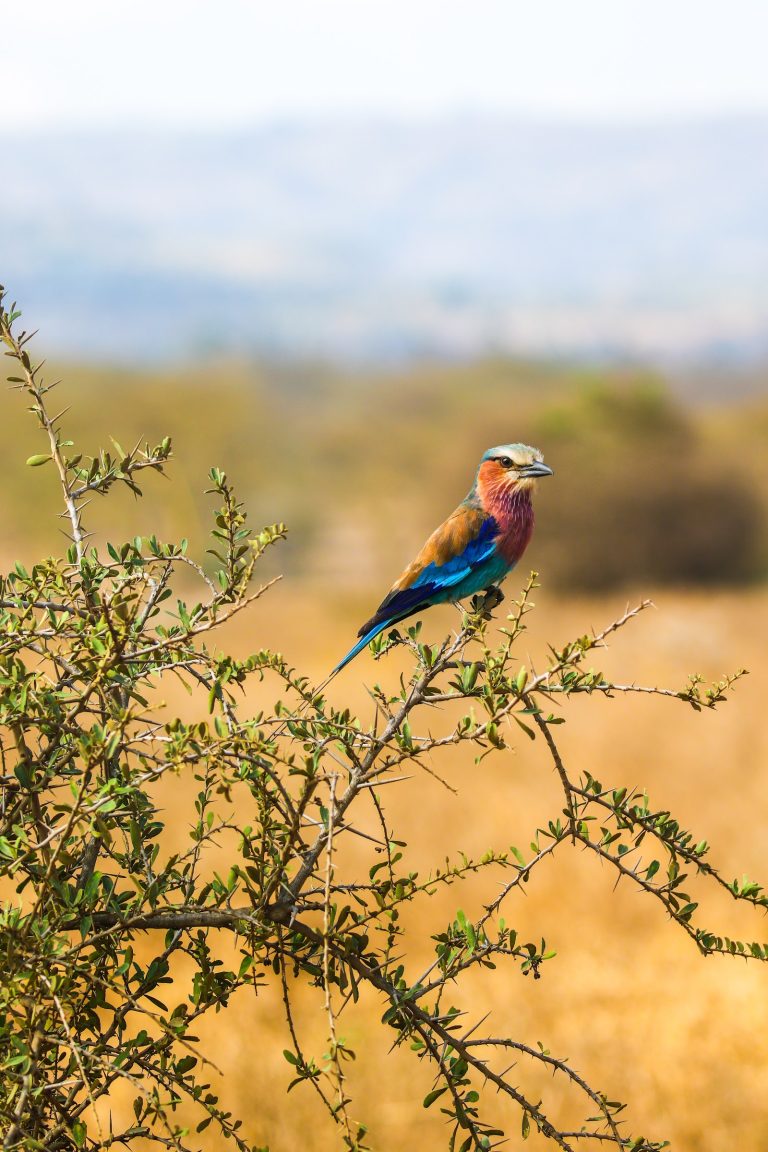
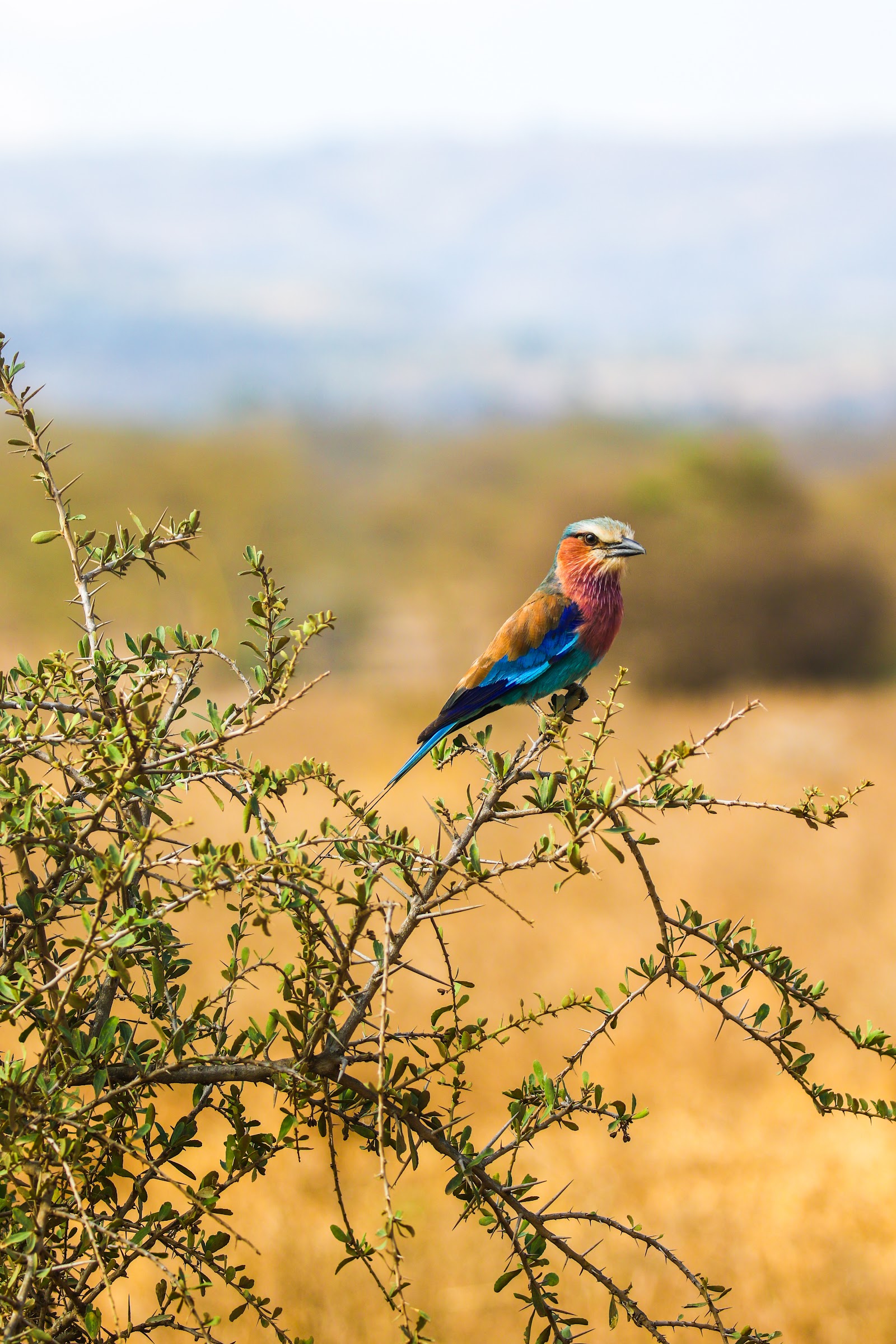
- Star birds: hornbills, lilac-breasted roller, golden-breasted starling, vulturine guineafowl, martial eagle and secretary bird.
- Best time: November to April for European and Asian migrants; residents all year.
- Best spots: Mzima Springs, Lake Jipe, the Galana River, Aruba Dam and the Ngulia Hills.
- From: our 3-day Tsavo East & West Safari starts at USD 600 per person.
Look Up Between the Elephants
Tsavo’s bird list rivals any dedicated birding park in Kenya — ask us to pace your game drives for it.
Why the Birds of Tsavo List Runs So Deep
The combined Tsavo ecosystem stacks an unusual range of habitats within reach of a single itinerary: the Galana River’s doum-palm forest in Tsavo East, Mzima Springs’ oasis and the Ngulia Hills in Tsavo West, and vast stretches of dry acacia-commiphora bush connecting them all.
Each habitat carries its own community. River forest hosts kingfishers, herons and fish eagles; the drier bush favours hornbills, bustards and larks; and the Ngulia Hills sit directly beneath a major migration flyway used by birds travelling between Europe or Asia and southern Africa.
That flyway produces Tsavo’s most extraordinary ornithological event. On some low-cloud, moonless nights from about November to December, thousands of night-migrating birds come down around the lights of Ngulia Safari Lodge in what researchers call a “fallout”. Ringing teams have studied it for decades, putting Tsavo firmly on the map of serious African ornithology.
Away from that event, the scale of the ecosystem means you rarely have to choose between game viewing and birding. Raptors work the thermals above elephant herds, weaver colonies hang from the same acacias that shelter resting lions, and an unhurried game drive can easily produce forty or fifty species.
Guides who know the local territories — a family of ground hornbills on a set stretch of track, a fish eagle pair’s regular perch above Mzima — can turn a strong list into something close to a curated tour, so ask for a birding-minded guide before your first drive.

The 7 Essential Birding Experiences in Tsavo
The Ngulia Migration Fallout — a globally significant phenomenon
On some misty nights from about November to December, low cloud disorients thousands of night-migrating birds crossing the Ngulia Hills, drawing them towards the lights of Ngulia Safari Lodge in extraordinary numbers — a scientifically important event that has supported decades of bird-ringing research and remains one of East Africa’s most remarkable, if weather-dependent, birding spectacles.
Hornbills of the Baobab Country — Tsavo’s most characterful residents
Red-billed, eastern yellow-billed and Von der Decken’s hornbills, plus the impressively large southern ground hornbill, all feature regularly across Tsavo’s drier stretches, their clattering calls and comically oversized bills making them some of the easiest and most entertaining species for beginner birders to learn and enjoy immediately.
Weaver Colonies in Action — engineering you can watch happen
Acacia and riverine trees across Tsavo often host dozens of intricately woven weaver-bird nests dangling from a single tree, males constructing and dismantling structures repeatedly until a female approves — fascinating behaviour to watch unfold over a patient ten-minute stop rather than a passing glance.
Raptors Over the Yatta Plateau — eagles working the thermals
Tsavo East’s long lava-plateau backdrop generates strong thermal updrafts that raptors exploit constantly — bateleurs, tawny eagles, augur buzzards and vultures riding the rising air with barely a wingbeat, visible from many of the park’s open viewpoints and game-drive stretches.
Waterbirds at Mzima and Lake Jipe — the wetland specialists
Tsavo West’s permanent water features draw a completely different bird community from the surrounding dry bush — herons, egrets, African fish eagles and, at Lake Jipe, strong wader and waterfowl numbers along the shallow, papyrus-lined shore, rewarding a dedicated wetland-focused stop.
The Superb Starling and Common Companions — the birds every game drive delivers
Iridescent superb starlings, vividly coloured lilac-breasted rollers and constantly active red-billed oxpeckers riding on buffalo and giraffe are near-certain sightings on almost every Tsavo drive, providing an easy, colourful entry point for visitors not yet confident calling themselves birders.
Dry-Country Specials — the reward for patient looking
Patient observers in Tsavo’s open bush are rewarded with vulturine guineafowl moving in noisy, colourful flocks, bustards striding through open grass and secretive nightjars flushing from the track at dusk. It is a real checklist-building challenge for visitors willing to slow a game drive for birds, and local guides relish sharing it with anyone who shows curiosity.
Pace a Drive for the Birds Too
A slower, birding-aware game drive still delivers the big game — just with a fuller checklist. Ask your guide for one.

Birds of Tsavo by Habitat
Knowing the habitat is the quickest way to know which birds of Tsavo to expect. Your guide will move between these zones on a normal day of game drives.
Dry bush and open plains
Most of Tsavo is dry acacia-commiphora bush. Here you will find hornbills, golden-breasted and superb starlings, white-headed buffalo weavers, d’Arnaud’s barbets, vulturine and helmeted guineafowl, kori and buff-crested bustards and secretary birds striding through the grass. Somali ostriches, with their blue-grey legs, live in Tsavo East.
Rivers and riverine forest
The Galana, Tsavo and Athi rivers are lined with doum palms and tall trees. Look for African fish eagles, Goliath herons, giant and pied kingfishers, palm-nut vultures and noisy flocks of white-bellied go-away-birds. Lugard Falls and the Galana are good stops in Tsavo East.
Springs, dams and lakes
Mzima Springs, Lake Jipe and Aruba Dam hold water all year. Expect African jacanas, egrets, spoonbills, storks, ducks and, in the migrant months, sandpipers and other waders from Europe and Asia. Lake Jipe is the best wetland in the park for serious birders.
Hills and rocky outcrops
The Ngulia Hills and the rocky kopjes of Tsavo West attract raptors such as Verreaux’s eagles, as well as rock-loving birds like the rock martin and mocking cliff chat.
10 Birds of Tsavo to Look For
| Bird | Where to look | How easy? |
|---|---|---|
| Lilac-breasted roller | Open bush, on bare branches | Very easy |
| Superb starling | Lodges and plains | Very easy |
| Golden-breasted starling | Dry bush | Fairly easy |
| Red-billed hornbill | Bush and lodge gardens | Easy |
| Southern ground hornbill | Grassland, walking in groups | Lucky |
| Vulturine guineafowl | Dry bush, mainly Tsavo East | Fairly easy |
| Secretary bird | Open plains | Moderate |
| Martial eagle | Tall trees, soaring | Moderate |
| African fish eagle | Rivers, Mzima, Lake Jipe | Easy near water |
| Somali ostrich | Tsavo East plains | Moderate |
Best Time to See the Birds of Tsavo
You can enjoy the birds of Tsavo in any month, but the seasons change the mix.
- November to April: migrants from Europe and Asia arrive, from bee-eaters and rollers to raptors and waders, and many residents breed after the rains. This is the richest period for a big list.
- November and December: the main window for the Ngulia fallout, which depends on misty, moonless nights and is never guaranteed.
- June to October: the dry season, when birds gather near water and the thinner bush makes them easier to see, though there are fewer migrants.
For more on the weather month by month, see our guide to the best time to visit Tsavo.
A Birding Day Among the Birds of Tsavo
A good birding day in Tsavo follows the same rhythm as a game drive, just with more stops. This is how our guides usually plan it.
- Dawn: leave camp at first light, when the bush is loud with francolins, barbets and starlings. Scan dead trees for rollers, shrikes and raptors warming up in the sun.
- Mid-morning: head for water, such as Mzima Springs, Aruba Dam or the Galana River, as birds come to drink and bathe. This is the best time for kingfishers, herons and waders.
- Midday: rest at the lodge. Lodge gardens and waterholes are often excellent, with sunbirds, weavers and hornbills coming close to the terrace.
- Late afternoon: drive the open plains for bustards, secretary birds and ground hornbills, and watch the sky for eagles and vultures riding the last thermals.
- Dusk: look for nightjars on the track and listen for owls as you return to camp.
On a day like this, keen birders often see seventy species or more, while still enjoying elephants, giraffes and the chance of lions.
Responsible birding in Tsavo
Watch nesting birds from a distance and never ask your guide to drive off the track for a better view. Do not play bird calls loudly to attract birds, as it can disturb them during breeding. If you see a dead vulture or another sign of poisoning, tell your guide so it can be reported to the rangers. Choosing a responsible operator and paying park fees helps protect the habitats that make the birds of Tsavo so rich.
Birding Tips and What to Pack
- Bring binoculars (8×42 or 10×42 are ideal) and a field guide or app for East African birds.
- Start early: birds are most active in the first two hours after sunrise.
- Ask your guide to stop at water, fruiting trees and weaver colonies.
- Use a 300–600 mm lens for bird photography, and a beanbag to steady it on the vehicle.
- Keep a simple list each day; it is fun to see your total grow.
Birding information and checklists for Kenya are available from Nature Kenya, the country’s leading bird conservation society, and park details from the Kenya Wildlife Service.
Birds of Tsavo Safari Costs and Packages
You do not need a specialist tour to enjoy the birds of Tsavo; any private safari can be paced for birding. Prices on our site include:
- Tsavo East & West Safari (3 Days) — from USD 600 per person.
- 2-Day Tsavo & Taita Hills Safari from Mombasa — from USD 420 per person.
- Kenya Birding Tour – Rift Valley Lakes, Kakamega & Masai Mara (8 Days) — from USD 2,050 per person, for a dedicated birding trip elsewhere in Kenya.
Ask for a private Kenya safari if you want a vehicle to yourself and the freedom to stop for every bird.
Tsavo Birding Facts
- The list: over 500 bird species recorded across the combined Tsavo East and West ecosystem.
- Habitat range: riverine forest, dry acacia-commiphora bush, hills and permanent wetland all sit within one itinerary.
- Ngulia fallout: a scientifically significant mass migrant “fallout” occurs on some low-cloud nights in November and December near Ngulia Safari Lodge.
- Hornbill diversity: at least six hornbill species occur across Tsavo, from the common red-billed to the large southern ground hornbill.
- Raptor country: the Yatta Plateau and open plains generate strong thermals favoured by eagles, buzzards and vultures.
- Wetland specialists: Mzima Springs and Lake Jipe support a distinct waterbird community absent from the surrounding dry bush.
- Best approach: a slower-paced, guide-led drive framed around birding adds many species without sacrificing big-game sightings.
Building Birding Into a Tsavo Safari
Birding pairs naturally with the wider wildlife focus of our 3-day Tsavo East & West safari, and complements our Tsavo West attractions guide for the Mzima Springs and Lake Jipe wetland stops. Compare with the birding depth of our Masai Mara birding guide and Amboseli birds guide if planning a wider Kenya birding circuit.
500 Species Across Kenya’s Biggest Wilderness
Bring binoculars alongside your camera. Message us to pace a Tsavo drive properly for birds.
Frequently Asked Questions
How many bird species live in Tsavo National Park?
More than 500 bird species have been recorded across Tsavo East and Tsavo West, spanning riverine forest, dry acacia bush, wetlands and hills over 22,000 square kilometres. That makes the birds of Tsavo one of the richest lists of any protected area in Kenya, with residents and seasonal migrants.
What is the Ngulia bird migration fallout?
The Ngulia fallout happens when low cloud on misty, moonless nights, mainly in November and December, disorients thousands of night-migrating birds crossing the Ngulia Hills in Tsavo West. They come down around the lodge lights, and ringing teams have studied the event there for decades. It is weather-dependent and never guaranteed.
What are the best birds to see in Tsavo?
Highlights include hornbills (among them the large southern ground hornbill), lilac-breasted rollers, golden-breasted and superb starlings, vulturine guineafowl, secretary birds and martial eagles. African fish eagles are easy to find at Mzima Springs and Lake Jipe, and raptors soar over the Yatta Plateau.
When is the best time for birdwatching in Tsavo?
November to April is best, when migrants from Europe and Asia join the resident species and many birds breed. November and December also bring the chance of the Ngulia fallout. In the dry season, June to October, birds gather near water and are easier to see in the thinner bush.
Can you combine birdwatching with a normal Tsavo game drive?
Yes. A slightly slower, guide-led drive adds many species without sacrificing elephants or lions, because bird-rich stops such as Mzima Springs, river edges and waterholes are on the main wildlife circuits. A private vehicle gives you the most freedom to stop whenever you spot something interesting.
Do I need special equipment for birdwatching in Tsavo?
A good pair of binoculars and an East African bird field guide or app cover most needs, as many species are visible from the safari vehicle at close range. Keen photographers will want a 300 to 600 mm lens, but casual birders can enjoy Tsavo’s list with very little extra kit.